Checked on 2026-11-19: if you are heading to a Singapore hawker centre for the first time, the simplest rule is to choose the table situation first, then order. Most stalls still work best with cash, but payment methods vary by stall. The one rule you should not treat as optional is tray return: Singapore’s current enforcement framework expects diners to clear used trays, crockery and litter. Below is the practical sequence, plus the etiquette that keeps a meal smooth instead of awkward.
The short answer: what to do first
If you want the fastest, least confusing approach, use this sequence:
| Step | What to do | Why it matters |
|---|---|---|
| 1 | Find a seat or choose a table first | Many hawker centres expect you to note the table number before ordering |
| 2 | Check whether the stall takes cash, card or QR payment | Payment is stall-specific, so do not assume one standard method |
| 3 | Queue at the stall and place your order | That is the normal service flow in most hawker centres |
| 4 | Collect food or wait for delivery if the stall offers it | Some stalls hand over food at the counter; others bring it to your table |
| 5 | When you finish, return trays and crockery and clear litter | This is the part with the clearest current rule and enforcement |
That sequence is based on official Singapore guidance and current enforcement information, checked on 2026-11-19. It is the right default for visitors, but individual stalls may still operate a little differently.
Official sources: Visit Singapore hawker-centre guidance; NEA hawker management overview.
How ordering usually works in practice
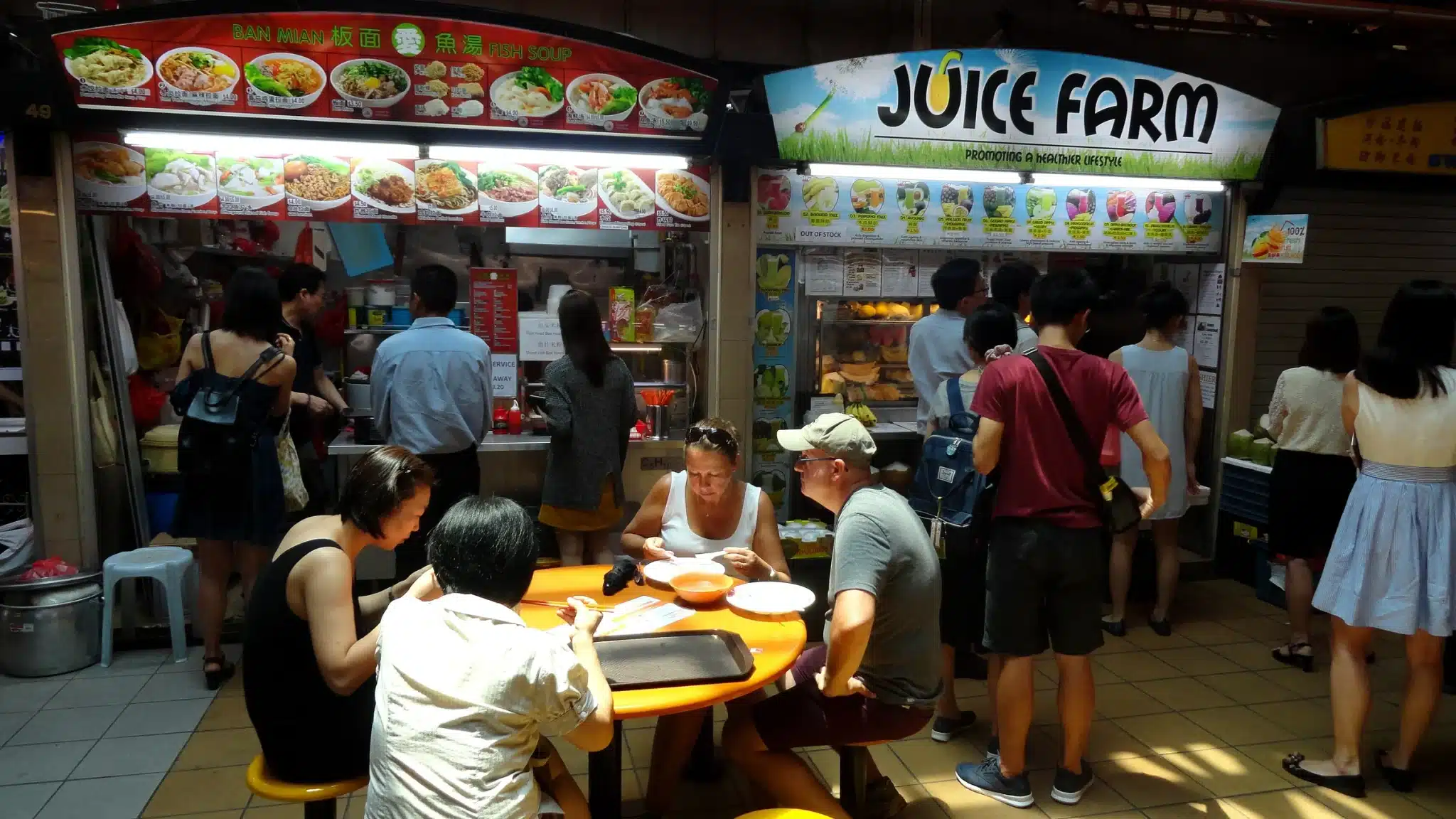
Visit Singapore’s guidance describes the common visitor workflow: look for a table first, note the table number, then go to the stalls to order. Table sharing is normal, and a seat may be “choped” with a personal item such as a packet of tissues. That is etiquette, not a law, but it helps you avoid standing around while your food gets cold in your head before you have even ordered.
There are two common stall patterns. Some stalls are fully self-service: you order, pay, and wait for collection. Others ask for your table number and bring the food to you. The practical clue is simple: if a stall worker asks for a table number, give it clearly; if not, assume collection is from the counter unless the stall tells you otherwise.
One helpful habit is to decide whether you want to eat at all before you join a long queue. Hawker centres can be busy at lunch and dinner, so it is sensible to have a backup stall in mind if your first choice has a line.
Source: Visit Singapore official hawker-centre guidance.
Payment: cash is still the safest default
The current official tourism advice is still to keep cash ready, because cards are not widely accepted at hawker centres. That does not mean cards never work; it means acceptance is inconsistent enough that a visitor should not rely on a card-only setup. Some stalls may accept QR or contactless payment, but that is stall-specific and can change.
So the practical answer is: bring Singapore dollars in small denominations, then treat card or QR as a convenience if the stall visibly supports it. If a stall displays accepted payment methods, trust the sign. If it does not, cash is the least risky assumption.
One more nuance: some stalls take payment when the food is delivered rather than when you order. That is normal. The key is to watch the stall’s process rather than forcing a single rule onto every counter.
Official source: Visit Singapore travel guidance on hawker payments.
Tray return, litter and what the rules actually require
This is the part visitors should take most seriously. NEA says diners must return used trays and crockery, and they should not leave litter such as tissues, wet wipes, shells or bones on the table. Since 1 June 2023, enforcement officers can ask for diners’ particulars if trays and crockery are not returned, and NEA says first-time offenders get a written warning while repeat offenders can be fined or charged in court.
NEA also notes that cleaners may still help with table clearing and tray areas during peak periods. That does not remove the diner’s responsibility; it just reflects how busy hawker centres are managed in real life. A practical reading is: clear your own table as much as you reasonably can, then use the tray-return point when you leave.
If tray-return racks are full, official guidance says diners are not expected to be penalized for leaving trays and crockery near the return station. That is a useful exception, but it is not a reason to leave everything anywhere else.
Official sources: NEA stepped-up enforcement notice; SFA tray-return facilities guidance; Visit Singapore essential travel information.
What to remember so you do not look lost
If you only remember four things, make them these: find the table first, check the stall’s payment method, queue with patience, and return your tray when you finish. Hawker-centre etiquette is not complicated, but it does depend on reading the room and following the stall’s flow rather than assuming restaurant-style service.
Also, do not overthink table sharing. In a busy hawker centre, it is normal to sit where there is space and to share a communal table with strangers. A brief nod is usually enough. The aim is not perfect formality; it is keeping the shared system moving.
Future applicability note: the ordering etiquette described here is stable common practice, but payment acceptance and stall workflows can change over time. The tray-return rule set is current as of 2026-11-19, but always check for any later NEA update before you travel.
Featured image: Photo: Fabio Achilli from Milano, Italy / Wikimedia Commons, CC BY 2.0. Resized and converted to WebP; the image adaptation retains its source license.