For most adults visiting London, an accepted contactless bank card or mobile wallet is the simplest starting point. Oyster becomes more interesting when you need a visitor child discount, an eligible concession, or a separate prepaid travel balance. The useful question is which option suits your group—not which card has the most convincing tourist branding.
Fares and payment rules checked on 7 November 2026. Prices below are in pounds sterling and describe the published 2026 rules; recheck TfL before a later trip.
Contactless or Oyster? Choose for your actual trip
- Adult with an accepted card and reasonable overseas fees: start with contactless. No separate travel balance to manage.
- Visitor aged 11–15: investigate Oyster with the Young Visitor discount before paying adult fares.
- Traveler with an eligible Railcard or other concession: check the exact discount rules. Contactless does not currently apply Railcard or child discounts.
- Adult who wants prepaid spending or whose bank card will not work: consider Oyster.
These are decision rules, not a promise that one product is cheapest for everyone. National Rail’s comparison explains the differences between contactless, Oyster and Travelcards. Start with the passengers and journeys you actually have, then compare the relevant costs.
The Oyster card fee belongs in your budget
TfL currently lists £10.50 to buy a standard Oyster card. For cards obtained on or after 4 September 2022, the card fee is non-refundable. That purchase cost is separate from the credit you add for journeys. Standard cards are sold at all Tube stations, most London Overground and Elizabeth line stations, and other listed outlets. See TfL’s purchase and refund rules.
Already own a usable Oyster? Your calculation is different from someone buying one for a two-day visit. Do not add a new-card cost to an existing card, or confuse refundable unused credit with a refundable purchase fee.
A Visitor Oyster is another product, sold before arrival. Compare its current price, delivery arrangements and conditions rather than assuming it is the same purchase as a standard Oyster bought in London. TfL’s visitor payment guide describes the options.
Daily caps help—but they are not unlimited London passes
A cap limits qualifying pay-as-you-go charges. You pay for the journeys you make until the applicable limit is reached; you are not buying that whole amount at the beginning of the day.
| Travel zones | Daily cap | Mon–Sun cap |
|---|---|---|
| Zones 1–2 | £8.90 | £44.70 |
| Zones 1–3 | £10.50 | £52.50 |
| Zones 1–6 | £16.30 | £81.60 |
Keep three boundaries in mind: your zones, your payment method and the travel week. TfL’s daily period runs from 04:30 to 04:29 the following morning. The weekly cap uses Monday through Sunday, not any seven consecutive days after you arrive. A Thursday-to-Wednesday trip crosses two weekly periods.
For a full week of heavy travel spanning that boundary, compare a seven-day Travelcard rather than assuming the automatic cap will produce the same result. See TfL’s capping explanation. If you barely use transport on some days, a pass may be unnecessary.
Use the same card or device, not just the same bank account
Your physical bank card, phone and watch are not interchangeable taps. Pick one and keep using it. Touching in with a phone and out with its associated physical card can produce an incomplete journey instead of the fare you expected.
Each paying traveler needs their own card or device for their journeys. A shared bank account does not make one physical card a group ticket. Keep enough battery for a phone or watch to remain usable, and keep other contactless cards away from the reader. TfL’s pay-as-you-go instructions cover devices, overseas cards and card clash.
A backup card is sensible; changing to it halfway through a journey is not the fix for a failing first tap. If something goes wrong, stop and ask staff before improvising at another gate.
Touch in and out correctly—even when a gate is open
On the Tube and rail services, touch in at the start and out at the end. Open gates do not remove that requirement. Some stations use standalone readers rather than barriers.
On London buses, touch in only. For trams, the usual rule is also touch-in only, but Wimbledon has specific interchange instructions: follow TfL’s touching-in-and-out guide if your route involves it.
A missing tap can mean a maximum fare, and maximum fares do not count toward capping. If a charge looks wrong, use your journey history to investigate the actual journey before deciding that Oyster or contactless is inherently more expensive.
Families should check the child discount first
For visitors aged 11–15, staff can add a Young Visitor discount to an Oyster or Visitor Oyster card. It provides 50% off adult pay-as-you-go fares for up to 14 days. Ask for the discount before starting the journeys you want discounted.
Children under 11 can travel free on the Tube, DLR, London Overground and Elizabeth line with an eligible accompanying adult, up to four children per adult; some National Rail services are included. Do not extend that statement to every airport train. Check the official visitor rules for your group.
Check airports and journeys beyond London separately
“It accepts my card” and “it is included in my central London cap” are different claims. Heathrow Express is specifically excluded from the caps in TfL’s adult fares table. Compare the train you intend to board, not just the airport name.
Oyster and contactless also have different geographic reach. Oyster is not accepted at Elizabeth line stations between Reading and Iver. Contactless extends to additional stations across the South East, but that does not make it a nationwide rail ticket. Check the current contactless coverage map and station list before an out-of-town trip.
The River Bus is a useful example of the cap trap
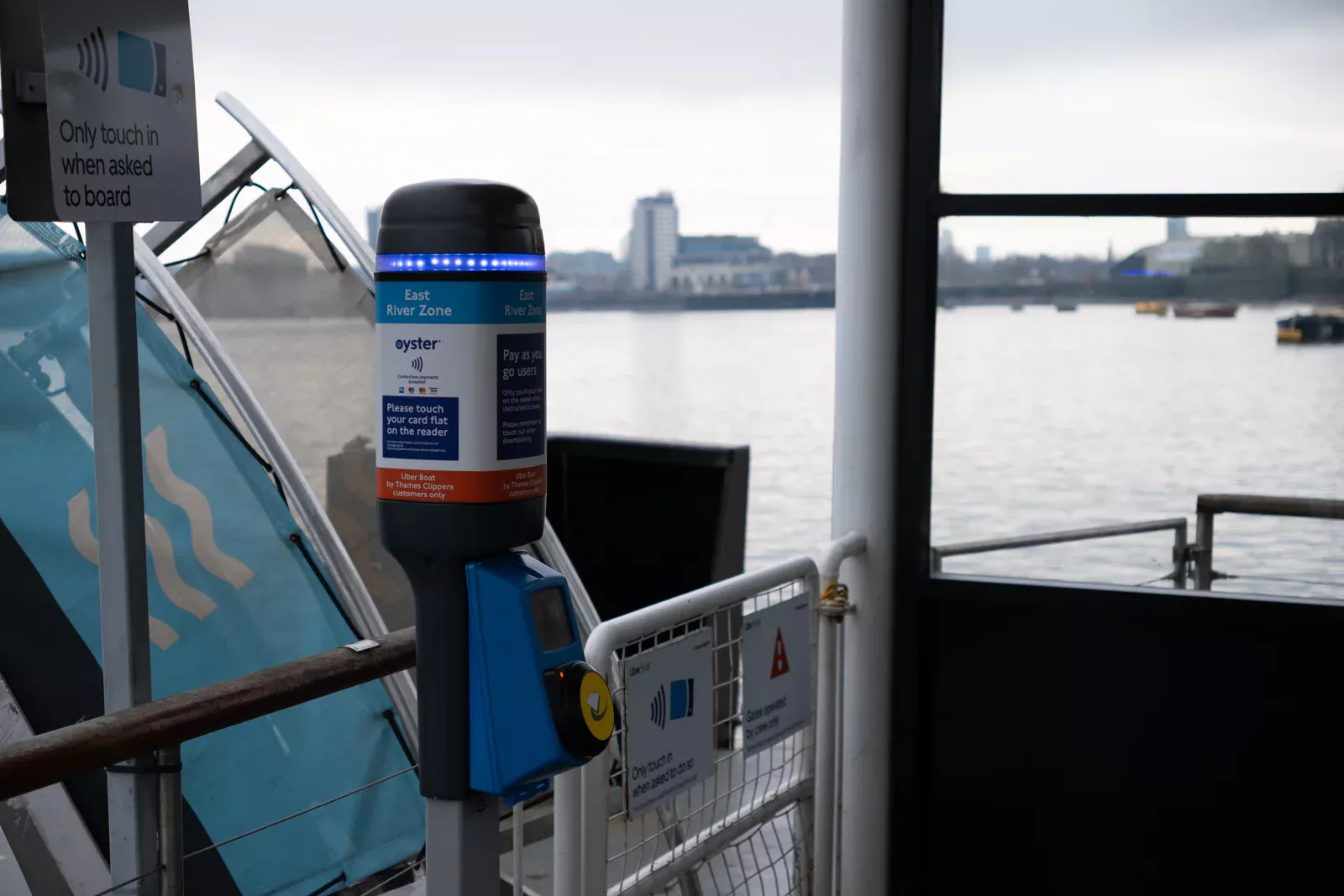
You can pay with Oyster or contactless on Uber Boat by Thames Clippers, but those River Bus journeys do not count toward capping. Its river zones are a separate fare system. Treat a boat ride as an additional transport decision, not a free extra after a busy Tube day. TfL explains the River Bus rules.
Before your first tap: a five-minute setup
- List the paying travelers. Separate adults, children and anyone eligible for a concession.
- Check your bank’s actual overseas terms. Include any fixed charges as well as percentages; do not assume all foreign cards cost the same.
- Choose one payment method per person. Decide before the station entrance, when there is no queue behind you.
- Check your airport transfer and hotel zone. Those can matter more than an extra central London Tube ride.
- Keep route planning separate from payment. An app can help you navigate without being a ticket you must buy.
Our UK transport apps guide covers the planning side. Once that is sorted, build the days around neighborhoods rather than repeated cross-city journeys: the five-day London itinerary is a useful starting point.
Quick answers
Is Oyster automatically cheaper than contactless?
No. Look at the adult fares and caps, card purchase cost, bank fees and any eligible discounts together. Buying an extra card has to solve a real problem to be worthwhile.
Can two adults use one Oyster card for the same journey?
No. Each needs their own valid payment method. The same principle applies when using contactless: do not try to tap one physical card through for both travelers.
Should I buy a Visitor Oyster just because it says “Visitor”?
No. Compare it with a standard Oyster and an accepted contactless card against your actual itinerary. A product name is not a savings calculation.
Featured photograph: Whitechapel station ticket hall, August 2021, by TheFrog001, via Wikimedia Commons, CC0 1.0. Resized and converted to WebP.