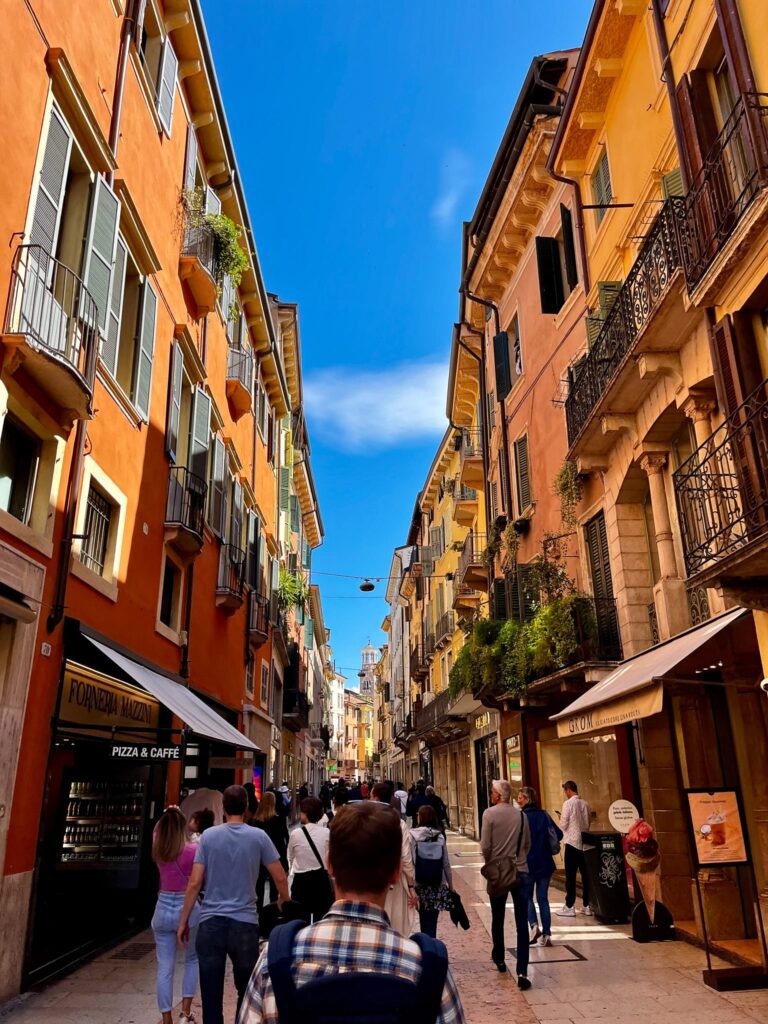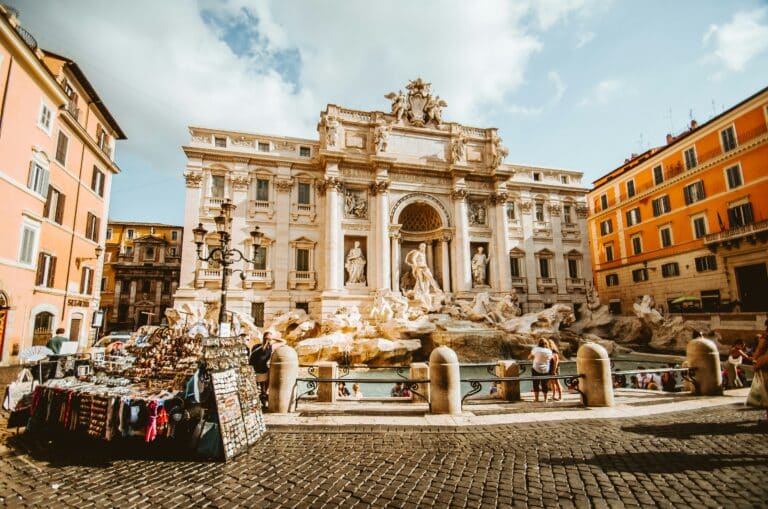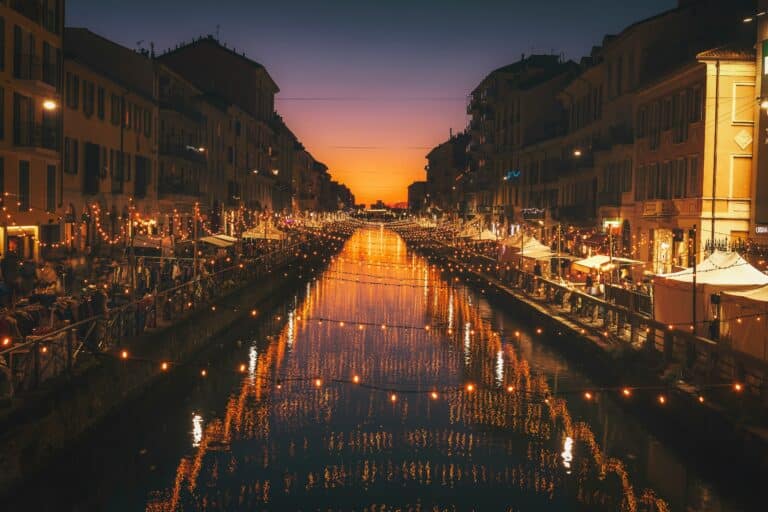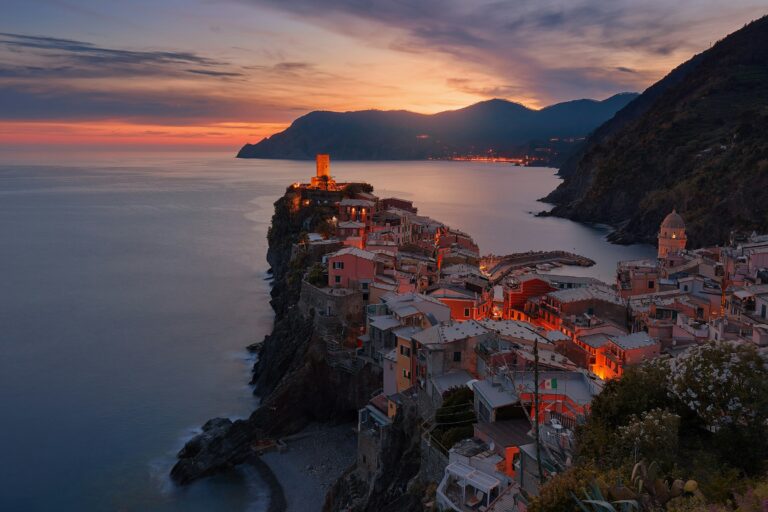
Verona is easy to flatten into shorthand: Roman stones, medieval towers, Shakespeare residue, a nice river bend. The more interesting version is the one that still behaves like a city. In this set of black-and-white photographs made in May 2023, the old center is not framed as a museum without friction. It is full of movement, management, commerce and routine.
That matters because Verona’s historic core is not just historically important; it is structurally central to the present city. UNESCO describes the World Heritage site as a Roman town inside the loop of the Adige, with major remains including the Arena, gates, bridges and theatre still embedded in the urban fabric. The photographs keep returning to that embedded quality. Ancient masonry, arcades, squares and fortified edges are shown less as isolated attractions than as working settings for walking, buying, policing, waiting, cycling and finding your way.

The black-and-white film stock helps compress centuries into one tonal range, but the contemporary city keeps pushing through: a pharmacy cross in a narrow lane, fashion branding at street level, police in a piazza, a coach by the walls, signage around a Roman structure. Those details are not interruptions. They are the point. Verona’s center survives because it is used, regulated and continuously adapted, not because it has been sealed off from ordinary life.
The piazza still does civic work
Some of the strongest images in the set are not landmark pictures so much as systems pictures. In the squares associated most plausibly with Piazza delle Erbe and Piazza Bra, the frame fills with umbrellas, benches, bicycles, scattered pedestrians, a van, officers in uniform and the steady churn of people crossing open stone ground. That mix is more revealing than a cleaner architectural study would be.


Official descriptions of Verona back that up. UNESCO calls Piazza delle Erbe and Piazza dei Signori the heart of the city, and the municipality identifies Piazza delle Erbe as the oldest square in Verona, on the site of the former Roman forum. It still hosts a daily market from Monday to Saturday, with produce, flowers, plants, souvenirs and gift items all part of the same commercial ecology. In other words, this is not heritage as backdrop alone. It is heritage as operating floor.
Piazza Bra works similarly, though at a different scale. Municipal tourism information presents it as Verona’s principal square, anchored by the Arena and connected to the Liston promenade and Via Mazzini. It is also a managed event space with permits, temporary traffic rules and public administration layered into its monumental setting. That’s a useful correction to the usual fantasy of the Italian piazza as a naturally occurring scene of café leisure. Leisure is there, obviously, but so are rules, deliveries, public order and event logistics. The old square remains central because it still carries modern civic load.
The Arena is not an isolated ruin
One photograph places a massive Roman stone structure directly into the street scene, with access signage and venue language visible against the masonry. That is a better way to understand Verona than the standard monument shot. The Arena is not sitting outside the life of the city. It is inside it, administered, signed, entered, maintained and folded into the daily legibility of the center.

UNESCO identifies the amphitheatre as one of Verona’s key Roman survivals, but municipal structures matter here too. The city’s Museums Directorate includes the Arena within an active civic cultural network, which means the building is not just protected as a relic; it is managed as part of a living public system. The signage visible in the photographs reinforces that practical status. Access points, gradinata references and event-oriented infrastructure all suggest operation rather than abstraction.
There is something very contemporary in that coexistence. The Roman shell carries enormous historical weight, but at ground level it still has to function like urban equipment. People need to orient themselves. Entrances need to be controlled. The perimeter has to negotiate adjacent buildings, shopfronts and pedestrian movement. The result is less romantic than many travel narratives want, and more convincing. Verona’s Roman past has not been placed behind glass. It has been wired into the routines of a busy city center.


Selective access shapes how the old center moves
The photographs repeatedly show motion without suggesting a fully pedestrian city. Cyclists cut across cobbles. A bus appears near the fortified edge. A car enters one commercial scene. Police stand in an open square that also functions as a circulation space. This feels accurate to how many Italian historic cores actually work: not car-free in a utopian sense, but carefully filtered.
Verona’s municipal mobility documents make that visible structure legible. The city established a Zona a Traffico Limitato in the Città Antica in 2005 to control unauthorized vehicle access within the historic center. The zone is monitored by electronic gates at multiple entry points, and bicycles, mopeds and motorcycles are generally allowed while other vehicle access is restricted by permits or time windows. That explains why the visual rhythm of the set feels so specific. The streets are not empty of transport; they are selectively permeable.
For a traveler, that distinction can seem nerdy until you notice what it does to public space. It changes the kind of noise a square absorbs. It changes who gets to pass through quickly and who must slow down. It allows heritage streets to remain active without surrendering entirely to private car logic. In the photographs, bikes and walking bodies dominate because the rules favor them, not because the center has somehow escaped modern mobility. Verona’s old core is managed, and that management is part of its atmosphere.
Retail signage punctures the fantasy of timelessness
One of the set’s most telling motifs is contemporary text embedded in old walls. A Lloyds pharmacy cross glows above a narrow lane. Fashion branding appears beneath shuttered windows and worn plaster. Tourism-related lettering turns up in a square. Even when the film aesthetic softens the era, the typography gives the game away: this is a commercial city center doing business now.
That friction is exactly what keeps the images from slipping into heritage cosplay. Too much writing about Verona leans on continuity until the city starts sounding embalmed. But old centers survive through tenancy, adaptation and ground-floor turnover. The presence of chain retail or pharmacy branding may offend anyone chasing a purer visual field, yet it also signals that the center remains useful for everyday needs as well as visitor consumption.
The more interesting design question is not whether modern signage belongs in a historic center. It already does. The question is how aggressively it asserts itself against masonry, arcades and narrow street profiles shaped long before illuminated crosses or global logos existed. In these photographs, that tension is visible but not catastrophic. Verona does not appear overwhelmed by branding. Instead, the city reads as layered: Roman and medieval structures above, current commerce at eye level, and pedestrians moving through both time signatures at once.
The river and the walls still organize the city
Several frames pull back to the Adige and to Verona’s fortified edges, which is essential if the old center is going to be understood as more than a collection of pretty facades. UNESCO defines the historic city in relation to the loop of the river, and notes that Verona also retains the character of a fortified town through Roman gates and later defensive works. Those larger physical limits still shape how the place is read and entered.
The river scenes in this set are useful because they do not treat water as pure scenery. The Adige appears with embankments, retaining edges and densely built riverfronts, reminding you that the river is infrastructure as much as image. UNESCO also notes Verona’s long history of flooding and the late-19th-century measures that brought the risk under control. You do not need to identify specific engineering works in the photographs to understand the broader point: the city and river have been in negotiation for centuries, and the current urban form is part of that negotiation.
The same goes for the crenellated wall at the edge of a square. It does more than decorate the background. Municipal tourism material describes Verona’s fortifications as a system of towers, ramparts, embankments and gates that once enclosed the whole center and remain legible today. In the photographs, buses, pedestrians and market tents gather in front of that inherited perimeter. The wall is no longer defensive hardware in its original sense, but it still organizes circulation and perception. That may be the defining quality of Verona in this set: old structures continue to matter because the city keeps finding practical uses for their presence.
Photography by Gil DeSaant. Explore more of his photography at gildesaant.com.