Milan is often reduced to surfaces that photograph well on postcards: the Duomo, the Galleria, a polished idea of fashion, a polished idea of modern Italy. But this set points somewhere more interesting. The city comes into focus through systems of movement—tracks in the street, overhead wires stitched across intersections, canal embankments shaped for pedestrians and commerce, stairwells dropping into the metro, arcades designed less as static spectacle than as conduits.
That matters because Milan’s older infrastructure has not been sealed off as heritage scenery. It is still doing work. The city’s iconic yellow trams remain part of daily circulation, and ATM’s long-lived Series 1500 cars—introduced in 1927 as Milan’s first tramcars with automatic doors—are still central to how the city imagines itself in motion. In one frame, route 10 appears not as a retro prop but as ordinary urban machinery, sharing space with scooters, storefronts, bank ads, and winter-bare trees.
The same logic runs through the rest of the city. Canal edges commonly associated with the Navigli and Darsena read here as mixed-use corridors rather than stage sets. Galleria Vittorio Emanuele II appears as an iron-and-glass passage linking civic nodes. The Duomo shows up with scaffolding in place, which the cathedral’s own custodians describe as part of an ongoing construction site devoted to conservation. In Milan, continuity is not about freezing the city. It is about keeping old frameworks active.
The tram is not a nostalgic extra
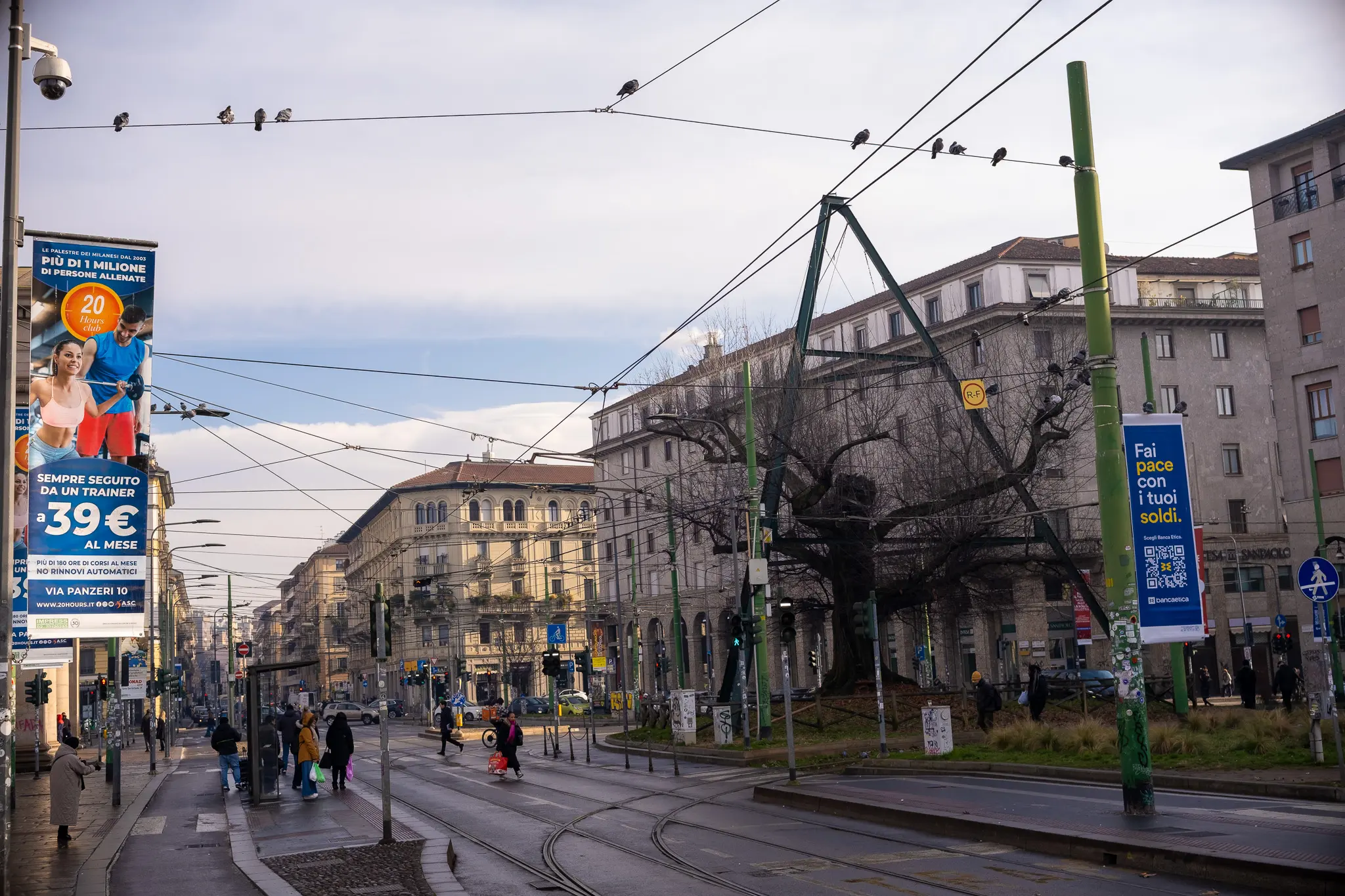
The most telling images in this set are the ones that refuse to isolate Milan’s trams as heritage objects. They are embedded in the normal mess of city life: wet pavement, curbside scooters, restaurant signage, apartment blocks, pedestrians waiting at crossings, and a web of catenary lines overhead. That is exactly the point. Milan’s tram network does not survive as a decorative afterimage of an earlier city. It remains legible as infrastructure.
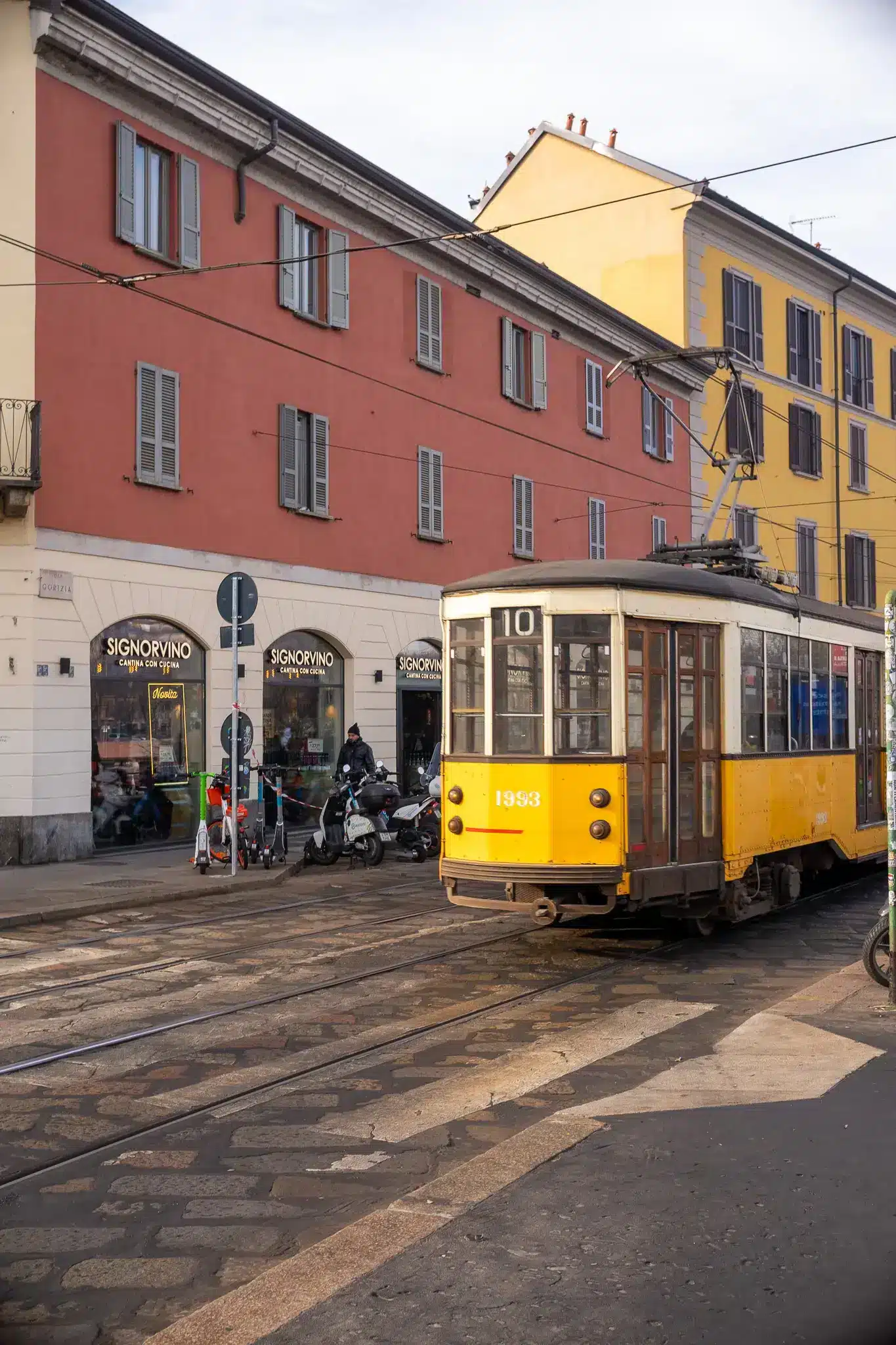
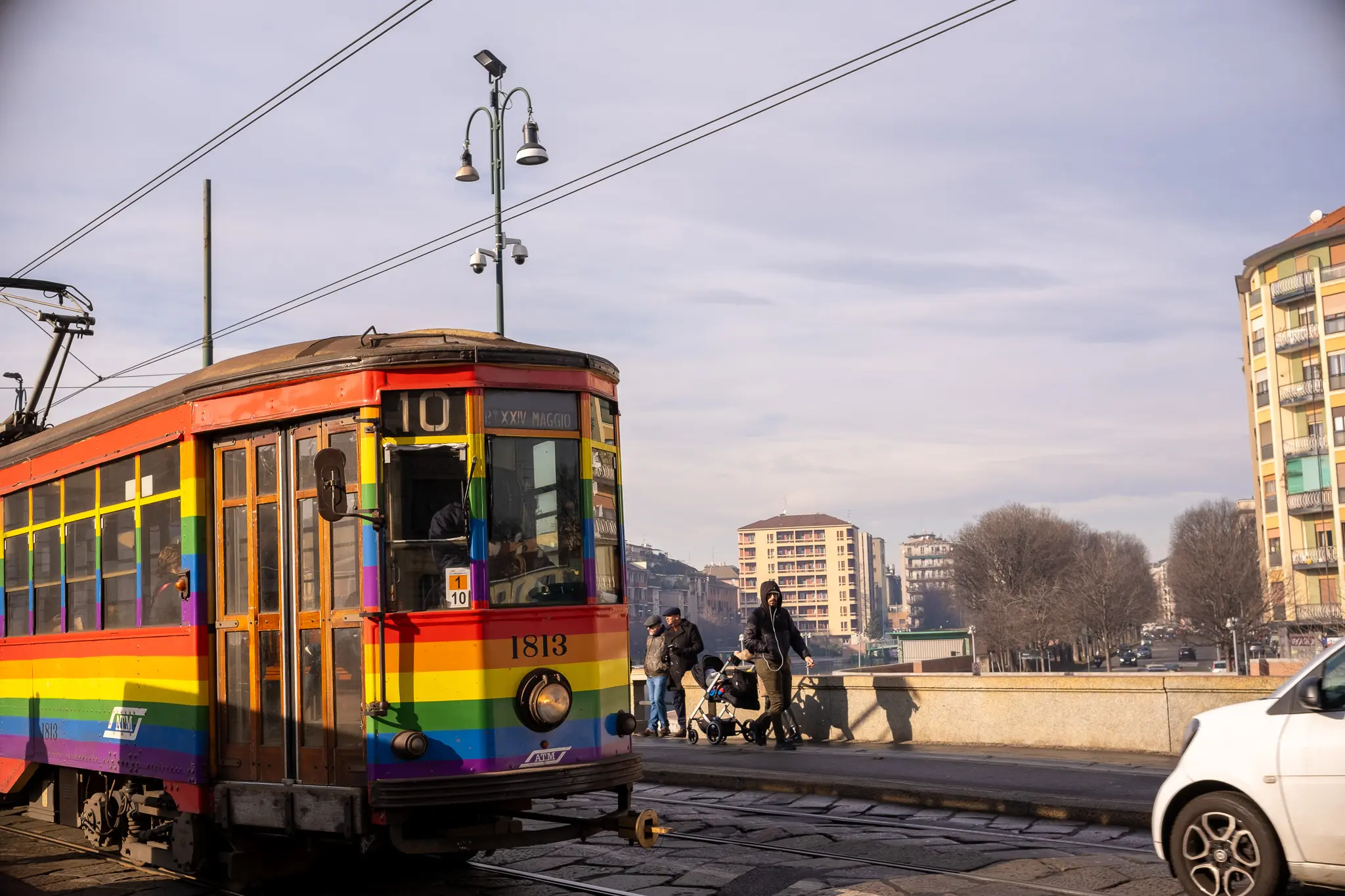
ATM’s Series 1500 cars, known locally as the Carrelli, entered service in 1927. Nearly a century later, they still anchor the visual identity of Milan far more convincingly than any branding campaign could. One photographed tram carries route 10, a line ATM maps between Viale Lunigiana and Piazza 24 Maggio. That route matters editorially because it ties the historic vehicle to everyday urban geography rather than a museum circuit. The tram is not performing old Milan for visitors; it is still threading through actual neighborhoods.
Even the rainbow-painted Carrelli fits this story of active reuse. ATM confirms that a rainbow-liveried tram entered service on line 10 in 2022 as part of a public inclusion campaign. Whatever day the photograph was taken, the larger point is clear enough: Milan adapts inherited hardware to present civic language. The car body, the wooden window frames, the rounded front, the route board—all of it belongs to a living transit system, not a sealed historical vignette.
That distinction gives Milan a particular kind of urban texture. Heritage here is not simply what you look at. It is what arrives, brakes, turns the corner, and carries people onward.
Along the canal, old infrastructure still organizes daily life
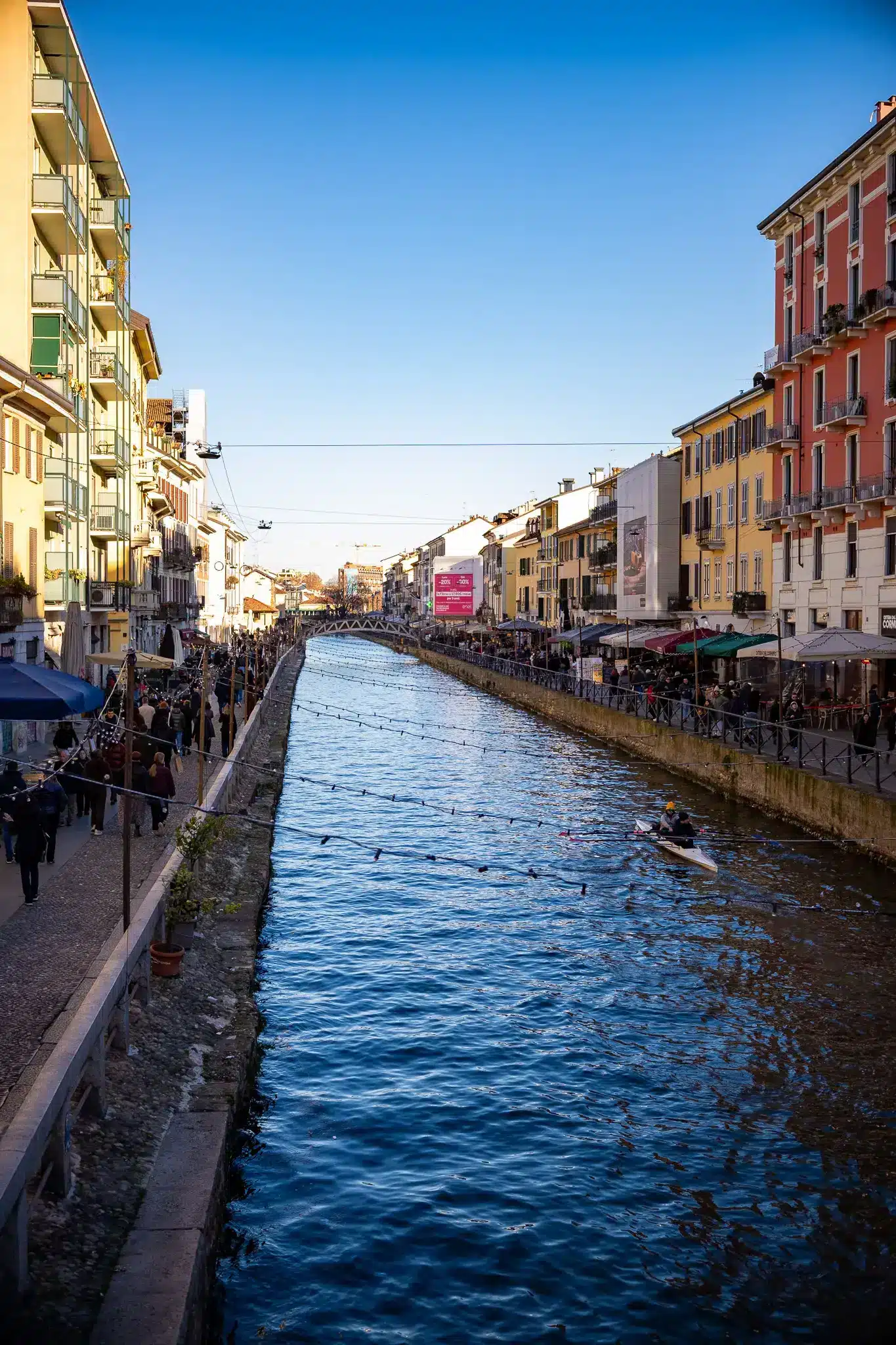
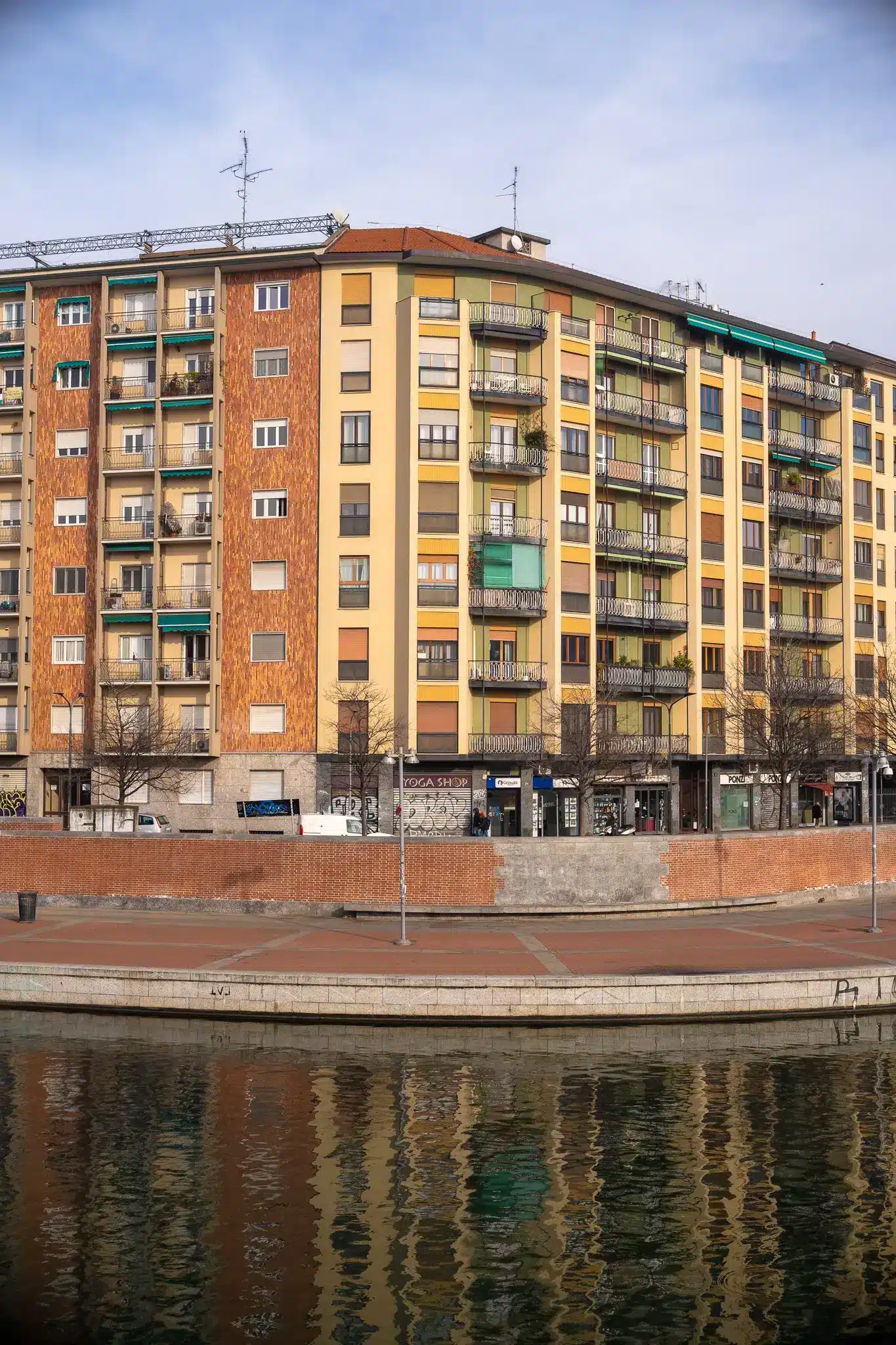
The canal photographs shift the same idea from rail to water. These edges likely belong to the broader Navigli-Darsena area, but what stands out is less the exact stretch than the pattern of use. Embankments, railings, mooring points, bridges, awnings, apartment facades, and promenade space all suggest a corridor still structuring daily movement and commerce.
Municipal material describes the Navigli district as extending along the Naviglio Grande and Naviglio Pavese, both ending in the Darsena, and today the area is regulated as an active neighborhood rather than a preserved relic. That framing matches the images. The water is not treated as scenic filler behind café tables. It remains the central line around which buildings face outward, pedestrians circulate, and small businesses position themselves. Even when boats appear, they read as part of a practical urban edge rather than a theatrical backdrop.
There is also a useful seasonal correction in these pictures. Leafless trees, cold light, and occasional wet stone pull Milan away from the sun-drenched Italian stereotype. The canal district looks inhabited, not idealized. Graffiti on shutters, mixed-use apartment blocks, discount signage, and lightly worn masonry all reinforce the sense that this waterfront belongs to ordinary city time.
That may be the most persuasive argument for calling this moving heritage. The old infrastructural line still dictates how space is used, but it has accepted later layers without losing its role. Milan keeps building on top of its routes instead of replacing them with cleaner fictions.
The Galleria works because it is a passage first
Few places in Milan are more overburdened by reputation than Galleria Vittorio Emanuele II. It is too often framed as a luxury container, all polished brands and historic grandeur. The stronger reading—and the one supported by these images—is more architectural than commercial. The Galleria is a machine for circulation.
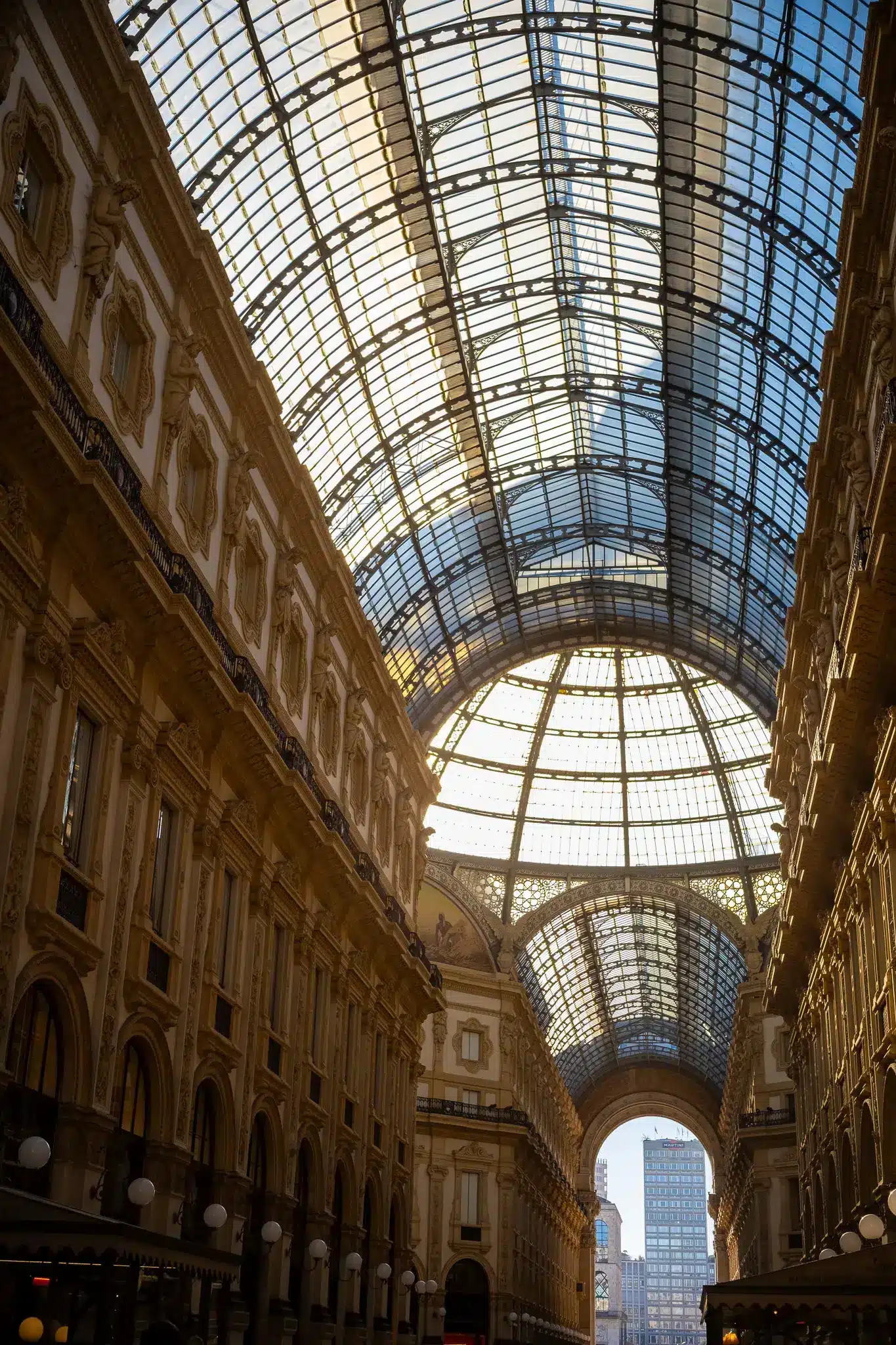
Official city material describes it not only as a destination but as a passage linking Piazza del Duomo toward La Scala, with direct access from the Duomo transit stop. That practical function helps explain why the structure still feels current. Its iron-and-glass canopy, domed octagon, mosaic floors, and disciplined black-and-gold signage do not just create spectacle; they organize flow. People move through it the way water moves through a channel, guided by light, symmetry, and the logic of connection.
The photographs lean into that engineering intelligence. The eye is drawn upward to the roof framework, to the eagle motifs, to the way ornament and structure cooperate rather than compete. This is 19th-century urban design with a very modern understanding of throughput: weather-protected pedestrian circulation wrapped in elaborate civic skin.
Seen in the context of the trams and canals, the Galleria stops being an exception and starts looking like another piece of Milan’s mobility DNA. It is heritage, yes, but heritage designed for transit between places. The city’s monuments often make more sense when read as routes.
Roman columns, metro railings, and restoration scaffolds share the same street logic
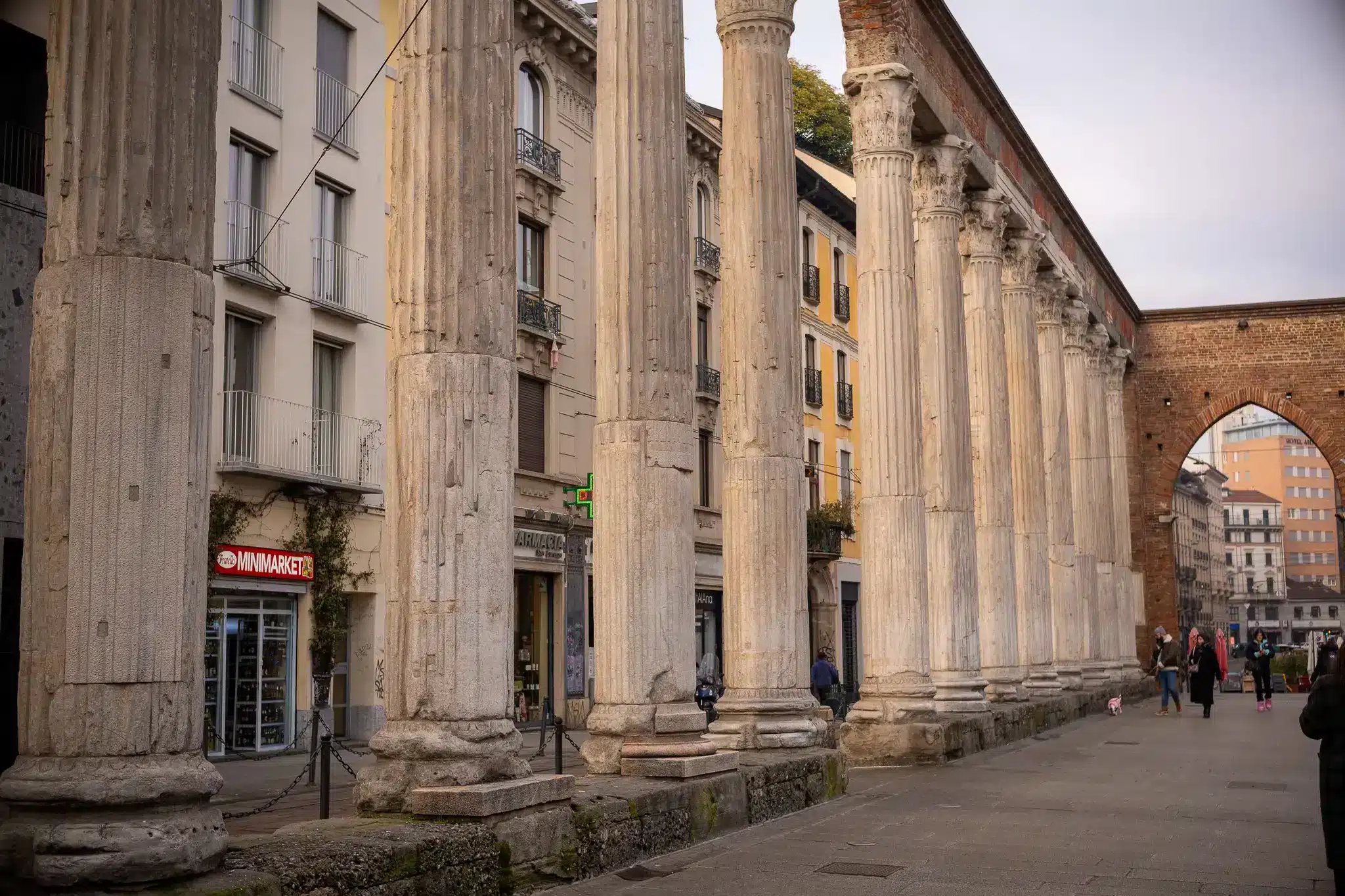
Milan’s layering becomes most literal when ancient stone sits a few steps from minimarkets, pharmacies, barber signage, and apartment balconies. The colonnade commonly seen along Corso di Porta Ticinese is the Colonne di San Lorenzo, which the Comune di Milano identifies as reused remains from an unknown 2nd-century public building in connection with the paleochristian basilica. What matters in the photographs is not just age, but exposure. These columns are street-visible and fully absorbed into everyday urban sequence.
That same sequence includes metro entrances, bike signs, scooter clusters, kiosks, and pedestrian guardrails. A red M outside a substantial corner building says as much about Milan as any cathedral spire. The city is full of access points—into tram networks, into underpasses, into arcades, into older districts where circulation patterns have been repeatedly adapted rather than erased.
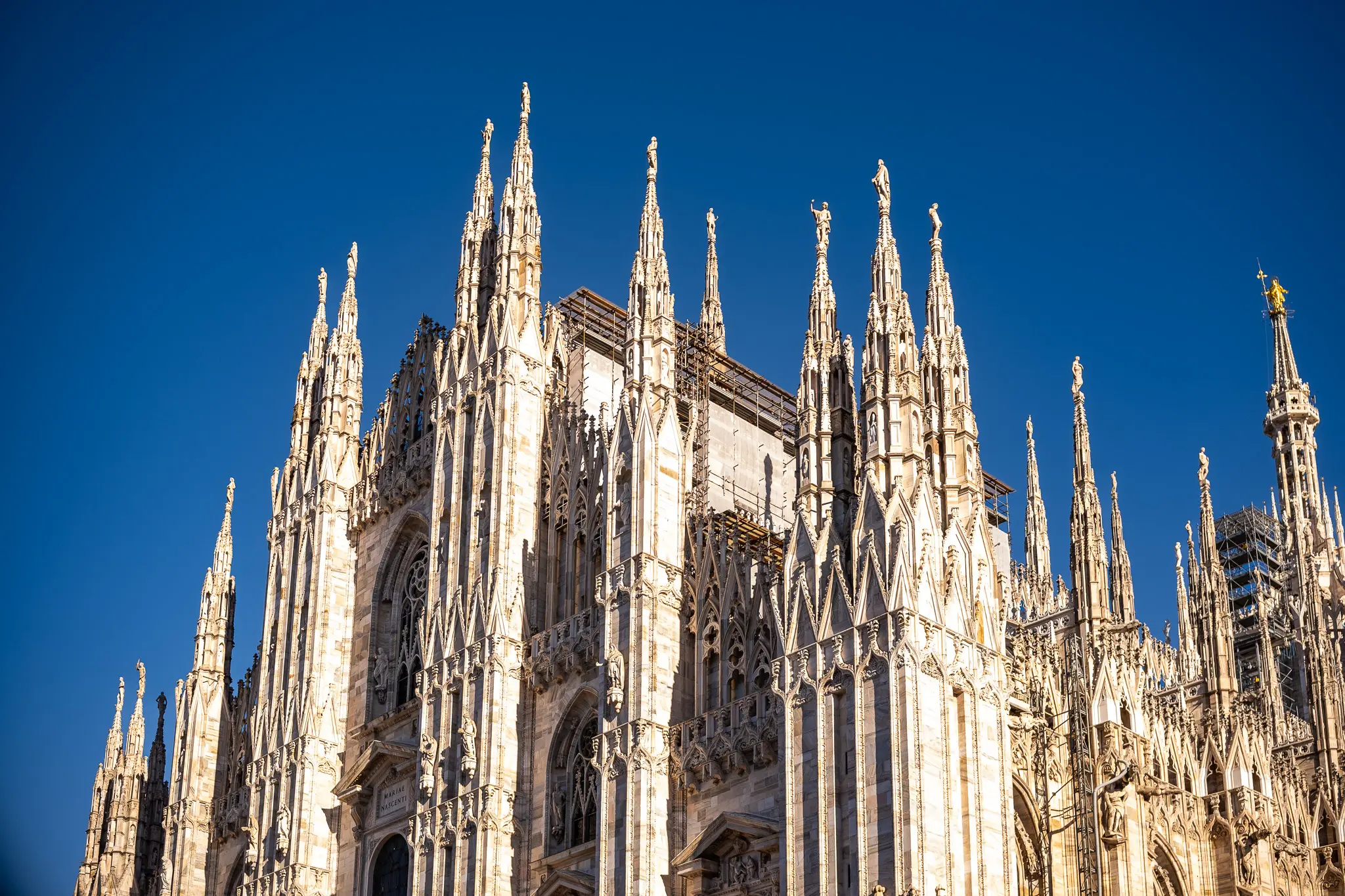
The Duomo belongs in this framework too, especially with scaffolding visible. The Veneranda Fabbrica del Duomo explicitly describes the cathedral as a permanent construction site, with continuous work on stone, glass, metalwork, and maintenance. In other words, restoration is not an interruption to the monument’s life. It is part of how the monument stays in use.
That is a very Milanese proposition. The city’s heritage does not present itself as untouched. It presents itself as maintained, rerouted, repurposed, and kept in service. Roman columns stand beside convenience retail. Gothic marble rises behind active worksites. Metro stairs cut into historic blocks. The old city remains legible because it keeps moving.
Photography by Gil DeSaant. Explore more of his photography at gildesaant.com.