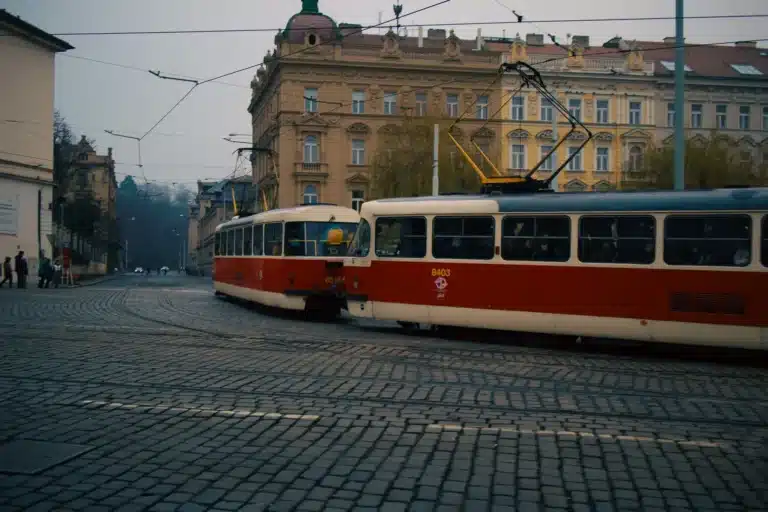
Dresden is easy to misread if you only approach it as architecture. The skyline gives you domes, crowns, lantern towers, sculptural rooflines and the full ceremonial language of a Saxon capital. But at street level, the city keeps interrupting that image with something much more practical: yellow trams, route displays, overhead wires, platforms, cyclists, ad boards, vendor carts and people crossing stone squares on ordinary errands.
That contrast is what gives the center its charge. In these scenes, Dresden does not look like a preserved stage set sealed off from use. It looks like a working city whose historic core is continuously crossed by public transit. The yellow-and-black identity of Dresdner Verkehrsbetriebe, which the operator itself refers to as its “yellow fleet,” becomes a visual connector between monumental façades and daily circulation.
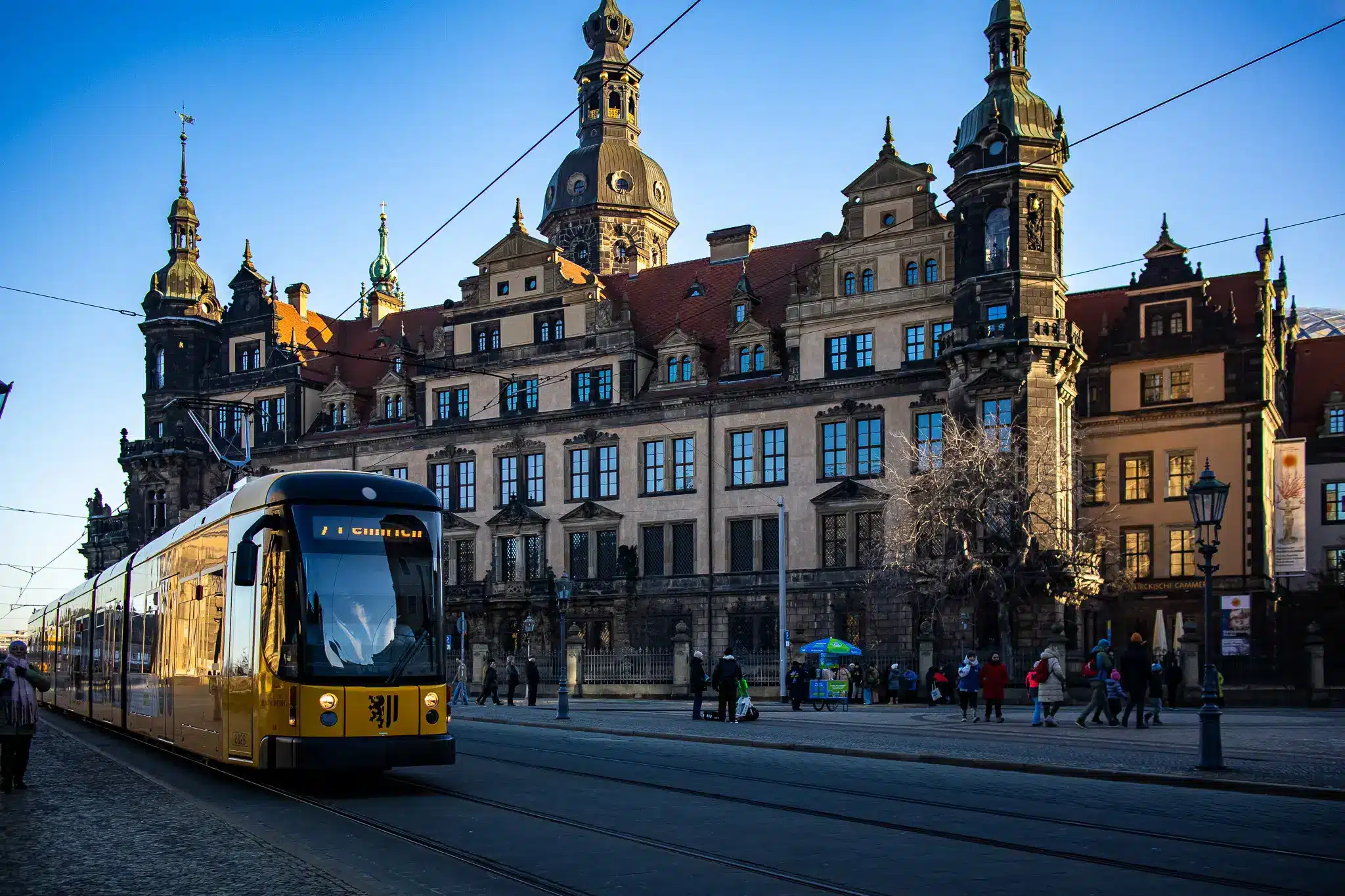
There is history behind that tension. Dresden’s center was destroyed over a large area in February 1945, and later reconstruction never meant simply freezing the city in amber. UNESCO nomination material described the approach as holding on to the old while creating something new from extended elements of the old. You can feel that idea most clearly not in a museum gallery, but at tram stops and squares where rebuilt grandeur still has to function as infrastructure.
Dresden’s yellow fleet is part of the view, not background noise
In a lot of historic European centers, transit is framed as the thing just outside the frame. In Dresden, it is often the frame. Official DVB stop information puts major tram activity directly into the core at places like Altmarkt, Postplatz and Theaterplatz, and that matters because the tram here is not merely a commuting device. It is one of the city’s most legible visual systems.
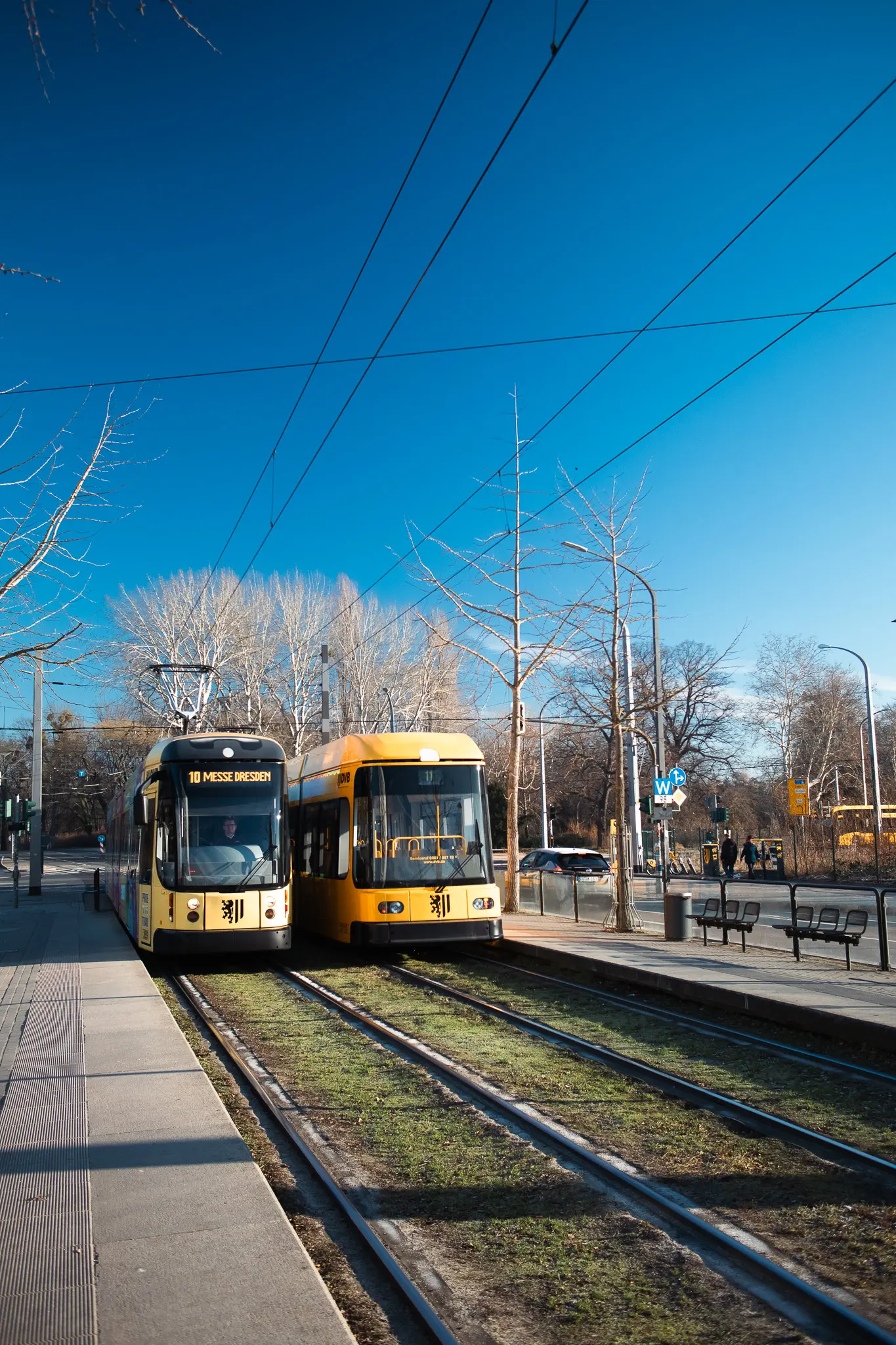
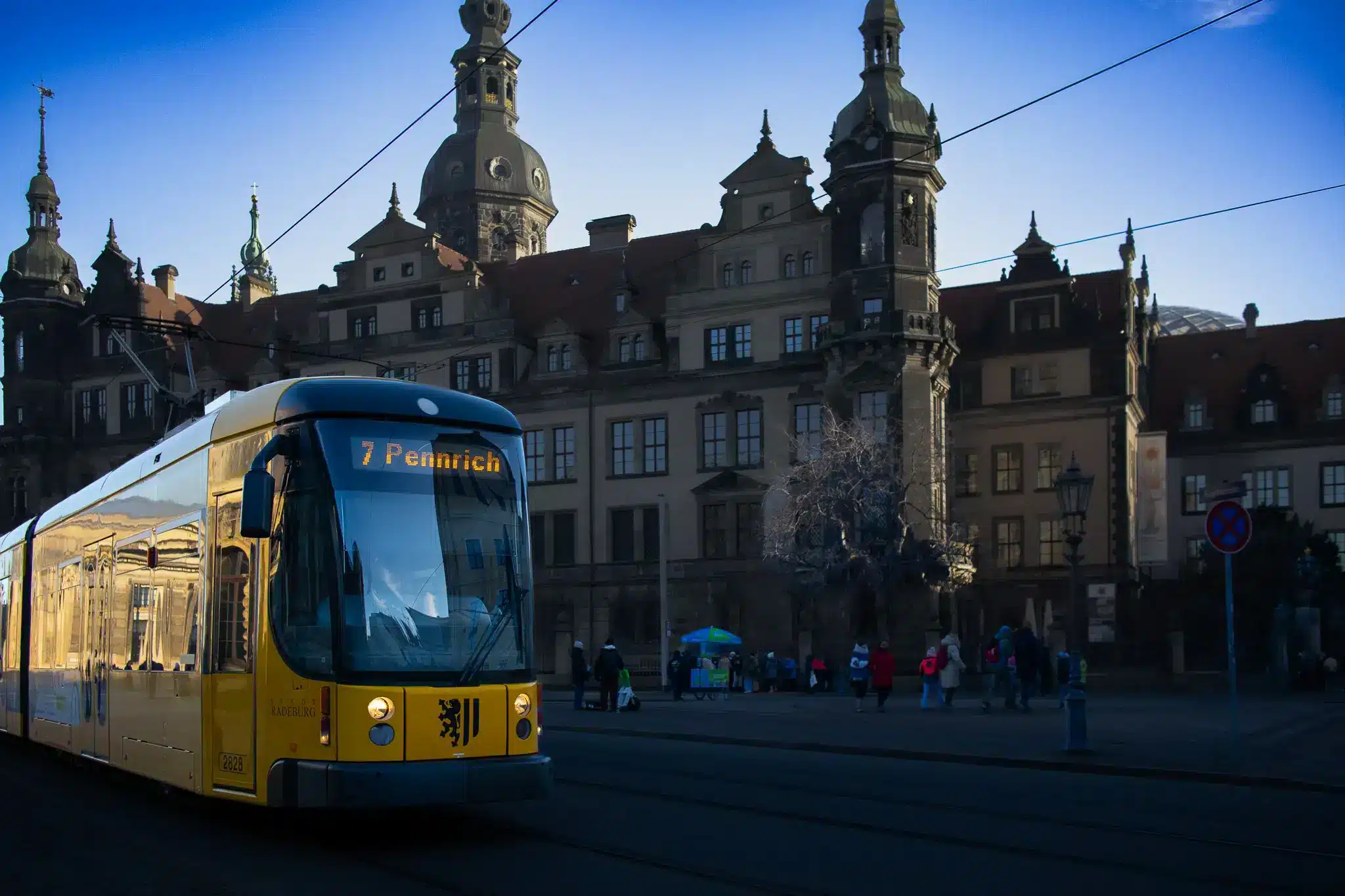
The color does a lot of the work. DVB’s yellow vehicles read instantly against winter stone, dark roofs and blue sky, almost like a piece of graphic design moving through a Baroque composition. The effect is not subtle. A tram slides past towers and domes, overhead wires score the sky, and suddenly the old-city image becomes less about nostalgia and more about sequence, timing and flow.
That visual confidence also says something about civic priorities. These are central, high-symbolism spaces, yet they are still expected to handle movement. The trams are not tucked away for the sake of a cleaner postcard. They announce that the center remains part of the city’s living transport network. If you want a clean metaphor, Dresden refuses one. Palace-scale architecture and public transit occupy the same shot, and both are essential to understanding the place.
Reconstruction here produced a usable center, not a sealed monument
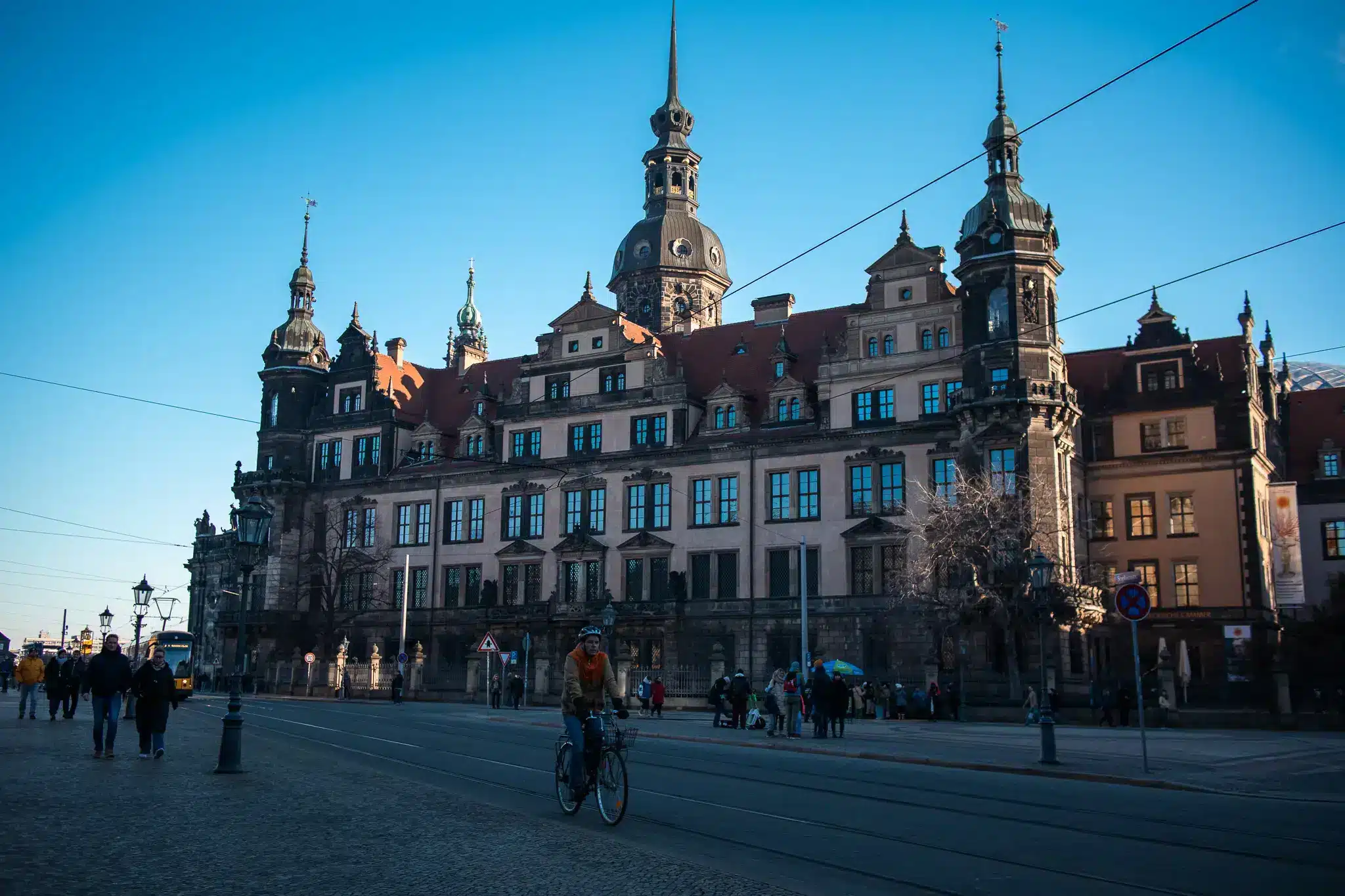
Dresden’s rebuilt core carries a lot of historical weight, but the most persuasive thing about it is how unsentimental its daily use can appear. Grand façades face tracks. Cobblestones lead to platforms. A cyclist cuts across an open square while pedestrians wait near curb edges and crossings. The city’s visual prestige is real, yet it is constantly negotiated by ordinary movement.
That makes Dresden different from the fantasy version of a restored old town, the one where heritage only survives by being thinned out into spectacle. Here, the monumental fabric still has to coexist with modern service systems and practical urban needs. Official DVB material for central stops such as Postplatz even emphasizes barrier-free access, a small but revealing detail. Accessibility belongs to the same conversation as heritage when the center is expected to function for residents as well as visitors.
The result is a city where the most interesting contrast is not simply old versus new. It is ceremonial architecture paired with present-tense usability. Reconstruction did not erase the need for platforms, shelters, rails and route logic. If anything, those elements make the rebuilt city more convincing. They keep the center from becoming a model village of itself.
Market stalls, kiosks and chain signage keep the squares from turning theatrical
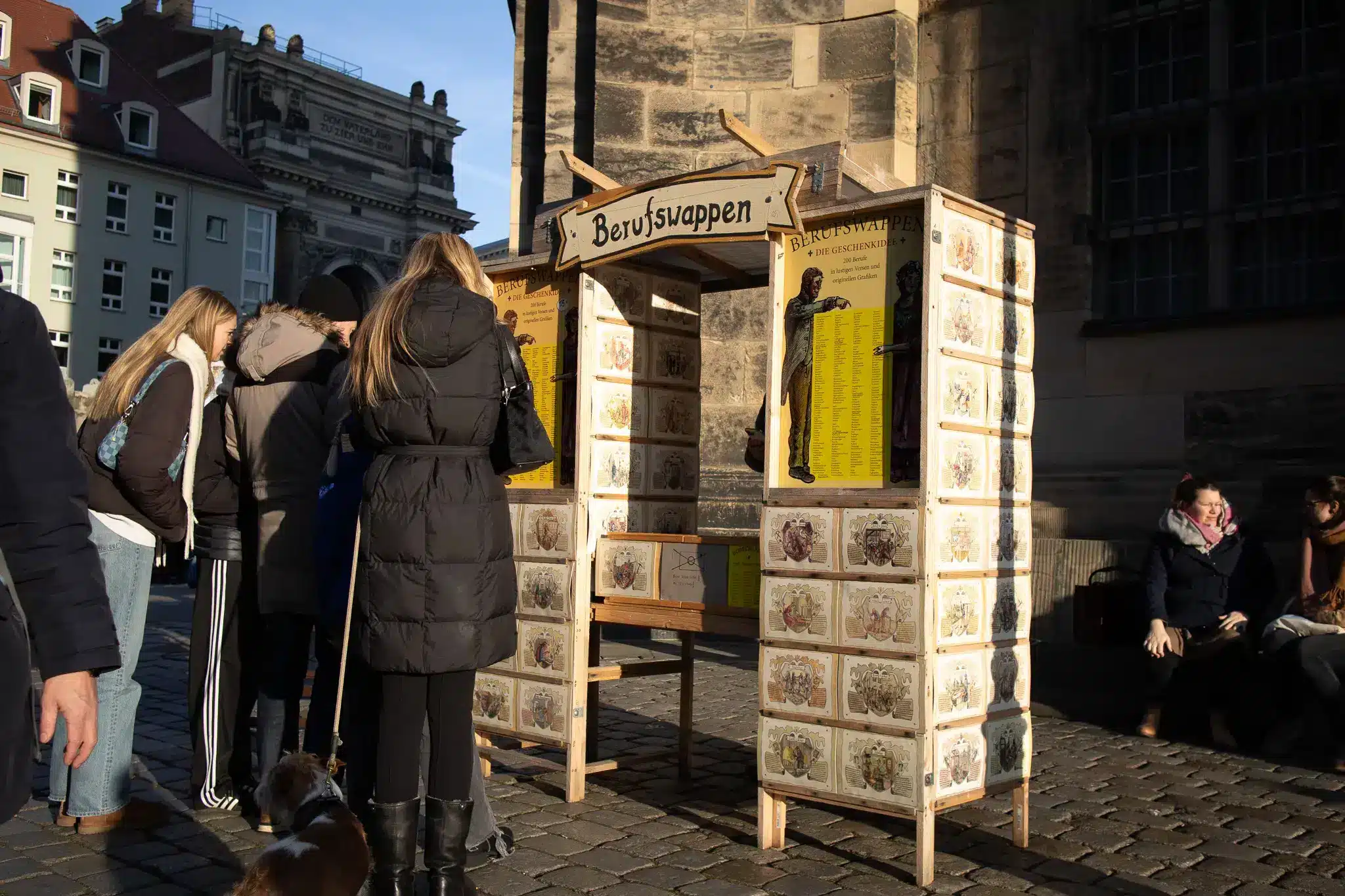
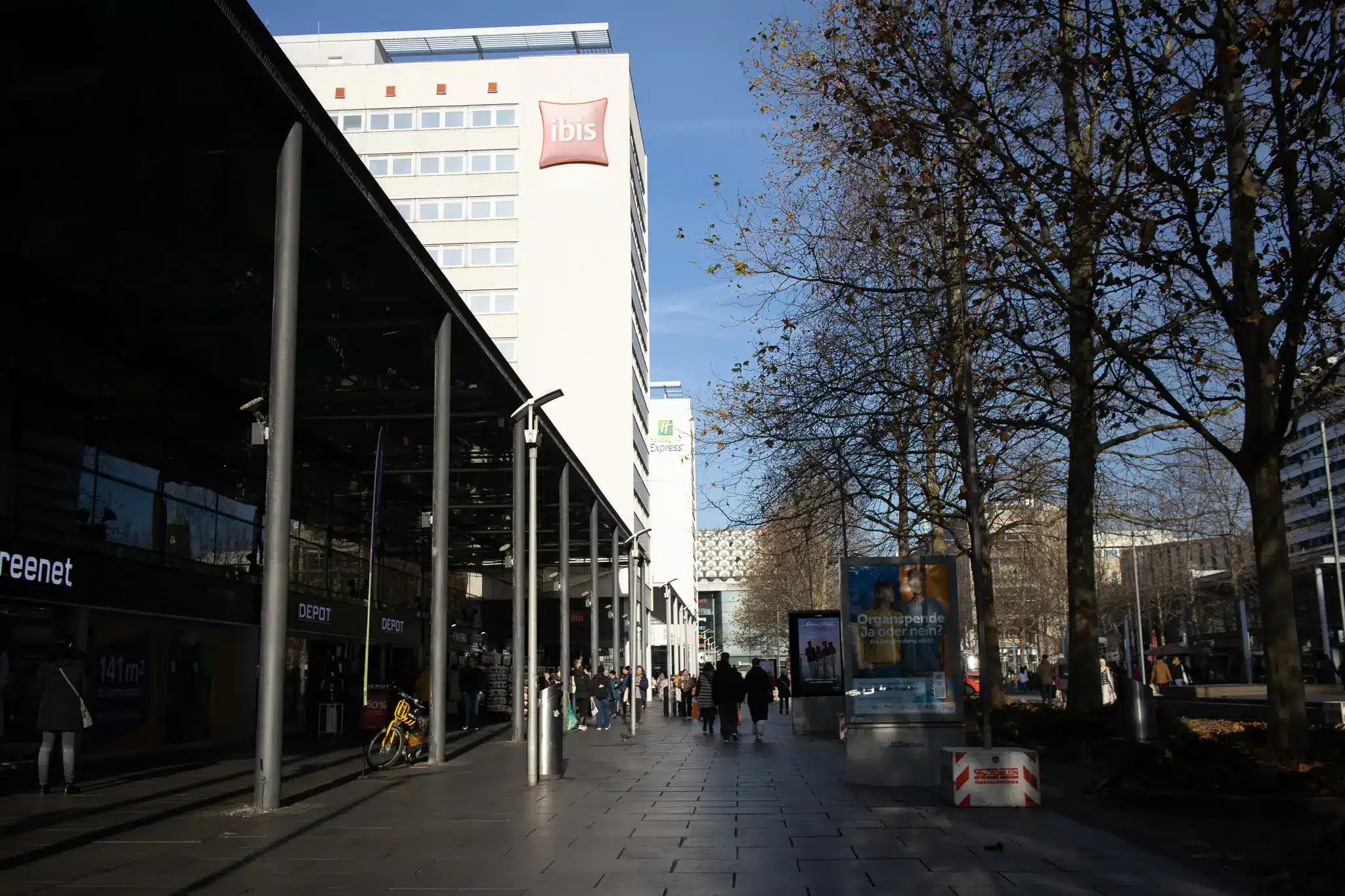
The public realm in central Dresden carries a deliberately mixed texture. Alongside major architecture, you see temporary stalls, practical retail, hotel branding, restaurant signs and freestanding ad boards. That can sound visually messy on paper, but it is part of what keeps the center credible. A square becomes more interesting when it has to accommodate a pizzeria sign, a souvenir kiosk and a tram stop in the same visual field as domes and statuary.
Municipal documents back up that impression. Dresden regulates vendor locations in central spaces including Theaterplatz, Postplatz and Schloßplatz, which means temporary commerce in monumental areas is not an anomaly. It is an expected, managed use of the city center. That administrative fact matters because it confirms what the street already shows: these squares are civic surfaces, not untouchable heritage carpets.
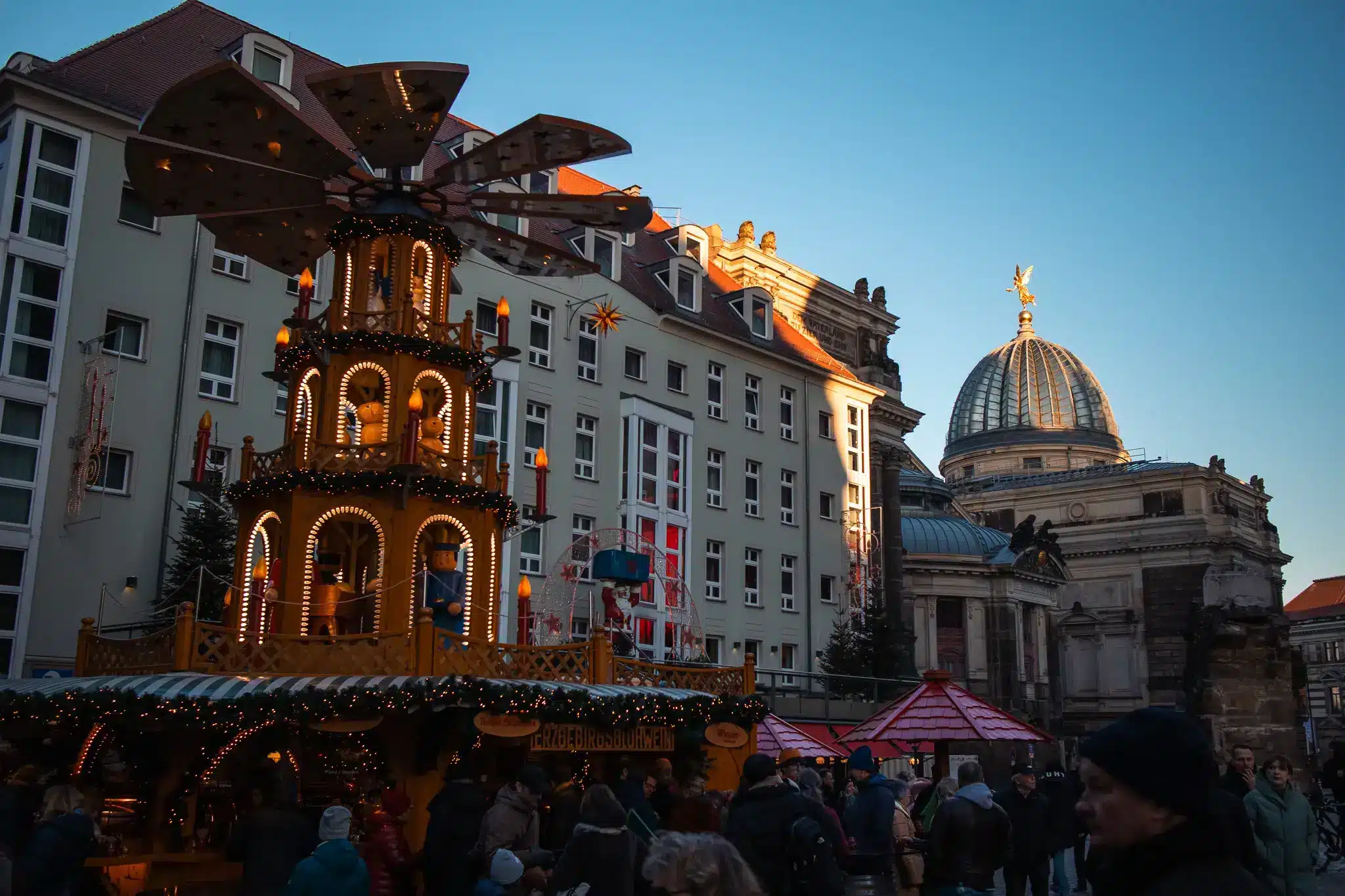
Seasonal decorations intensify that feeling. Altmarkt is the home of the Striezelmarkt, widely presented by the city as Germany’s oldest Christmas market, and Erzgebirge craft traditions remain strongly associated with Dresden’s winter public culture. Even without overclaiming any single stall scene, the wooden pyramid forms, hanging star decorations, striped booths and bundled pedestrians all point to a center that knows how to shift between transit node, shopping corridor and festive commons. The point is not quaintness. The point is adaptability.
Even the smallest street details argue against a museum reading
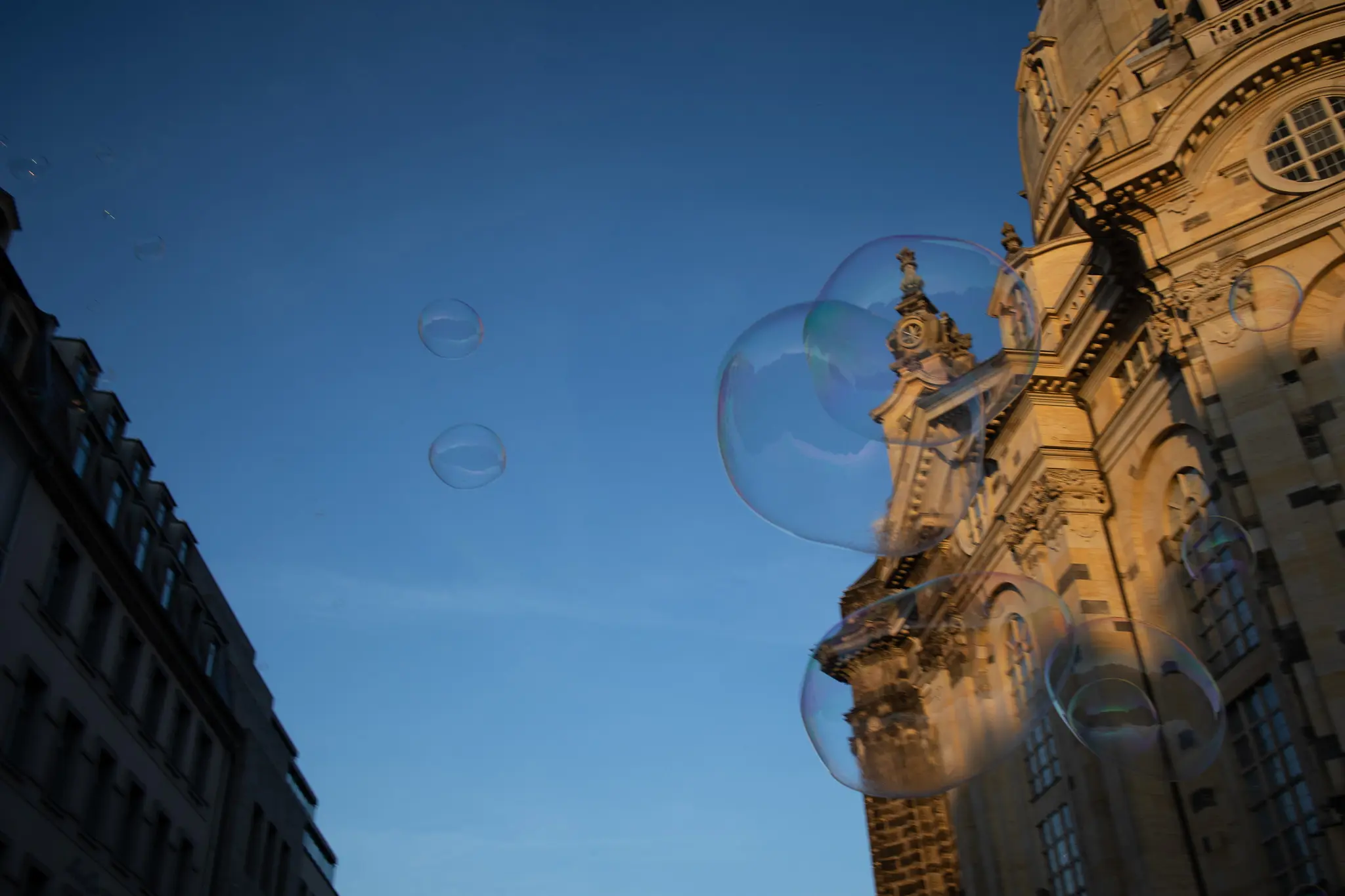
Some of the most telling moments are the least monumental. Soap bubbles drift into otherwise heavy architectural compositions. A vendor umbrella sits near a grand façade. German text appears not as branding theater but as urban texture: route displays, posters, restaurant lettering, commercial signs, public notices. A reflected doorway or a shaded passage suddenly matters as much as a dome.
These details soften the authority of the stone. They also pull Dresden back into the register of lived city experience, where weather, timing and incidental street animation can interrupt architecture’s attempt to dominate the scene. That interruption feels healthy. A city this visually loaded needs a bit of randomness to avoid becoming too self-conscious.
There is also a design lesson here. The center works not because every element belongs to the same era or style, but because the city tolerates overlap. Historic masonry, modern glazing, transit hardware, tourist infrastructure and ordinary pedestrian behavior all sit inside the same composition. Dresden’s identity emerges from that layering, not from purity.
Maybe that is why the trams matter so much. They are not just vehicles passing through pretty streets. They are evidence that the center still performs a civic role. In Dresden, the Baroque skyline keeps its authority, but the yellow fleet keeps it honest.
Photography by Gil DeSaant. Explore more of his photography at gildesaant.com.