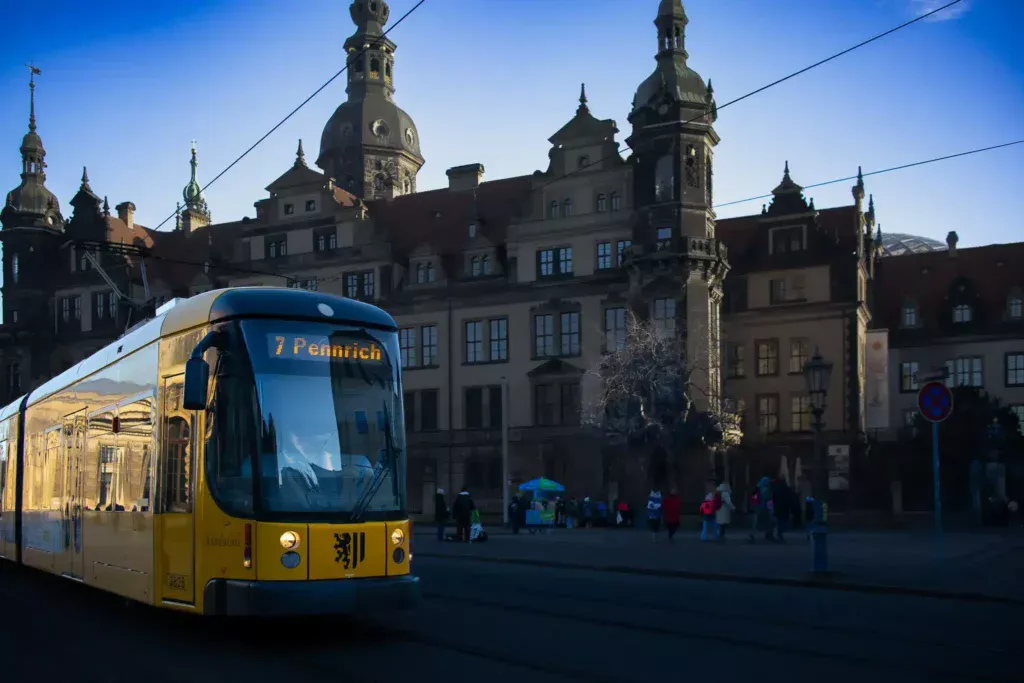
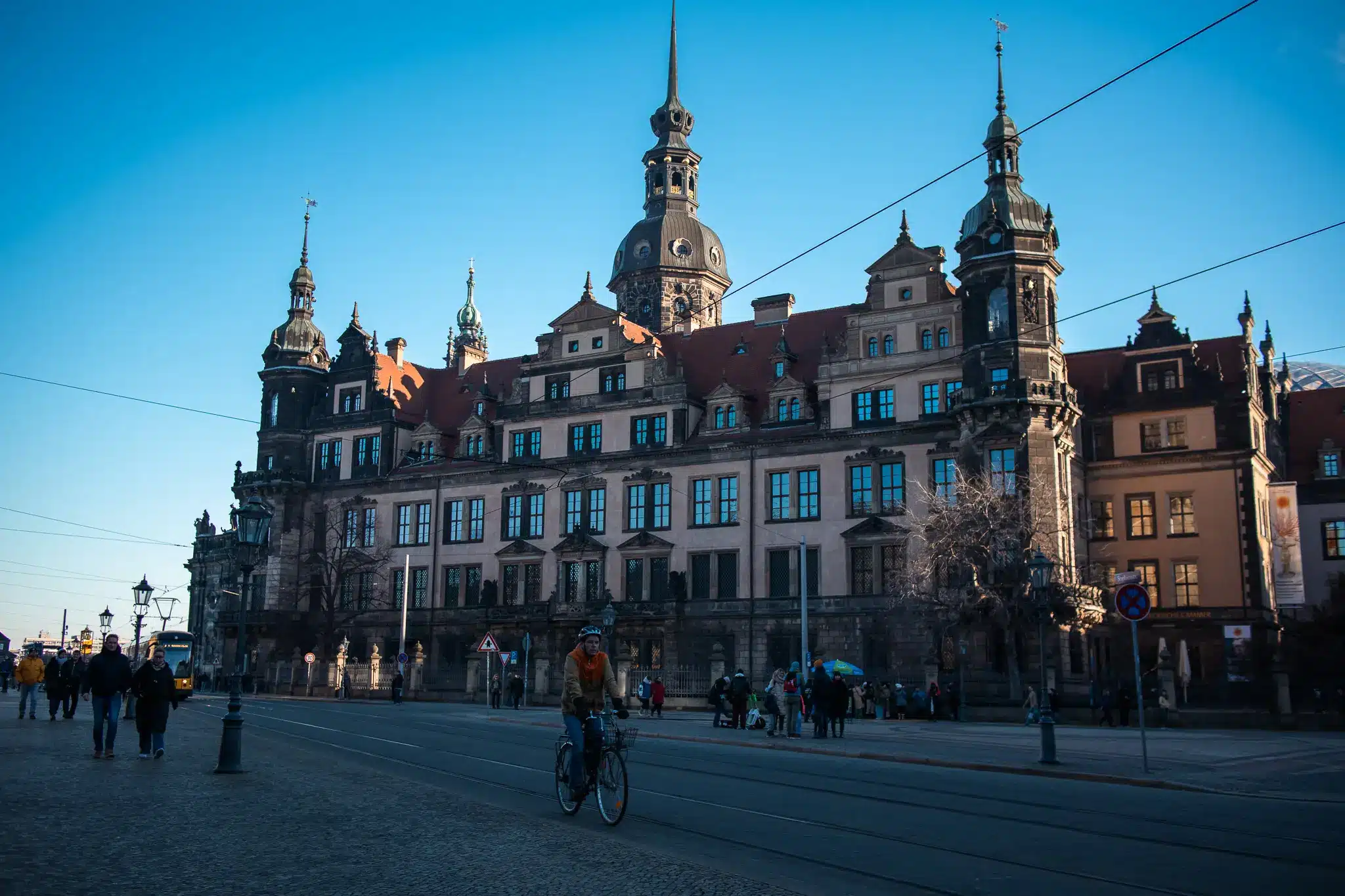
There are cities that present history as a still life. Dresden does something more interesting. Its monumental core—domes, crowns, palace facades, sculptural rooflines—does not sit apart from daily use. Yellow trams cut across the foreground. Wires hang over ceremonial squares. Cyclists pass beneath towers built to project dynastic power. A vendor umbrella pops up in front of stonework that was designed for court display, not casual commerce. The point is not contrast for its own sake. In Dresden, heritage and circulation seem to have agreed to occupy the same frame.
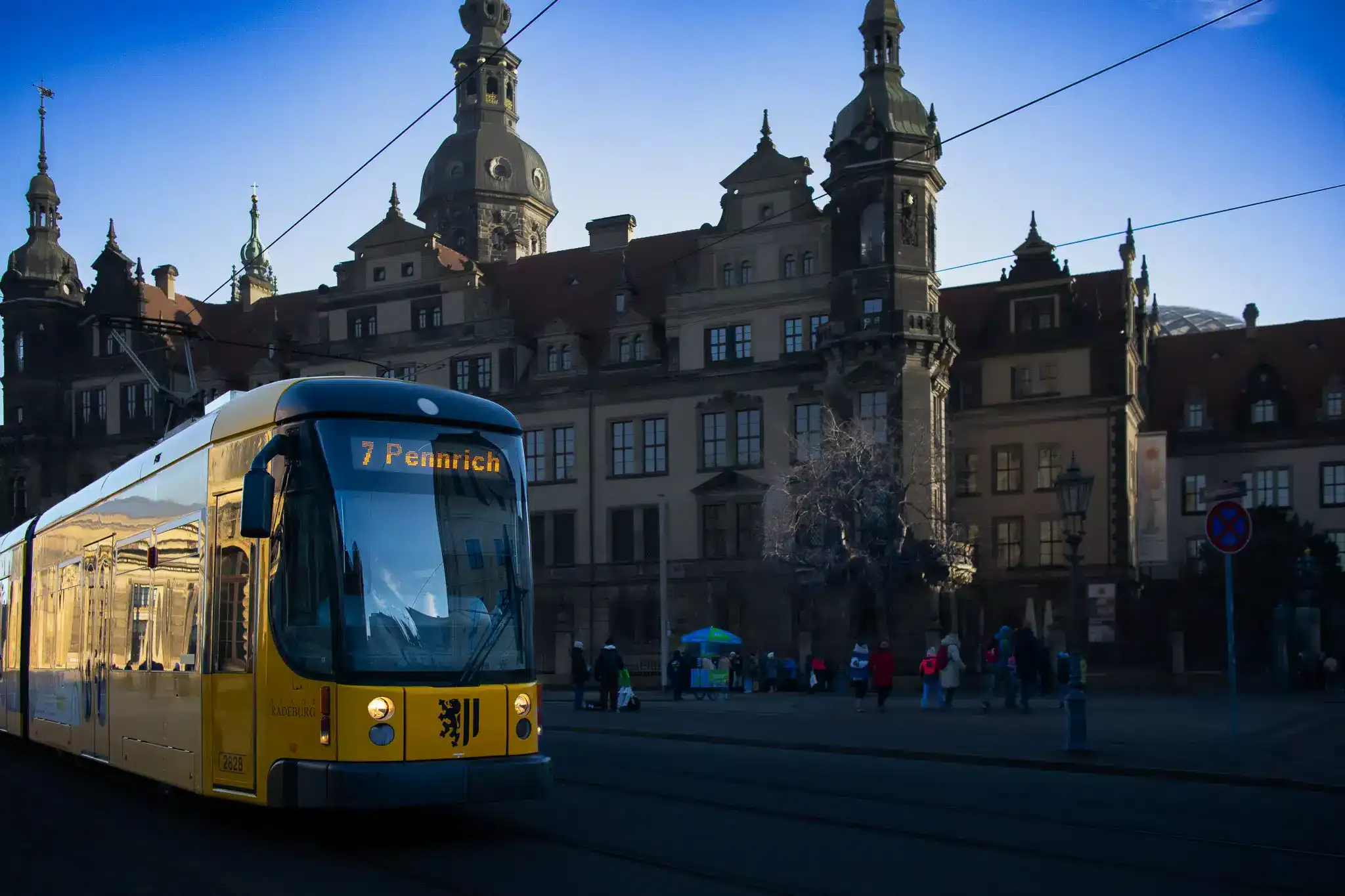
That is what gives the city its particular visual charge. The old center is undeniably theatrical, but not in the dead way some historic districts become theatrical—preserved as backdrop, emptied of friction, polished into a permanent postcard. Here, public movement keeps interrupting the grand composition. A tram signed for Messe Dresden glides through a space more often photographed as architecture alone. Another shows regional-facing destinations such as Radeburg or Pennrich, a reminder that the center is not merely for visitors orbiting landmarks. It is part of a network.
Dresden’s tram story runs deep. Dresdner Verkehrsbetriebe traces the city’s local-transit history to 1872, when the first horse-tram line began operation. That long continuity matters, but the stronger point is contemporary rather than nostalgic: the tram is not a decorative holdover. It remains embedded in how the city works. Official planning documents treat Postplatz as a central interchange, and the urban corridor linking places such as Augustusbrücke, Theaterplatz, and Altmarkt shows that movement through the old center is not accidental spillover from modern life elsewhere. It is designed into the core.
That design choice becomes especially legible around Theaterplatz, where some of Dresden’s most ceremonial architecture stands in close proximity to ordinary transit use. The Semperoper, on Theaterplatz, first opened in 1841, was rebuilt after an 1869 fire, destroyed again in 1945, and reopened after reconstruction in 1985. That compressed history says a lot about Dresden in general. The city’s grandeur is real, but it is not untouched. Some of what reads as old continuity is also a postwar civic project of rebuilding, reconstruction, and reinvention. A tram crossing that landscape does not profane it. If anything, it makes the reconstruction legible as part of living urban time rather than museum time.
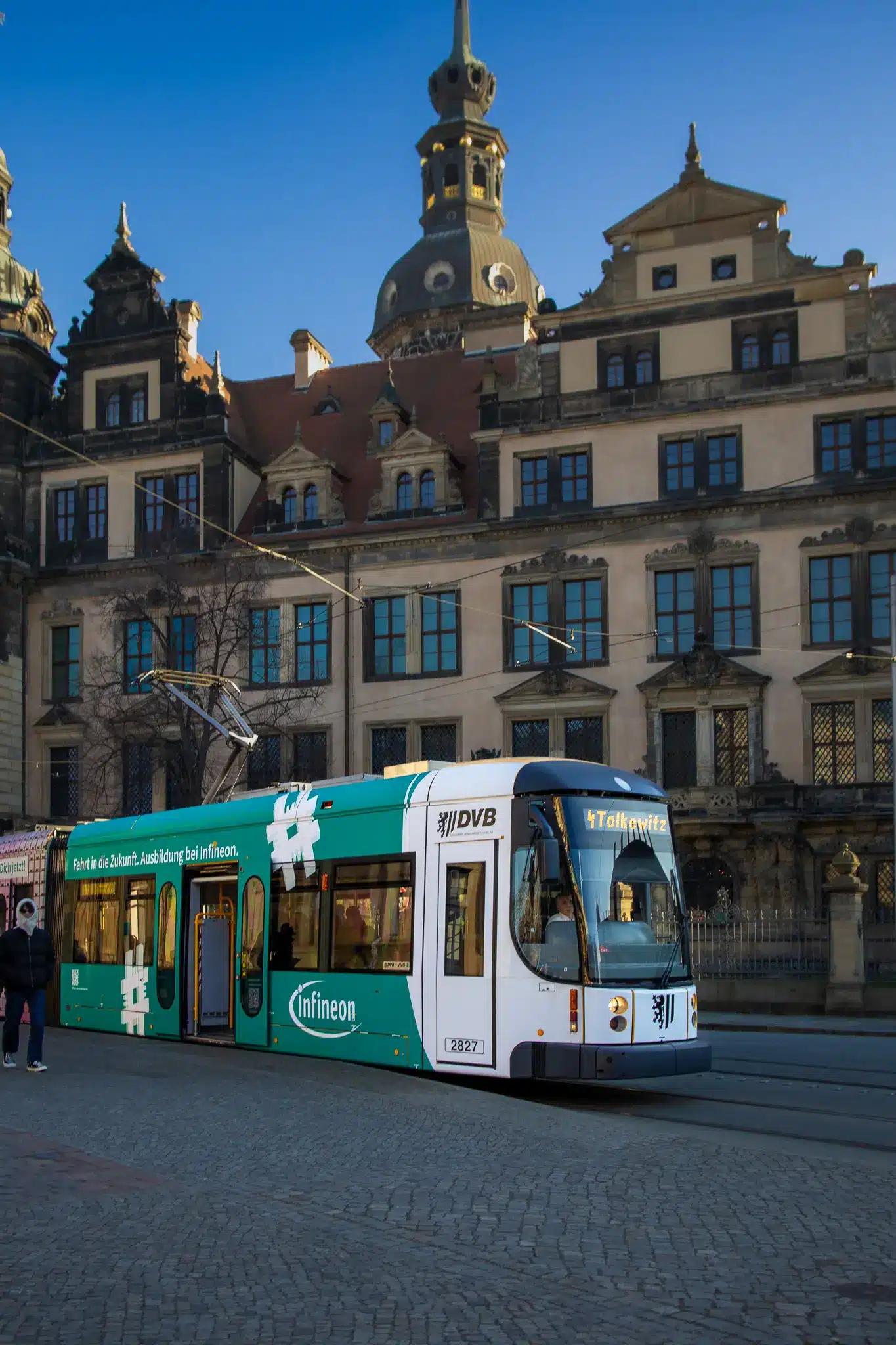
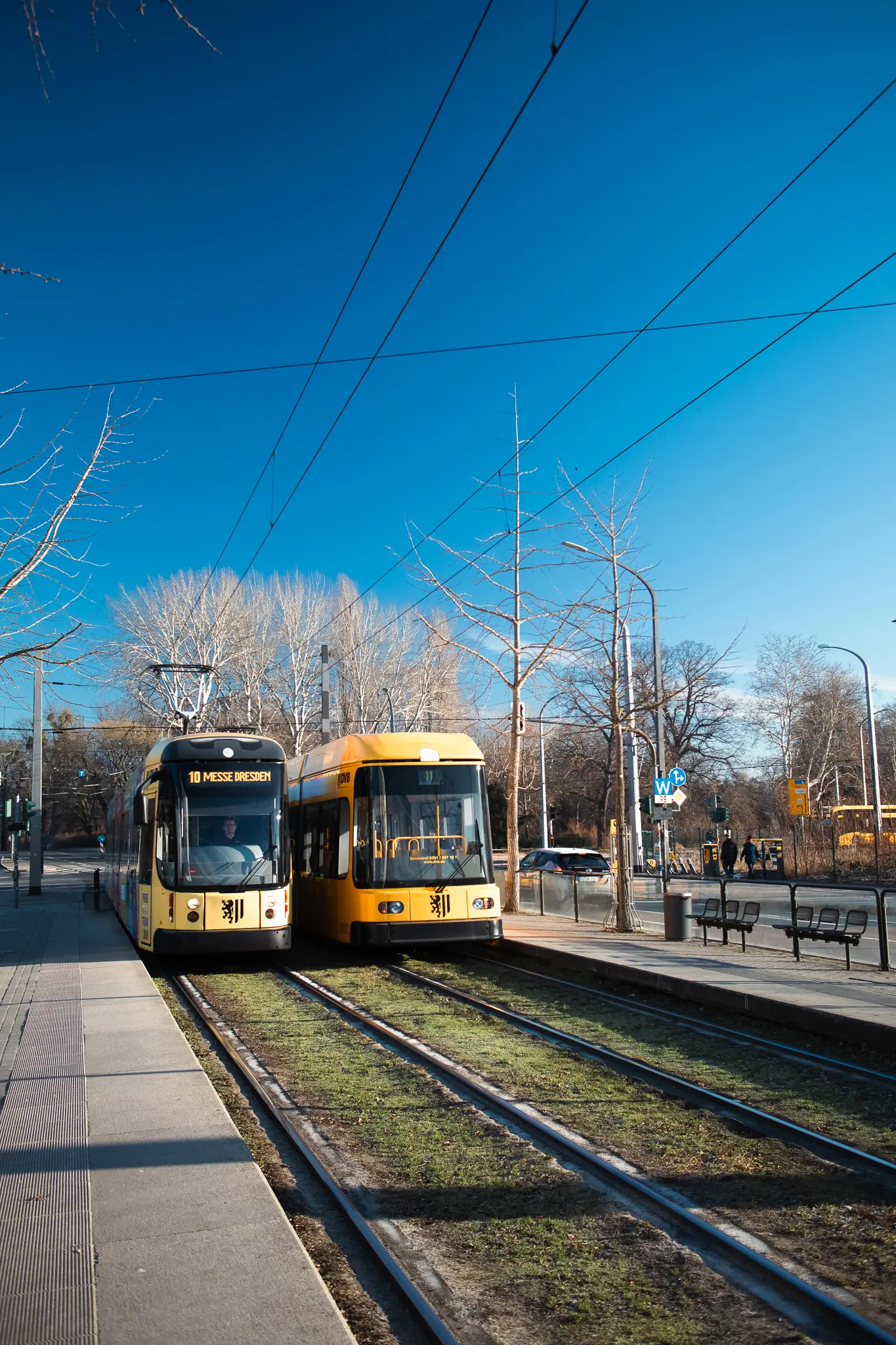
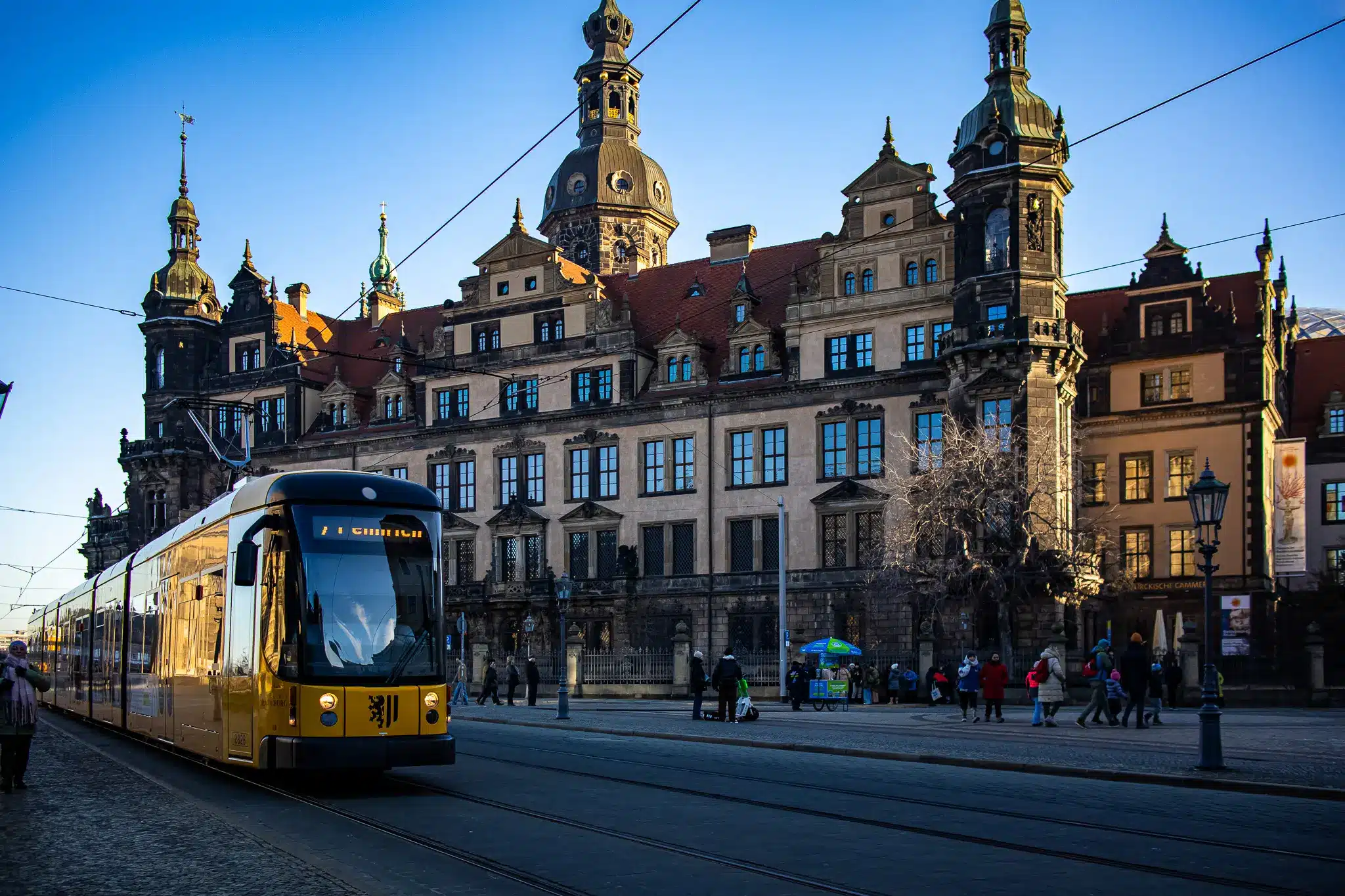
This is where Dresden gets more complex than the standard heritage-city script. The ceremonial facades can look almost unreal in winter light—green cupolas, clock faces, gold finials, balustrades lined with figures—but the street keeps refusing pure monumentality. Tracks run through the foreground. Platform edges and signal poles enter the composition. Overhead catenary lines slice the blue sky into geometry. Public infrastructure adds a second graphic system on top of the Baroque one.
For a photographer, that overlap is hard to ignore. Baroque architecture loves mass, ornament, procession, and axial drama. Tram infrastructure brings repetition, cable tension, route logic, utility poles, and bright blocks of municipal color. One system was built to impress; the other to move bodies efficiently through the city. In Dresden, neither fully cancels the other. Instead they sharpen each other. The yellow vehicles look even more emphatic against pale stone and red roofs. The facades look less embalmed when a modern articulated tram pulls up beneath them.
Sometimes the details are almost funny in their refusal to perform historical purity. A tram carries a contemporary ad campaign for Infineon training and recruitment as it passes a historic facade. A platform canopy edges into a scene of arched masonry. A blue-and-green vendor umbrella stands before an ornate institutional frontage. None of this feels especially staged. It feels like a working city declining to airbrush itself.
That refusal extends beyond transit. In the winter market scenes, the old town is not reduced to romance. You see striped stall roofs, star decorations, a large wooden festive structure, partial signage reading Weihnachtsmarkt, and another sign beginning ERZGEBIRGSKUNSTWEIHN…—enough to connect the imagery to the broader Saxon Christmas economy without pretending every stall can be identified from a glance. Dresden’s official Striezelmarkt presents Erzgebirgische Volkskunst as a defining part of its seasonal culture, and that context matters. The Ore Mountains tradition is not just decorative surplus; it is a regional craft language with deep roots in Saxony. In these street scenes, though, it appears the way many urban traditions now appear: mixed into pedestrian flow, retail signage, temporary structures, and the visual clutter of public life.
One of the sharpest side notes in the set is a kiosk selling Berufswappen—profession-themed printed gifts advertised as “200 Berufe in lustigen Versen und originellen Grafiken.” It is a wonderfully specific piece of vernacular commerce: somewhere between souvenir print culture, occupational humor, and small-scale graphic design. Nearby, contemporary illustration styles share the same retail space. That juxtaposition says something useful about central European old towns in the present tense. They are not coherent historical sets. They are marketplaces where folk forms, tourist habits, local language, anime aesthetics, and legacy print culture all end up on adjacent racks.
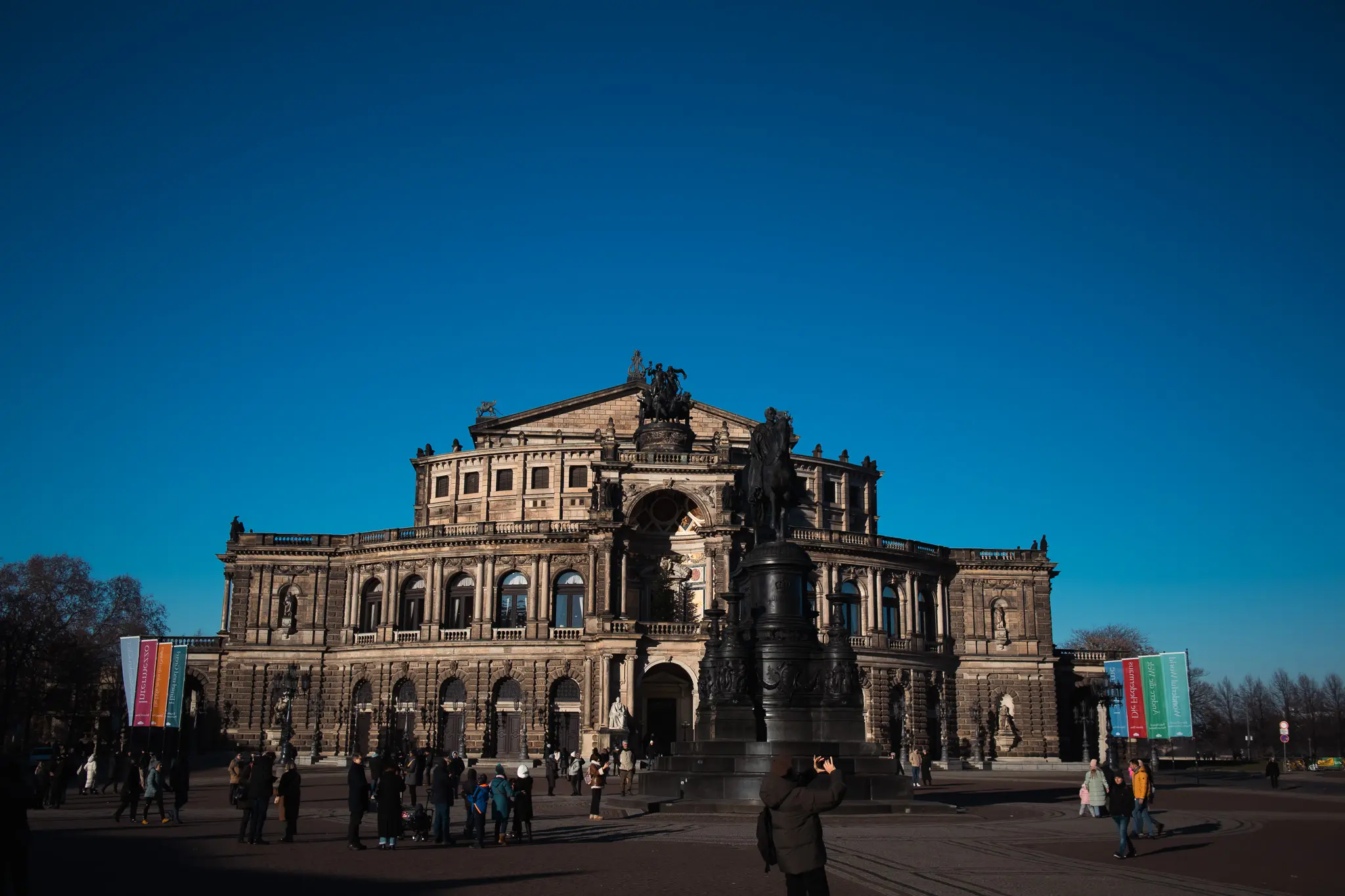
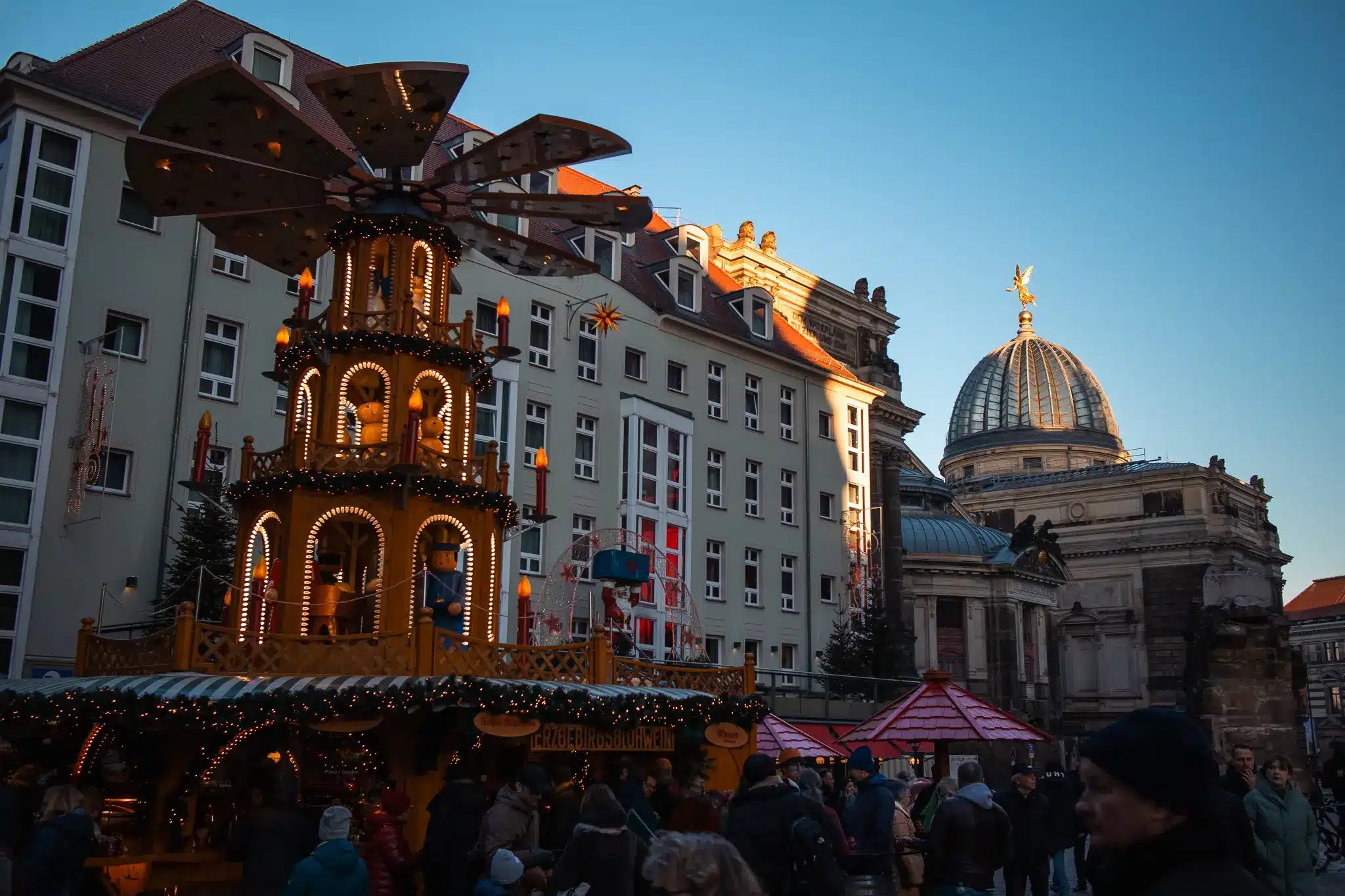
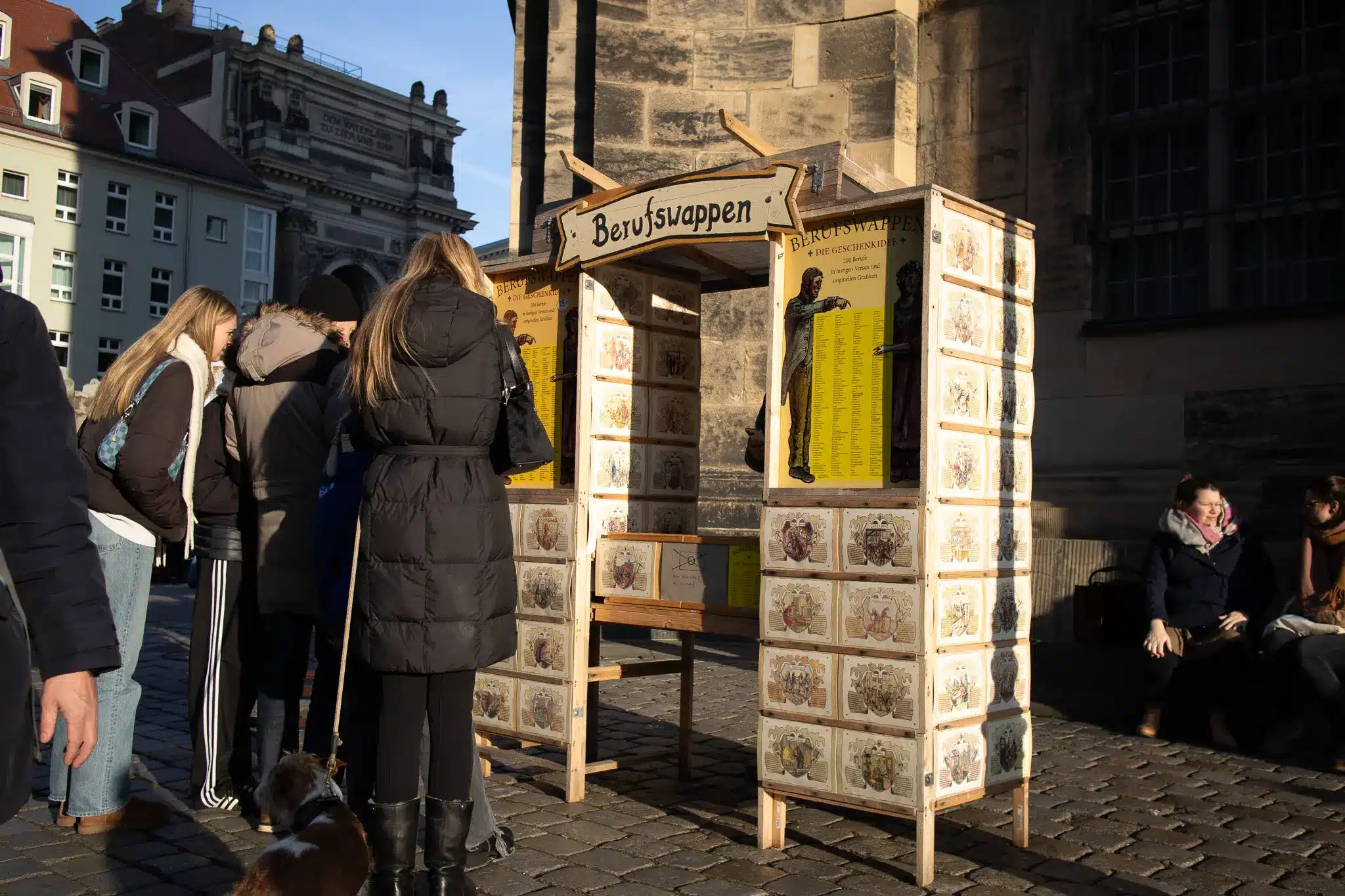
Even the lighter motifs in the images work against heaviness. Soap bubbles drift through several low-angle views of monumental stone buildings, briefly softening architecture built to endure centuries. No explanation is necessary beyond what the pictures already show. Bubbles, pedestrians, trams, bicycles, market stalls: temporary things moving through durable settings. The city is most convincing at exactly that scale, where the monumental and the ordinary keep colliding.
And Dresden is not only old-town grandeur anyway. Other frames move into a more generic central-city landscape of chain hotels, retail signage, ad panels, and pedestrian corridors. The presence of ibis, Express, DEPOT, and JCDecaux is not especially poetic, but that is the point. The center is layered. Historic Dresden is not suspended outside commerce, branding, or standardized urban development. It coexists with them, sometimes awkwardly.
That coexistence may be the most honest thing about the city. Dresden’s identity is often presented through its rebuilt skyline and its heavy symbolic architecture, and those elements are undeniably potent. But the stronger image is not the isolated landmark shot. It is the moment when a DVB tram rolls through the frame and makes the whole composition current. A city once shaped by royal display, then by destruction, then by reconstruction, now reads through movement: route signs, platforms, tracks, cyclists, waiting passengers, and bridges rebuilt for trams, bicycles, and pedestrians rather than private cars.
In other words, Dresden does not look most like itself when nothing is happening. It looks most like itself when the square is in use.