Edinburgh is one of those cities that makes sense less as a skyline than as a stack. A lawn becomes a former loch. A gallery sits on an engineered mound. A Gothic tower rises behind tram wire. A fortress appears not at the edge of the city but directly above it, as if geology and government signed the same lease.
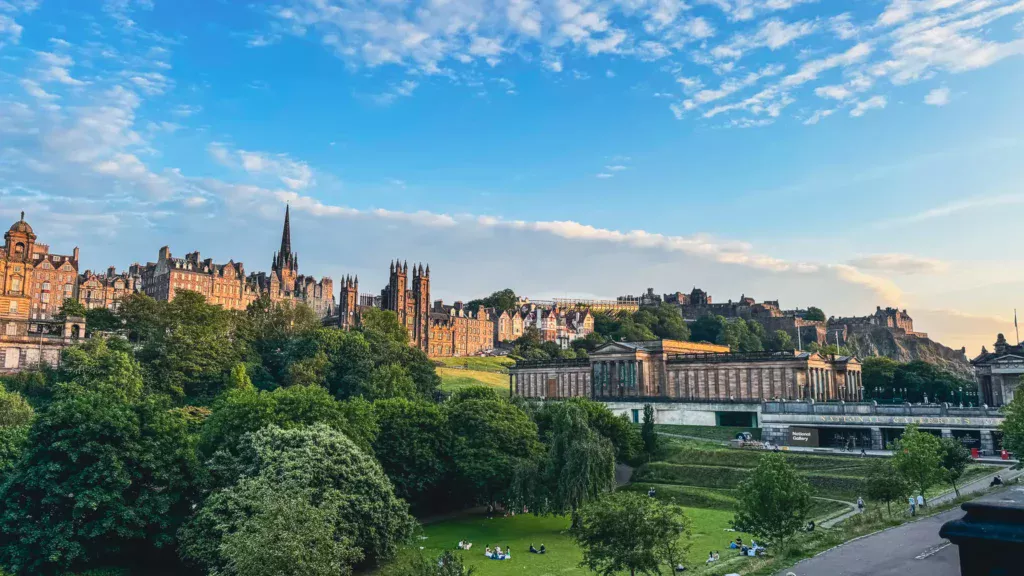
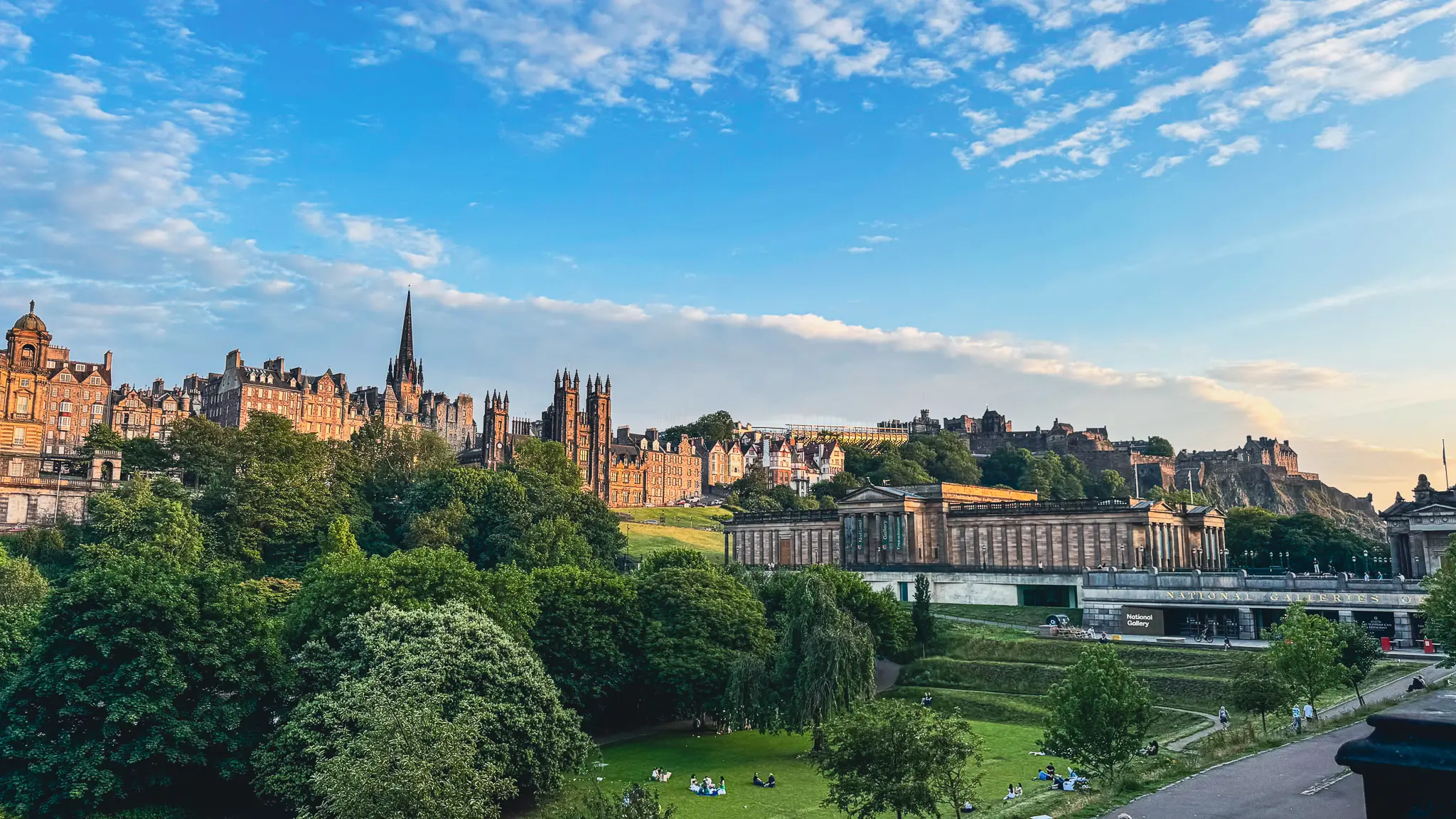
The strongest images here are not the standard long-lens monument views. They keep catching Edinburgh in compression: the Scottish National Gallery signage with Princes Street Gardens in front, the Old Town ridge behind, and the castle never far from the frame. UNESCO’s description of the Old and New Towns leans on exactly this topographic drama, with the medieval ridge, the glacial plain to the north, and the links across the Waverley Valley creating the city’s most recognizable views.
That layered quality also explains why Edinburgh’s everyday details matter so much. Gold institutional lettering, road markings, tram cables, retail typography, bunting and painted shopfronts all read against heavy stone and steep ground. The city does not separate heritage from daily use. It compresses them into the same sightline.
The Mound turns a city view into an urban cross-section
From Princes Street Gardens, Edinburgh presents itself as a cross-section rather than a façade. The parkland below was once the Nor’ Loch, later transformed into the gardens that now occupy the valley beneath the castle. Above that green floor sits The Mound, and on it the Scottish National Gallery, one of the public institutions that helps organize how the city is seen as much as how it is used. The gallery’s site is not incidental backdrop. It is part of the mechanism that links New Town street level, garden space and Old Town elevation.
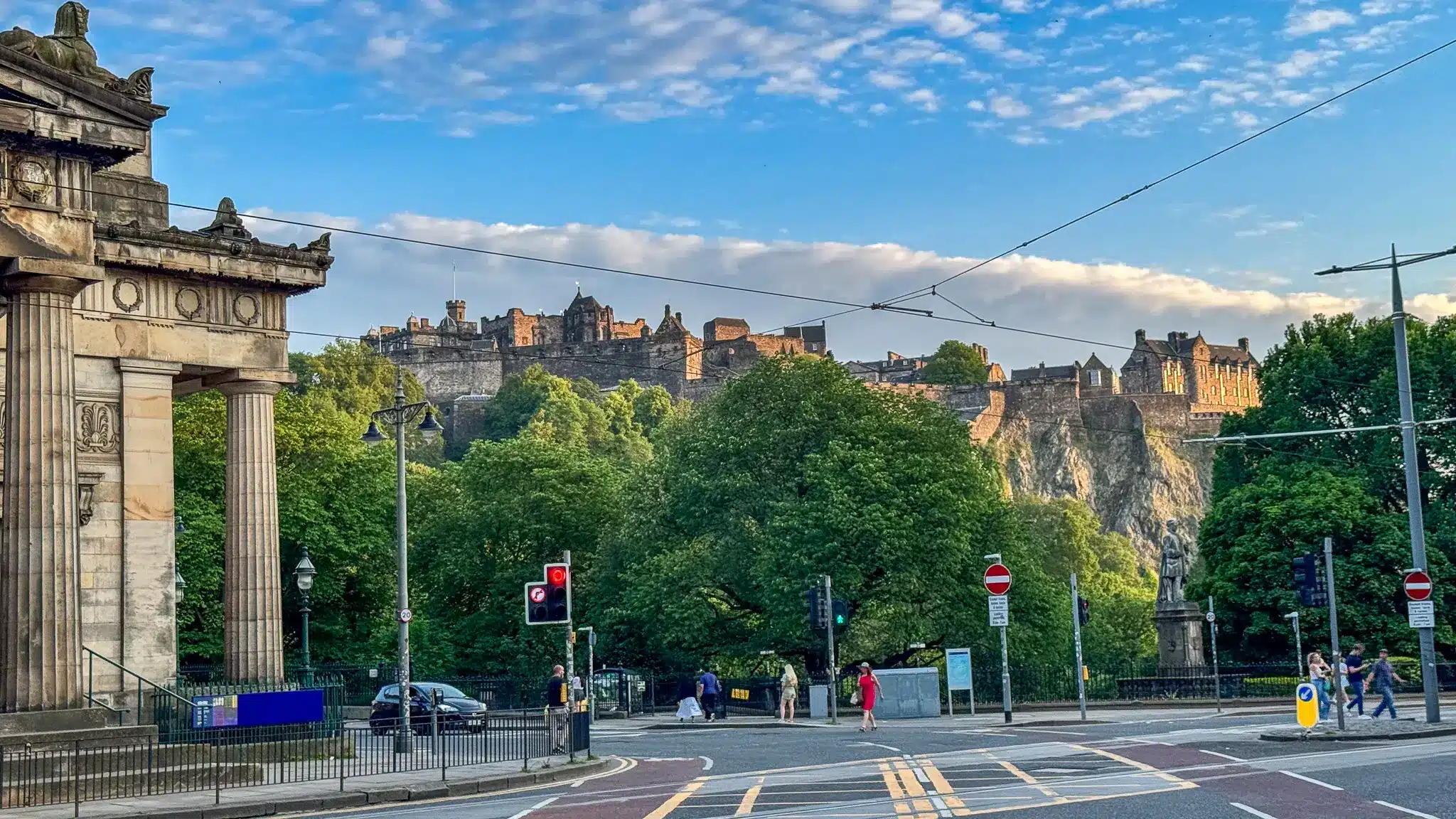
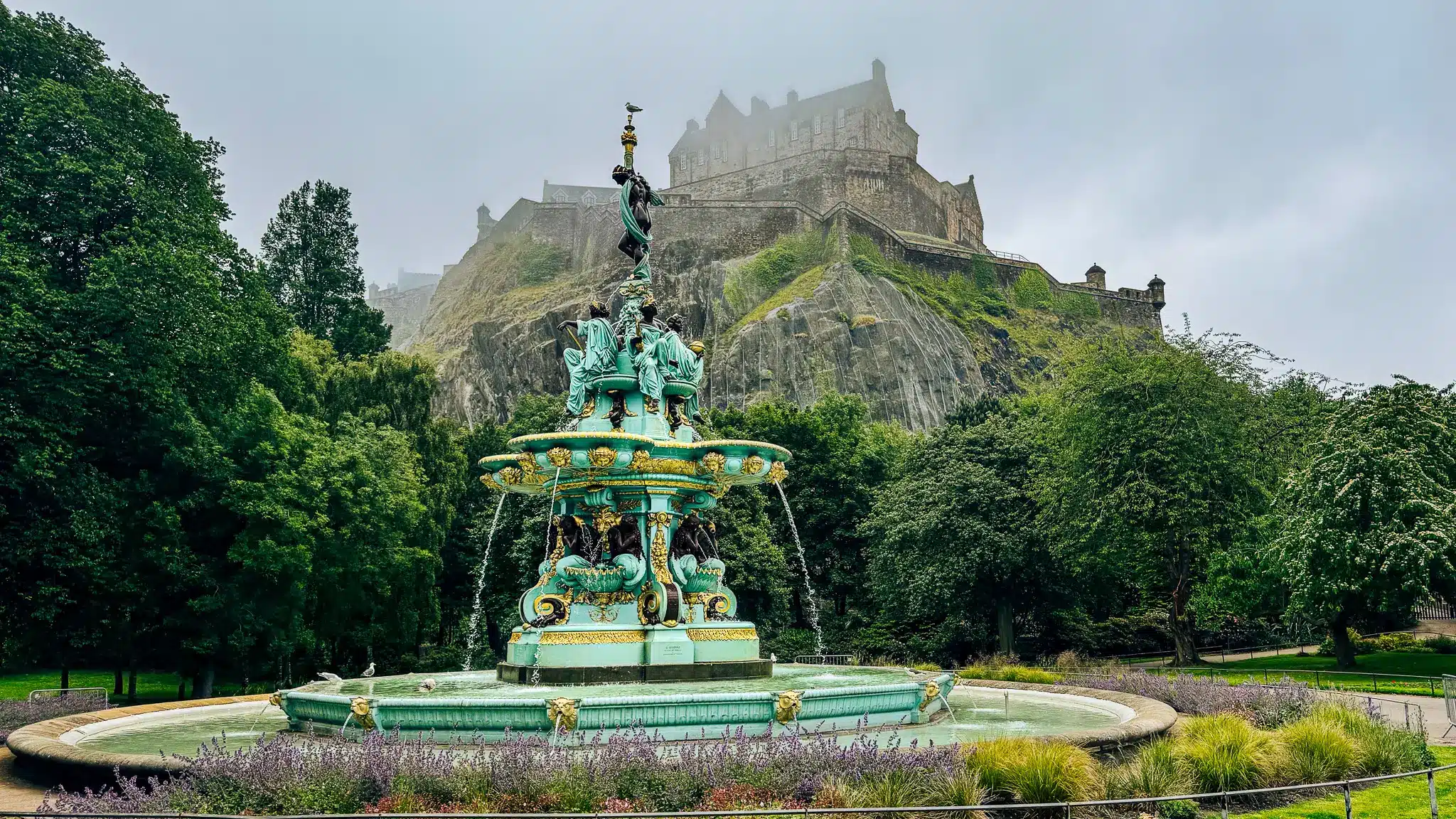
The institutional history adds another layer to what can look, at first glance, like a naturally perfect composition. The Royal Scottish Academy building on The Mound opened in 1828 as the Royal Institution, while the National Gallery building opened to the public in 1859. That means the view many visitors read as timeless is actually built from successive civic decisions: drainage, landscaping, road building, cultural investment, and the steady shaping of the valley into a managed public landscape.
In these frames, people sitting on the grass matter almost as much as the skyline. Edinburgh’s drama works because the monumental is never isolated from the ordinary. Lawns, paths, museum signage and commuter routes all sit beneath church spires and castle rock. The city’s visual identity comes from the fact that its most ceremonial elements are embedded in everyday circulation.
Tram wires and Gothic stone share the same airspace
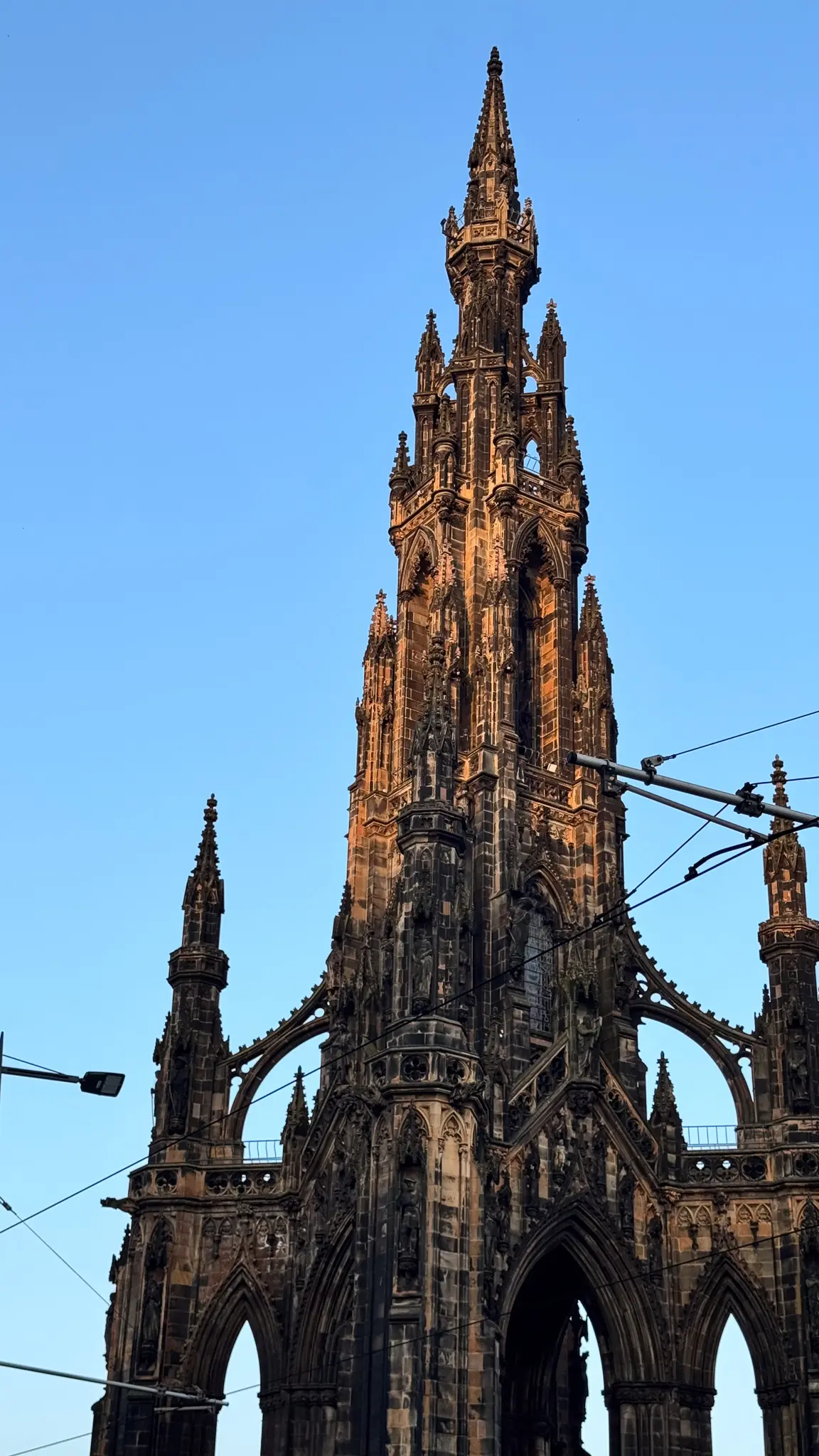
One of the clearest modern signatures in central Edinburgh is overhead tram infrastructure cutting across historic views. In another city, that might feel like visual interference. Here it reads more like an honest annotation. Edinburgh Trams run through the city centre, including Princes Street and St Andrew Square, which means modern transit infrastructure is threaded directly through some of the most protected and reproduced sightlines in Scotland.
That coexistence is not casual. City planning documents explicitly assess the effect of tram infrastructure on townscape, conservation areas and key views in the World Heritage Site. In other words, the wires, poles and alignments are not outside the heritage story; they are part of an ongoing argument about how a historic capital continues to function.
Photographically, the effect is great because it refuses the fantasy of a sealed historic set. A Gothic spire lit by late sun looks different when a cable line slices through the frame. A classical monument and a castle-backed street scene feel more precise when traffic lights, crossings and tram hardware remain visible. Edinburgh is not compelling because it is frozen. It is compelling because its older forms survive in active negotiation with movement, power supply, maintenance and public transport.
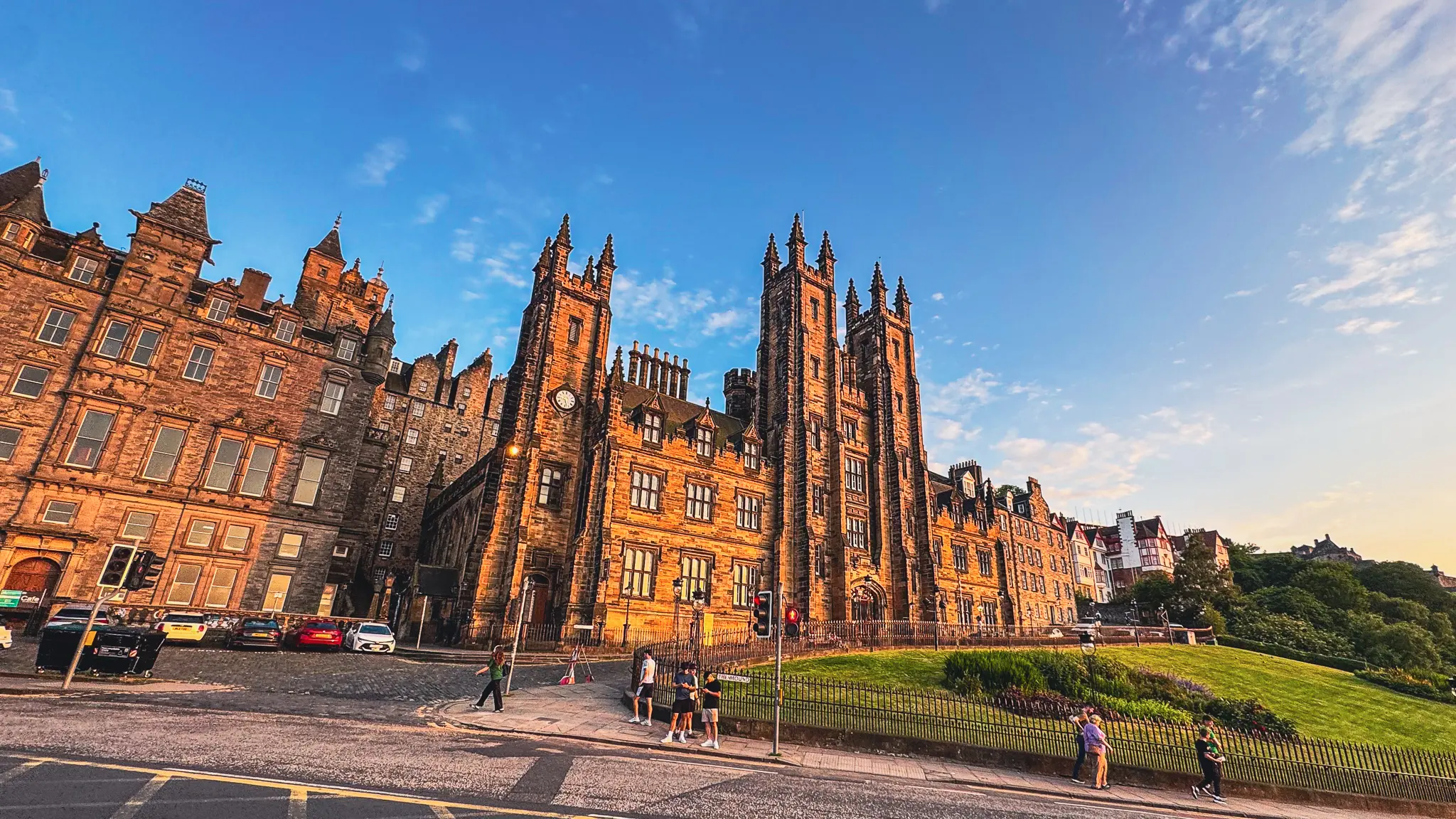
The result is a city whose romance is sharpened by systems. Stone still dominates, but it is now accompanied by catenary wire, signal poles and painted lanes. That mix gives Edinburgh a more interesting visual logic than any purely medieval branding ever could.
West Bow sells Edinburgh through contrast, not purity
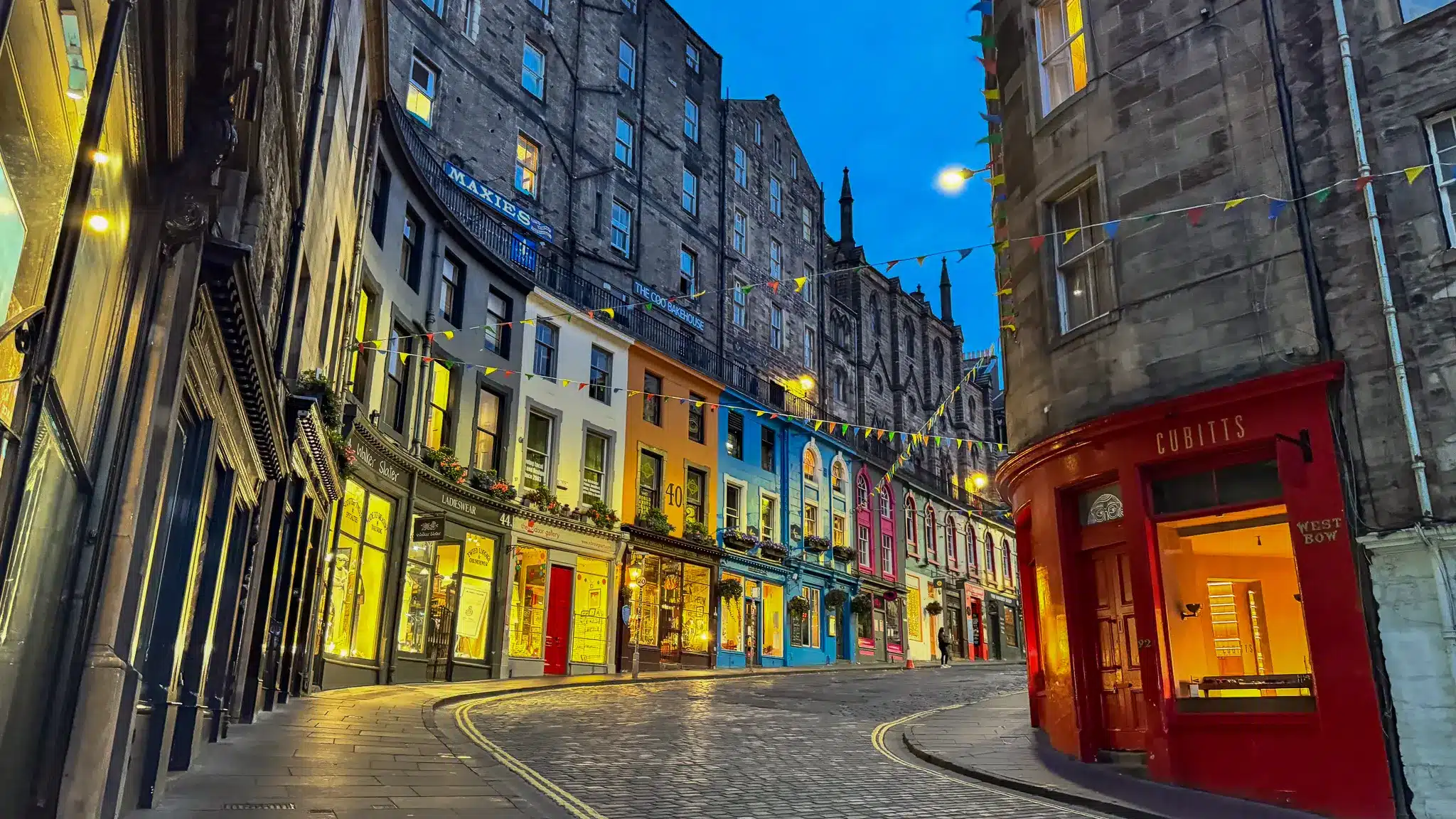
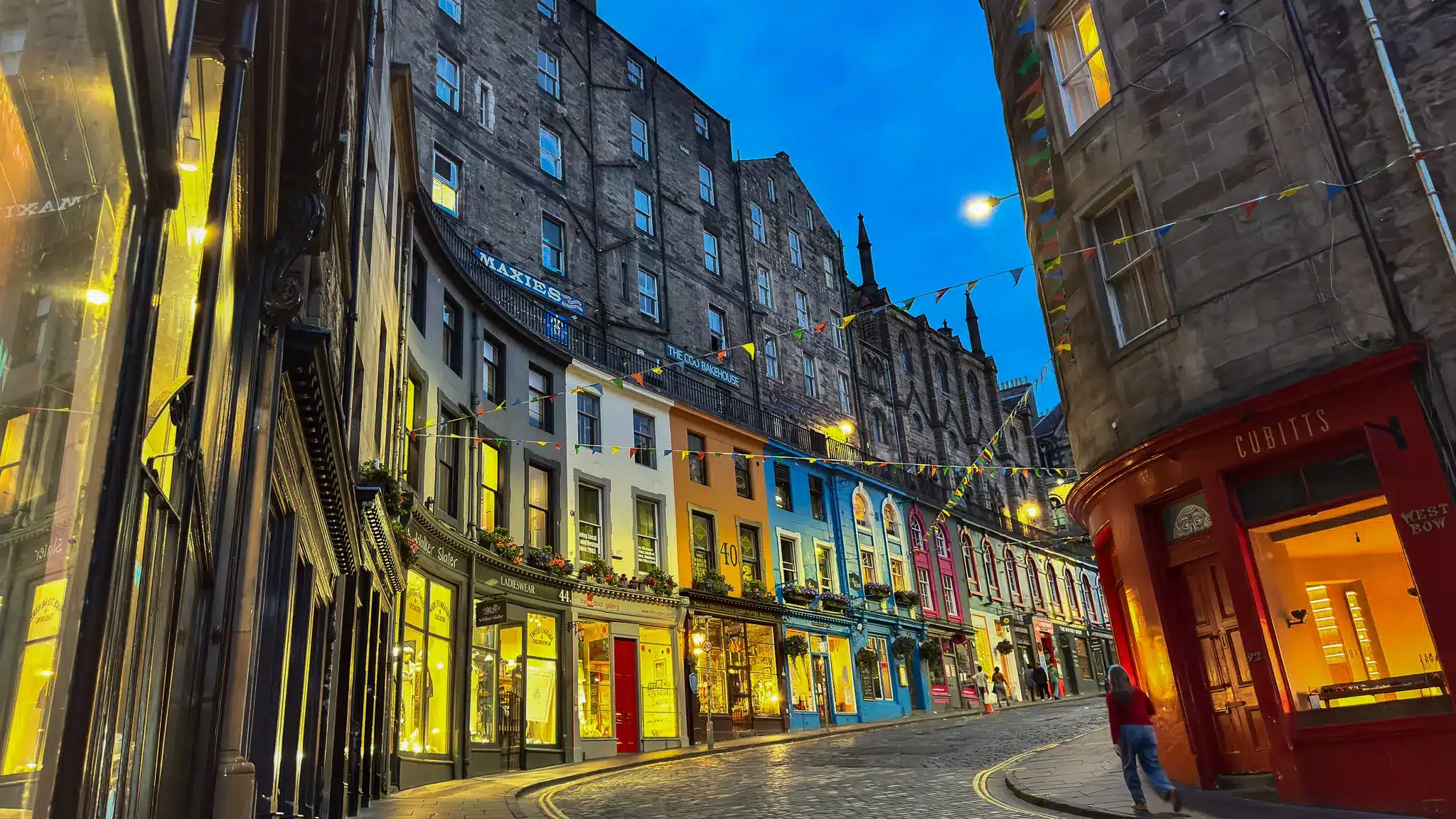
West Bow is one of the best examples of how Edinburgh’s historic image is produced through selective survival and active commercial use. Historic Environment Scotland notes that most of old West Bow was swept away when Victoria Street was built to connect the Grassmarket with George IV Bridge. What remains is not an untouched medieval lane but a fragment within a reconstructed and highly managed streetscape.
That makes the street more interesting, not less. The tension between dark stone tenements above and saturated shopfront colors below is exactly the point. Blue, pink, yellow and red fronts sit under steep façades and tall chimneys, while bunting and boutique signage stretch across a curving roadway marked with unmistakably British double yellow lines. It is a heritage-commercial environment, and it looks like one.
Edinburgh’s conservation rules help explain why this contrast feels controlled rather than chaotic. Changes to shopfronts and advertising in conservation areas can require planning permission or advertisement consent, and the council has actively enforced signage issues on West Bow. So the visual friction between old masonry and contemporary branding is not accidental. It is managed, argued over, and repeatedly adjusted.
That also means the typography matters. Whisky references, optical branding, tailoring signs and street names become part of the city’s texture, as legible as the stonework. West Bow does not project a fantasy of historical purity. It shows how Edinburgh packages and regulates contemporary retail inside a deeply inherited frame, with enough control to preserve character and enough looseness to keep the street alive.
Parliament Square shows how authority is built into the streetscape
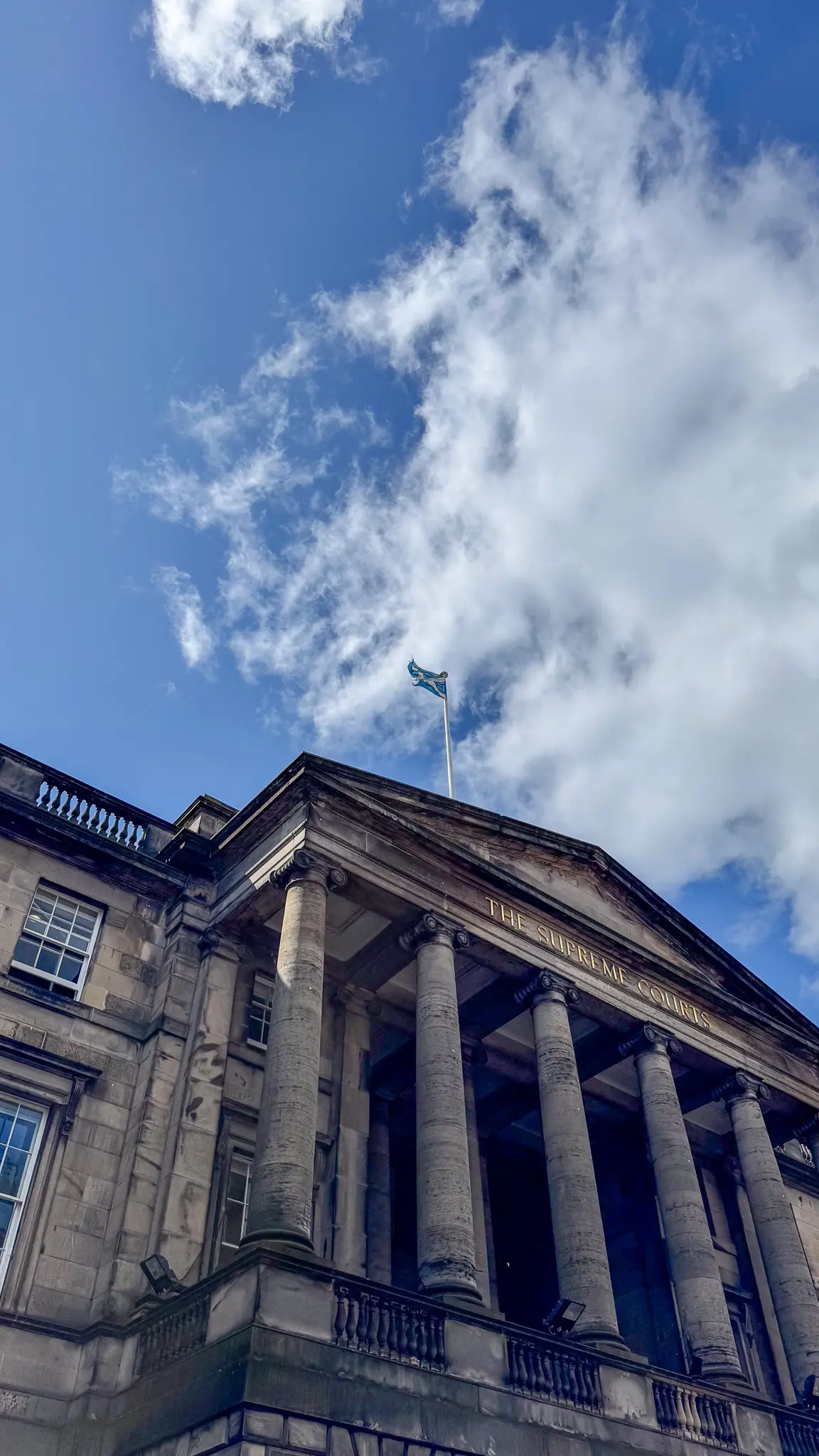
Edinburgh’s density is not only architectural or topographic. It is institutional. Near Parliament Square, the Supreme Courts of Scotland sit within a concentrated legal and civic landscape that Historic Environment Scotland describes as a vital part of a wider suite of law-related buildings in the Old Town. The architecture is classical rather than rugged, but it participates in the same compression that defines the rest of the city.
Gold lettering on a pediment can do a lot of work in Edinburgh. The city often communicates power through restrained graphic cues rather than spectacle: carved stone, iron railings, formal flags, engraved names, a canopy line, a polished plaque. Even when a façade fills the frame, it rarely feels detached from the surrounding urban fabric. Courts, galleries and other civic buildings are woven into ordinary walking routes, tourist circulation and retail streets only a few turns apart.
This matters because Edinburgh’s public image is often flattened into castles and closes. But the city’s character also comes from the adjacency of functions. Judicial authority, cultural institutions, commercial signage and public gardens coexist within a short distance and often within a single frame. The effect is less theme park than compressed capital: ceremonial on the surface, practical at ground level, and always staged by the slope of the land itself.
Photography by Gil DeSaant. Explore more of his photography at gildesaant.com.