
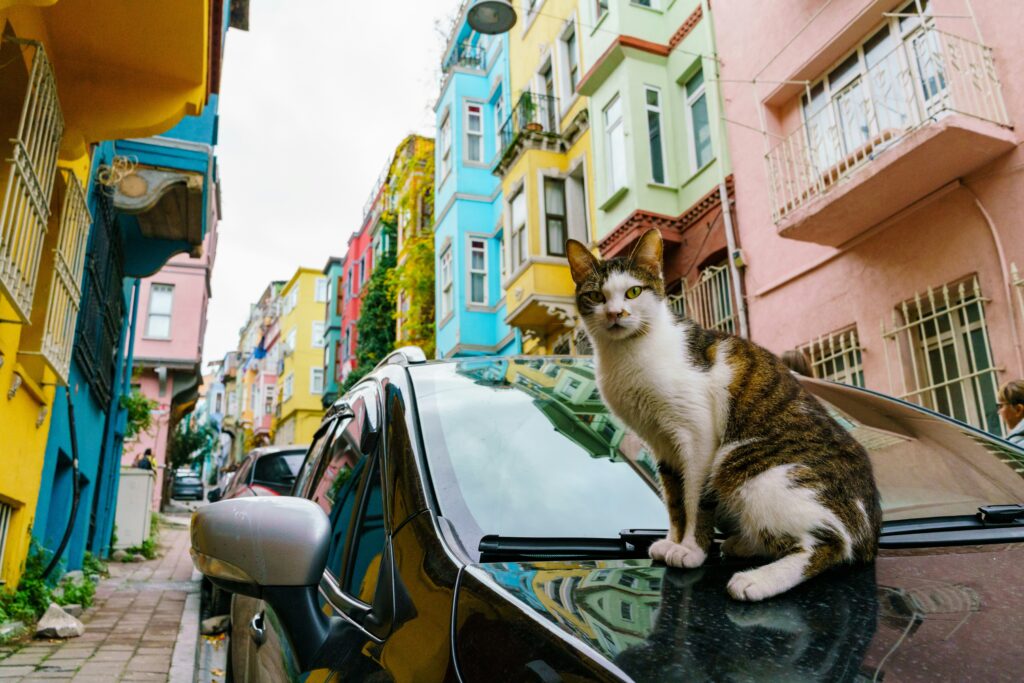
Istanbul’s cats are not a citywide petting zoo. They are free-roaming domestic animals woven into neighborhood life: fed by shopkeepers, watched over by volunteers, treated by municipal veterinarians and, sometimes, left to fall through the gaps. This guide explains the history without the recycled folklore, suggests where to observe the cats naturally and covers how to interact without becoming a nuisance—or creating one.
Community cats, not a single furry population
“Community cats” is the most useful umbrella term for the cats of Istanbul. It covers free-roaming, unowned animals that may be sociable or wary, healthy or sick, sterilized or unsterilized, and regularly cared for or largely on their own. Calling every outdoor cat “feral” is inaccurate; plenty are comfortable around familiar people and businesses. Equally, friendliness does not necessarily mean a cat is lost or available for adoption.
Many occupy a middle ground between conventional pet and urban wildlife. A cat may sleep in an apartment entrance, eat outside a grocery shop and receive veterinary help from a volunteer without having one legally responsible owner. Others are abandoned pets or genuinely unsocialized animals. Collective affection helps, but it does not guarantee food, sterilization or medical treatment.
There is no sufficiently robust figure for how many free-roaming cats live across Istanbul, so be suspicious of neat totals repeated online. The visibility of cats is easier to establish than their number: they are routinely found around residential streets, ferry approaches, markets, bookshops, mosque courtyards and shopfronts.

History, faith and internet folklore
Istanbul’s cat culture has deep roots, but no single origin story adequately explains it. Peer-reviewed historical work describes Ottoman-era residents feeding street animals, charitable foundations or bequests supporting their care, and a profession known as the mancacı, associated with supplying food for street cats and dogs. Anthropologist Kimberly Hart has interpreted modern feeding practices as a form of embodied social memory connected to Ottoman compassion and charity—without suggesting that every person leaving a bowl outside is consciously reenacting history.
Religion forms part of the context, but it is not the whole explanation. An authenticated Islamic tradition describes cats as ritually clean and water from which a cat has drunk as suitable for ablution. That can help explain their acceptance in domestic and religious spaces. It does not mean cats are holy or sacred in Islam.
History, faith or internet folklore?
- Supported: Cats are treated as ritually clean in a well-attested Islamic tradition.
- Supported: Ottoman urban life included organized and charitable feeding of street animals.
- Unsupported: The widely shared claim that the Prophet Muhammad owned a cat named Muezza and cut off his sleeve rather than wake it does not appear in recognized early hadith or historical sources.
- Unproven: Shipboard cats arriving through Istanbul’s port are a plausible part of the city’s history, but there is not enough evidence to make them the primary origin of today’s population.
Neighborhood organization, urban history, individual affection, modern animal activism and municipal services all matter. “People care because Islam likes cats” is tidy, shareable and much too simple.

How Istanbul’s care network works
Care is decentralized. Residents and shopkeepers leave food and water, make simple shelters and keep an eye on familiar animals. Volunteers may organize sterilization or treatment, while private veterinarians and municipal teams provide professional care. The arrangement can work remarkably well for a particular cat on a particular street, but it is not universal coverage.
Istanbul Metropolitan Municipality, known as İBB, says its services for unowned animals include examination, treatment, vaccination, sterilization, identification, registration and adoption work. A sick or injured free-roaming animal can be reported through Alo 153; the case may be handled by İBB or routed to the relevant district municipality. İBB’s current policy says cats not adopted after rehabilitation are normally returned to the area from which they were collected.
That return policy matters because a healthy-looking cat may have established feeding points, caregivers and territory. Visitors should not move one simply because it appears unaccompanied. If an animal is obviously injured or dangerously ill, report it rather than attempting an improvised relocation. If language is a barrier when calling, ask accommodation staff or a nearby business for help communicating the location and condition clearly.
Türkiye amended Animal Protection Law No. 5199 in 2024, changing definitions and increasing municipal shelter and population-control obligations. The most consequential shelter-retention and euthanasia provisions repeatedly refer to dogs, while some broader clauses concern unowned animals generally. Cats should not be described as wholly unaffected, but neither should dog-specific provisions be applied to them indiscriminately. The Constitutional Court rejected challenges to major provisions in May 2025.
None of this makes Istanbul a feline paradise. Abandonment, uncontrolled breeding, infectious disease, traffic injuries and uneven access to veterinary treatment remain part of the picture.
Where to see cats without turning them into attractions
You do not need a cat tour or a list of supposedly guaranteed feline celebrities. Work cats into an ordinary day and let the encounters happen in spaces they already use.
- Cihangir: Apartment entrances, gardens and small businesses make this hilly Beyoğlu neighborhood a strong example of shared urban space. Bowls and shelters belong to local care routines, not a tourist display.
- Kadıköy and Moda: Markets, residential streets, parks and waterfront areas show how cats fit into everyday life on the Asian side. Kadıköy is also associated with Tombili, the reclining cat memorialized by a municipal statue, but its precise current position should be confirmed locally before making a special trip.
- Kuzguncuk and Üsküdar: Residential lanes, local shops and Bosphorus-side spaces offer a quieter setting. Do not enter gardens or obstruct narrow pavements while following a cat.
- Balat and Fener: Cats often settle around shopfronts, but this area already receives heavy photography-focused tourism. Doorways are not studios, and shop cats are not contracted performers.
- Beyazıt’s Sahaflar Bazaar and the Grand Bazaar: Cats have established routines among booksellers and long-running businesses. Ask before photographing inside a shop and never block an animal’s exit route.
- Mosque courtyards and public gardens: Cats commonly share these spaces, but visitor and worship rules come first. Hagia Sophia’s famous cat Gli died in 2020; do not expect a successor or treat any resident animal as an attraction.
For a cat-themed indoor stop, the private Cat Museum Istanbul in Galata currently advertises admission at 200 TL, Monday-to-Saturday opening and Sunday closure. The separate Beşiktaş Municipality Kedi Müzesi currently lists free weekday entry. Recheck prices and hours before visiting. Both are object-based cultural attractions, not shelters, cat cafés or guaranteed live-animal encounters.

Istanbul cat etiquette: observe first, touch second
Let the cat choose whether an interaction happens. A relaxed animal may approach, rub against a leg or accept gentle contact. A cat that backs away, flattens its ears, lashes its tail or retreats under furniture has already answered.
- Do not lift, corner or wake a cat for a photograph.
- Give mothers and kittens extra space.
- Keep food and camera equipment away from escape routes.
- Ask before touching or photographing a cat inside a business.
- In mosques, follow site rules and keep photography secondary to worship.
- Do not use flash close to an animal’s face.
- Never move an apparently healthy cat from its neighborhood.
Feeding is not automatically helpful. A regular caregiver may be managing medication, diet or sterilization, and piles of leftovers attract insects and create conflict. Check for an established bowl or ask a nearby shopkeeper before adding food.
If feeding is appropriate, offer a small amount of commercial cat food at an existing feeding point. Put out clean, fresh water and remove packaging and leftovers after roughly 30 minutes. In Istanbul’s summer heat, water may be more useful than another rich meal.
Do not give milk: many adult cats cannot digest lactose. Avoid seasoned restaurant scraps, onion, garlic, chocolate and cooked bones. Even plain chicken should be cooked, unseasoned and boneless.
Season changes the practical needs. During wet or cold weather, do not pull cats from boxes, doorways or other shelters for a clearer picture. İBB advises drivers to tap the hood before starting a vehicle in cold conditions because cats may shelter near engines or beneath cars. In hot weather, leave shaded animals alone and avoid moving them into direct sun.
How visitors can help without playing rescuer
For an injured or visibly sick animal, note the precise location, take a clear reference photograph if it can be done without pursuit, and call Alo 153. Traffic trauma, inability to stand, serious bleeding or severe breathing difficulty requires municipal or veterinary help, not food and hopeful improvisation.
For financial or material support, use organizations with an official presence, current contact information and transparent requests. İBB publishes a Volunteer Support Line at 0212 453 73 73, currently listed as operating weekdays from 09:00 to 17:00, for questions about donating food, medical equipment or money. Its SemtPati platform advertises animals available for adoption through municipal facilities.
Established organizations include HAYTAP and the Turkish Society for the Protection of Animals. Before supporting any smaller social-media campaign, check recent activity, organizational status where applicable, veterinary invoices and whether payment can go directly to a clinic. Popularity is not financial transparency.
Do not impulsively “rescue” a friendly cat for international adoption. It may have established caregivers, and cross-border adoption requires veterinary, identification and import procedures. Supporting sterilization and medical treatment is usually more useful than removing a healthy neighborhood cat.

What to do after a bite or scratch
Do not dismiss a small wound. Türkiye has rabies risk, and a skin-breaking scratch or bite needs immediate care even if it does not bleed heavily.
- Wash the wound immediately with soap and running water for at least 15 minutes.
- Seek prompt medical assessment for rabies, tetanus and bacterial-infection risk.
- Follow the clinician’s advice on post-exposure vaccination and further treatment.
Istanbul’s health authorities state that designated hospitals provide rabies vaccination around the clock, though current hospital arrangements should be checked locally. Do not wait for symptoms or rely on the cat appearing healthy.
The best way to understand Istanbul cat culture is to stop treating the cats as collectibles. Notice who refills the water, which shop leaves a sleeping corner undisturbed and how an animal moves through territory shared with people. Observe on the cat’s terms, feed only when it fits an existing care routine, and use municipal or verified welfare channels when help is genuinely needed. The result is a more honest encounter with Istanbul—and a less intrusive one for the animals that live there.

