Dresden often gets framed through its domes, towers, and the heavy symbolic freight of destruction and rebuilding. That story is real, but this set points somewhere more specific. Again and again, the eye lands on yellow trams, overhead wires, platforms, and destination boards sharing the frame with ceremonial-looking architecture. The effect is less old-master postcard, more operating system.
What stands out is not simply that public transport exists near historic buildings. Plenty of European cities can claim that. In Dresden, the tram network appears visually inseparable from the center’s public image. DVB itself leans into that reading, describing its yellow trams and buses as part of the cityscape like the Frauenkirche or the Elbe. That sounds like marketing copy until you see how often the network asserts itself in the middle of the monumental core.
This matters because central Dresden is not an untouched relic. Parts of its best-known streetscape are restored, rebuilt, or reconstructed after wartime destruction, with the Frauenkirche as the clearest example and the wider Neumarkt area shaped by decades of debate over how history should be reassembled. In that context, the tram is not a visual intrusion into heritage. It is one of the things that makes the center function as a city instead of a set.
The yellow tram is as legible as the skyline
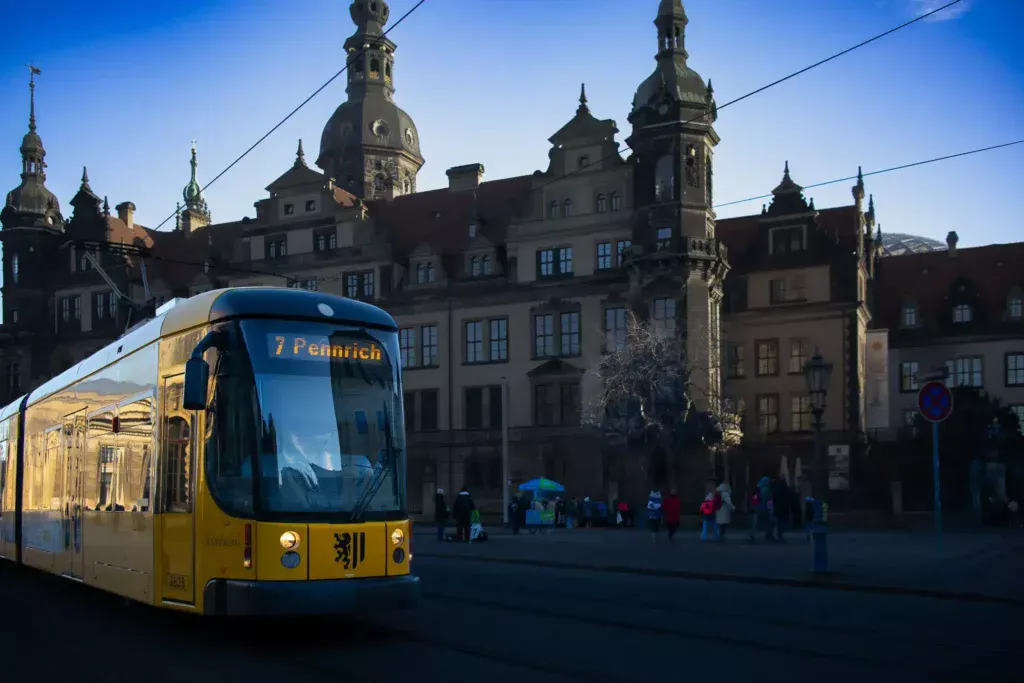
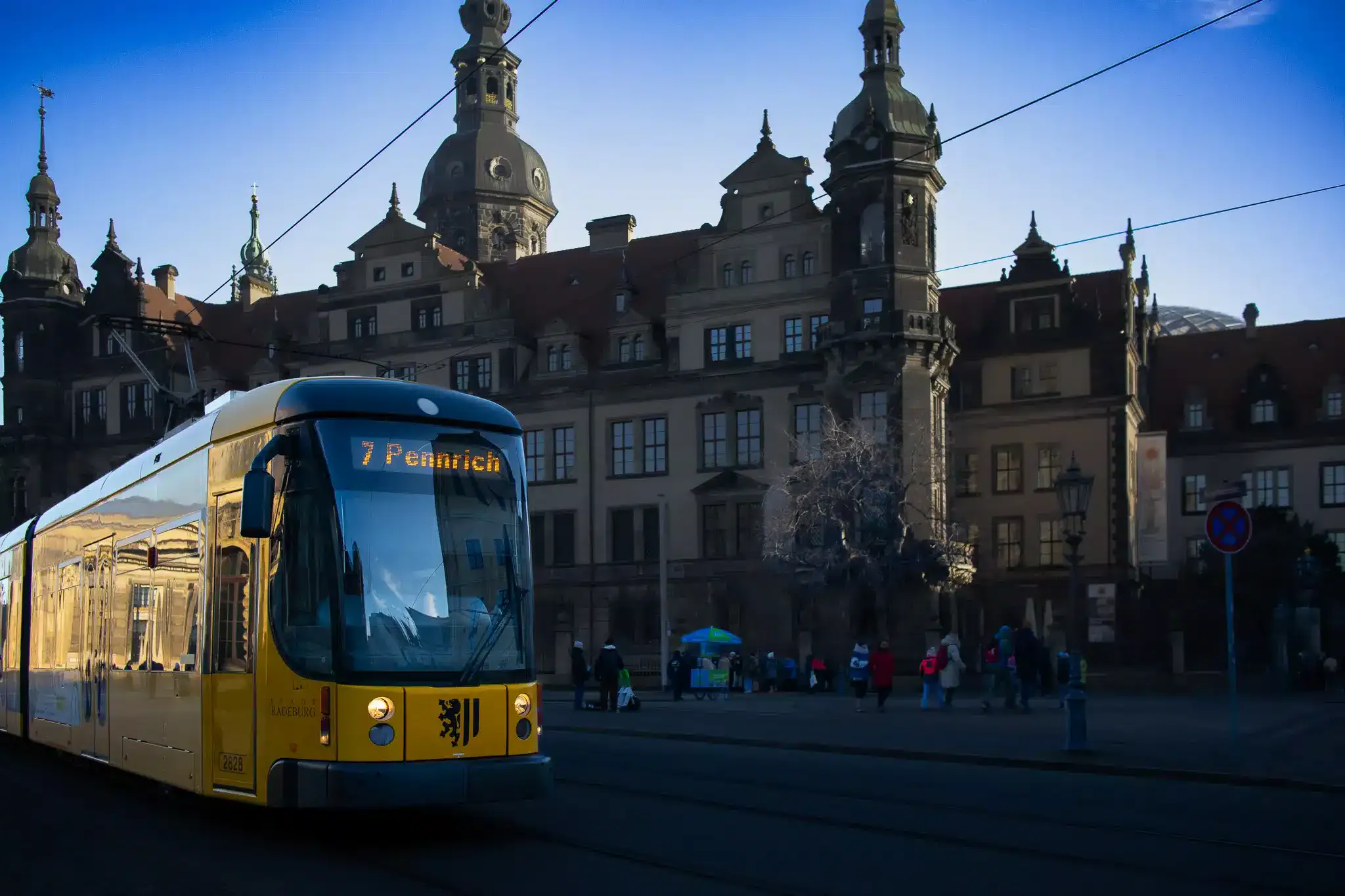
The most consistent visual motif here is simple: Dresden’s yellow trams keep pulling equal focus with the architecture. A route display reading Messe Dresden. Another tram marked Pennrich, another Radeburg, another Tolkevitz on a wrapped car. DVB logos surface in the same field of vision as domes, dormers, towers, and sculpted facades. You do not have to know the network in detail to understand what the photographs are saying. Movement through the center is organized, branded, and highly visible.
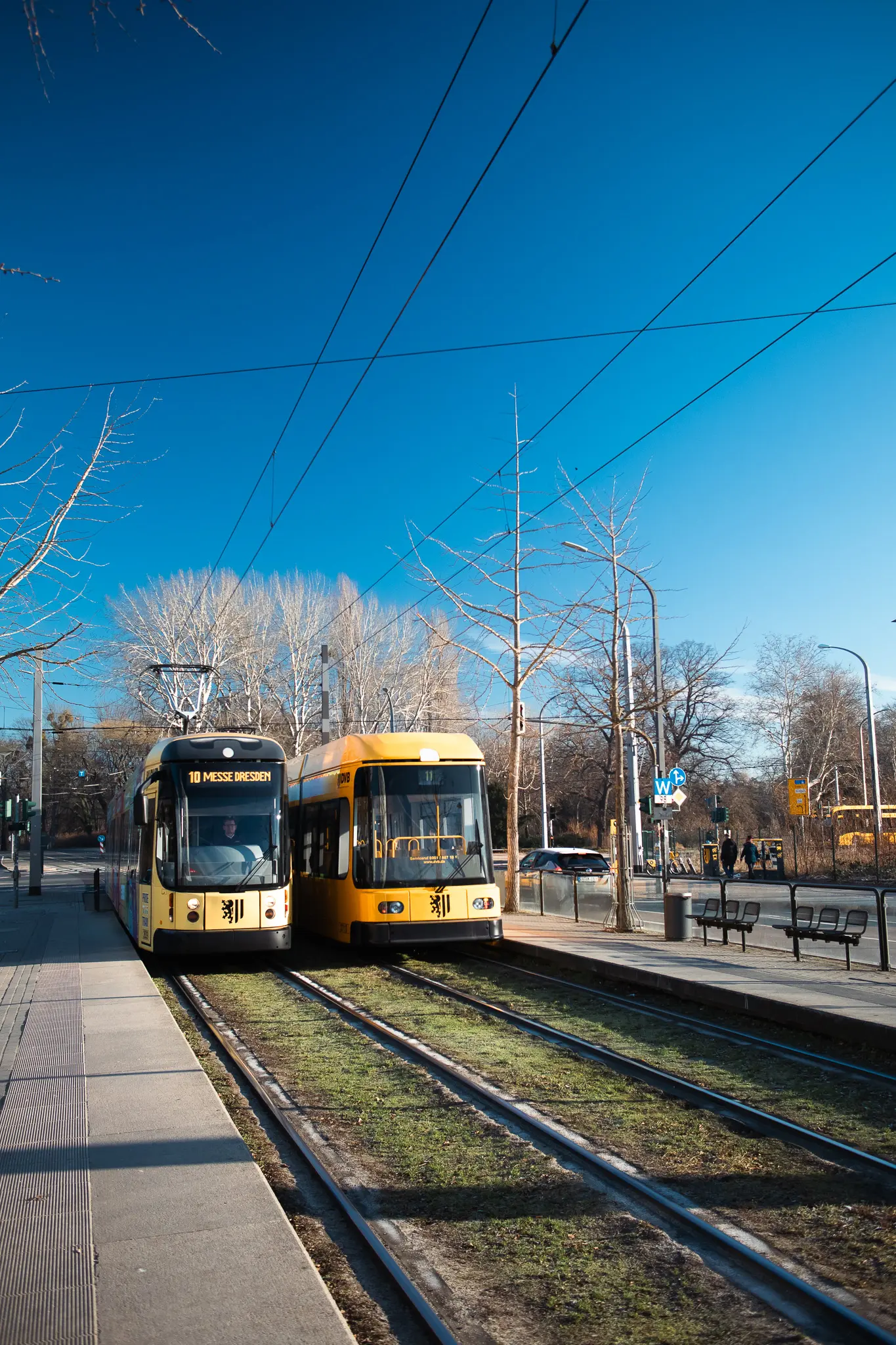
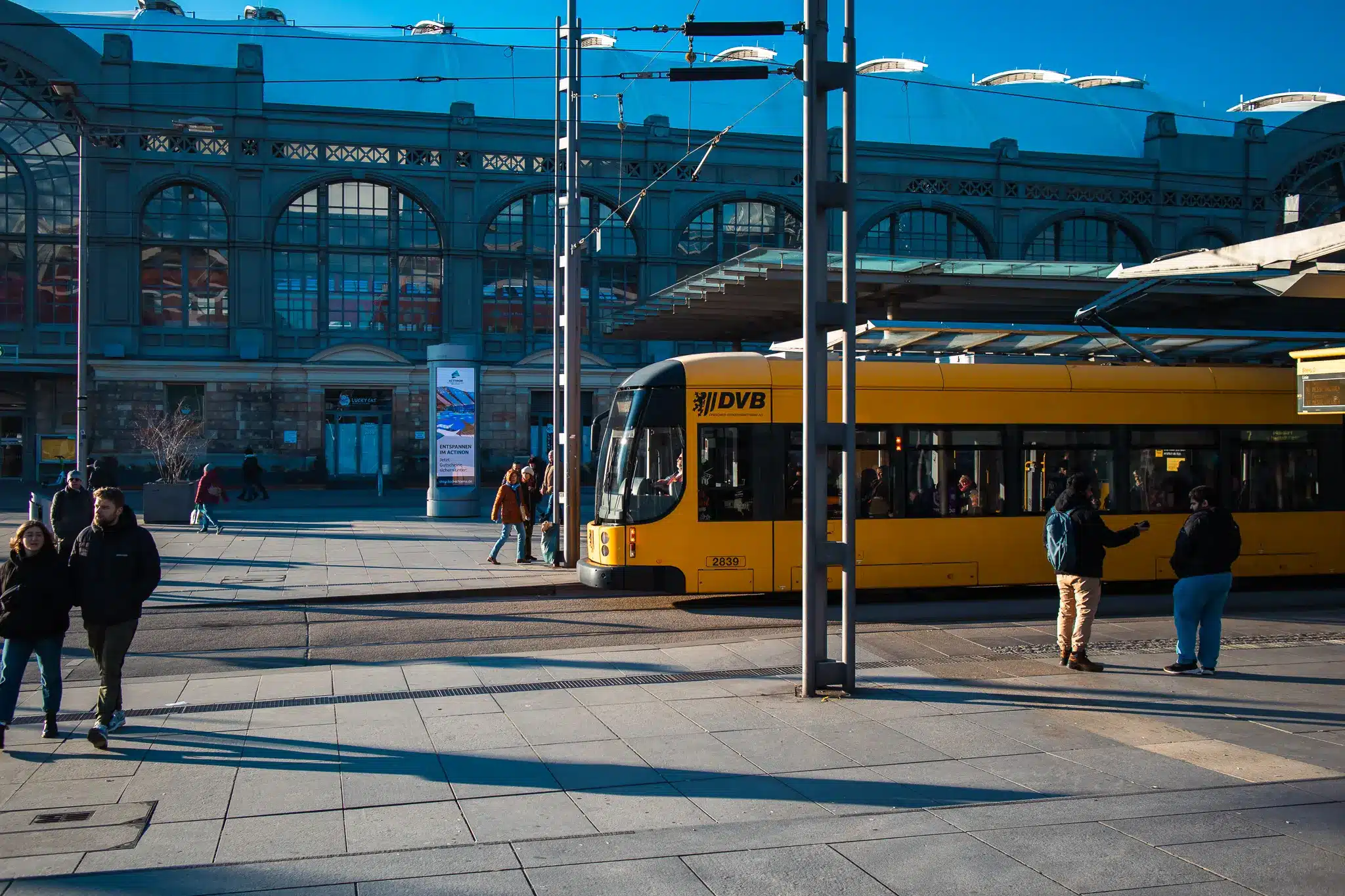
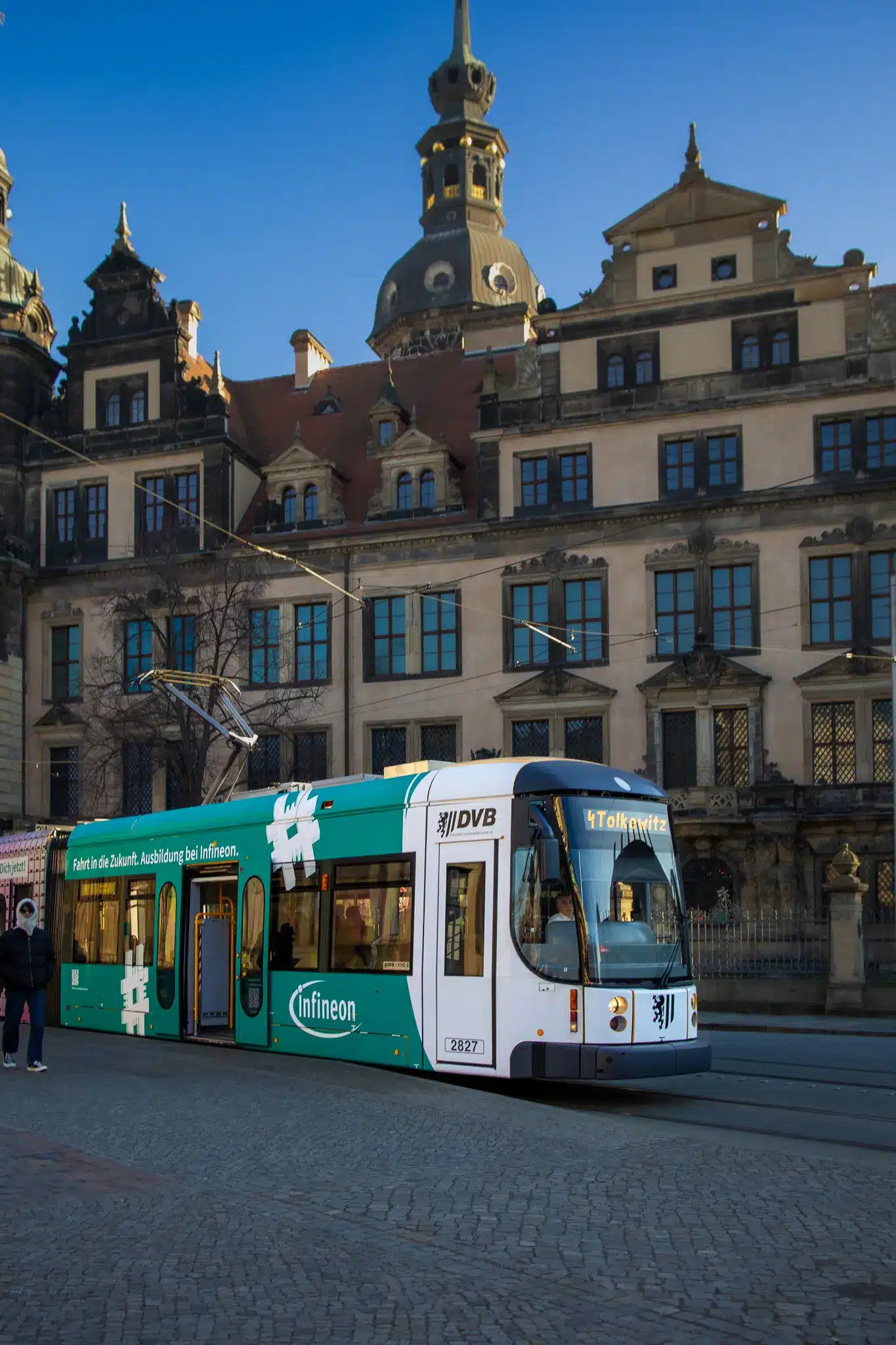
DVB’s own numbers back up that reading. The company reports a dense citywide system with 194 low-floor trams, 767 stops, and roughly 183.7 million passengers annually in 2024. This is not boutique mobility for visitors drifting between landmarks. It is heavy-use urban infrastructure. Official route overviews also show multiple lines crossing the inner city through major central stops, confirming that the historic core is a through-space for regular service rather than a transit-free display case.
There is a design lesson in that yellow, too. Public transport in many cities fades into neutral tones, as if infrastructure should apologize for itself. Dresden does the opposite. The yellow fleet reads clearly in winter light, against pale stone, under cobalt sky. Even when a tram is wrapped with corporate advertising, the baseline identity remains strong enough to register as civic rather than incidental. The color behaves almost like wayfinding at city scale.
Monumentality survives because ordinary circulation never stops
Several frames pair platforms, catenary lines, rails, shelters, and waiting passengers with facades that look built for dynasties, courts, or state ceremony. That juxtaposition is the article. Not conflict between old and new, but dependence. The grand architecture gains credibility by being used around, approached, crossed, and passed every day. The trams, meanwhile, gain a strange theatrical backdrop that keeps routine movement from feeling visually anonymous.
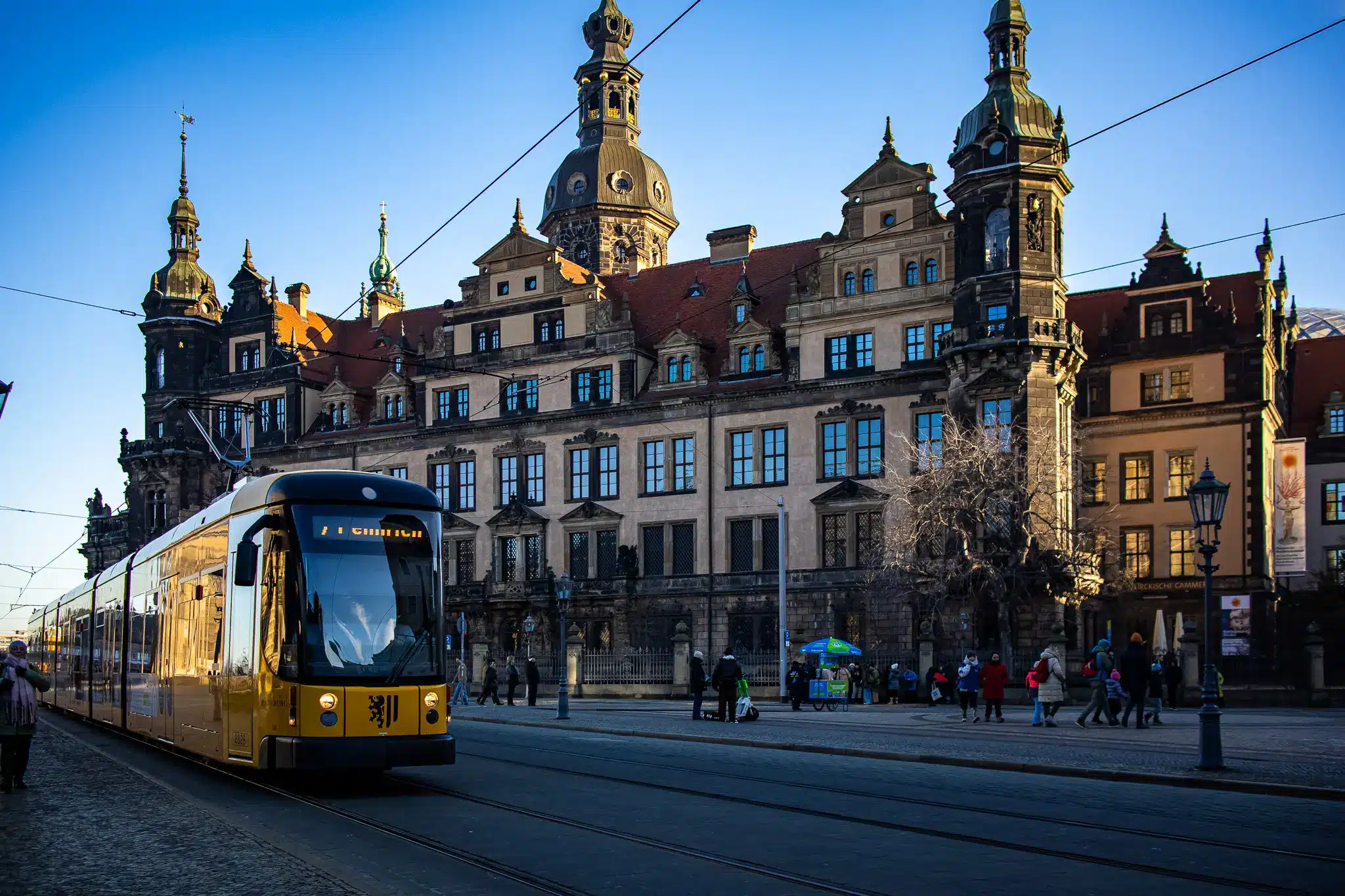
Dresden’s mobility planning supports this reading in at least one especially telling location. City material on Augustusbrücke makes clear that the bridge was rebuilt for trams, cycling, and pedestrians, and not returned to private motor traffic. The Neustädter Markt stop on the bridge ramp is part of that arrangement. In other words, a major heritage setting was deliberately configured around public movement, not sealed off from it. That choice says a lot about the city’s priorities. Historic scenery is not being protected from transit; transit is part of how the scenery is inhabited.
Even the winter cues in the set work this way. Seasonal lights, market-style wooden structures, and bundled pedestrians do not override the transport logic of the center. They sit on top of it. Official winter materials from Dresden still explain central event areas in terms of tram access, which feels completely consistent with these images. Temporary festivity modulates circulation, but it does not replace it.
Dresden’s old-town image is partly reconstructed, which makes the transit honesty more interesting
There is a temptation, especially in German city centers with this much stonework and skyline drama, to talk as if the place has simply persisted intact. That would flatten Dresden into myth. The Frauenkirche was nearly destroyed in World War II, left in ruins for around half a century, and rebuilt beginning in 1994, with exterior and interior completed in the 2000s. Around Neumarkt, reconstruction since the 1990s has involved arguments over authenticity, memory, and how closely new building should follow lost forms.
That history changes the meaning of these tram scenes. The wires, platforms, glass shelters, ad wraps, and route displays do not contaminate a pure historic environment. They expose the fact that central Dresden is a made and remade urban stage where continuity has been actively produced. The city is not pretending to be frozen. It is showing its seams, sometimes elegantly, sometimes bluntly.
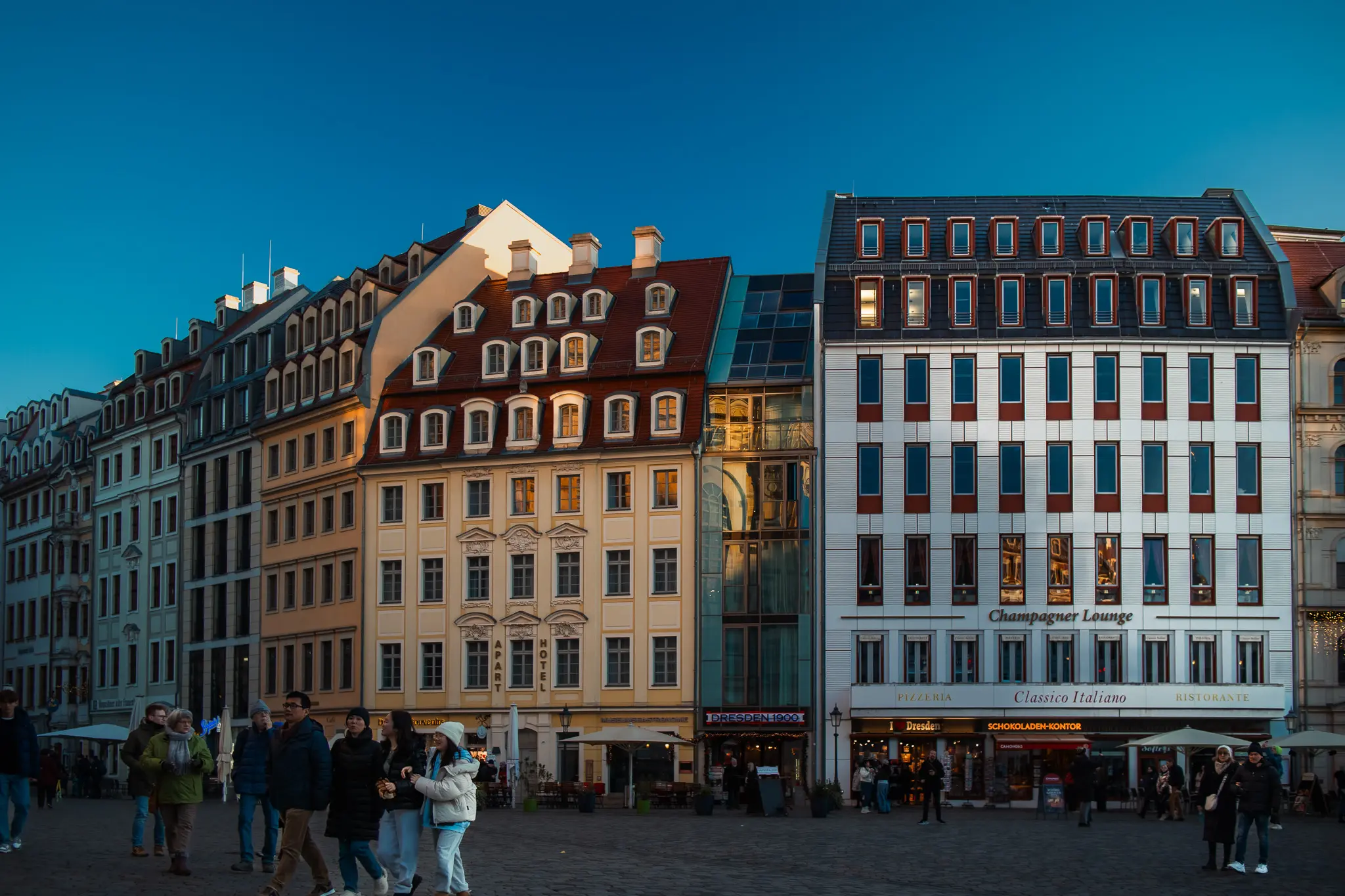
For a 90s kid eye, there is something almost post-production about it all: a rebuilt skyline, branded rolling stock, chain-hotel edges, vendor carts, souvenir kiosks, and public squares that can hold both civic grandeur and retail pragmatism without collapsing. The honesty is not in historical purity. It is in the coexistence.
Street language keeps the center from drifting into museum mode
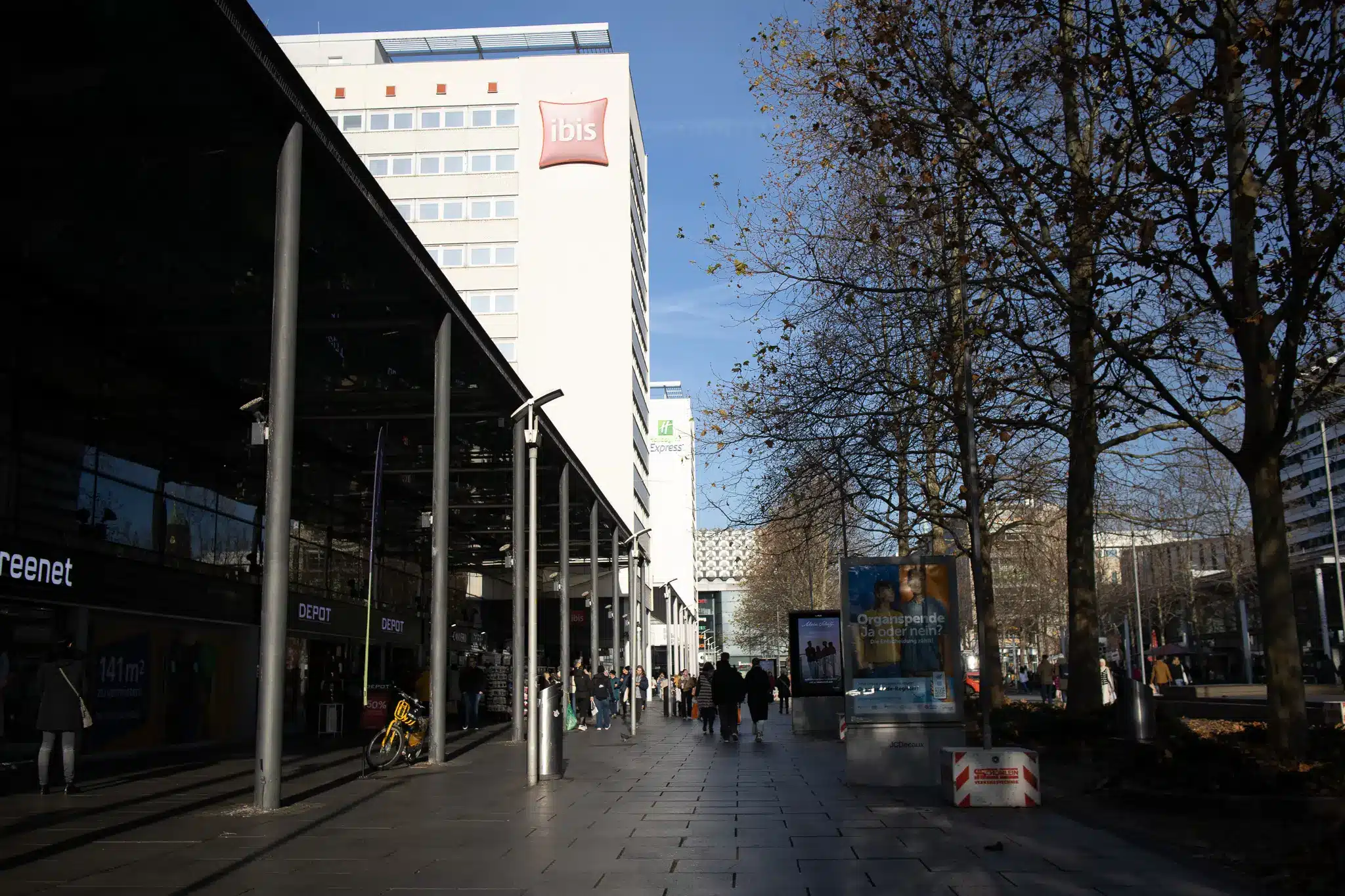
One of the smartest threads in the set is typographic. Dampfer fahren! LAS TAPAS. Schokoladen-Kontor. Dresden 1900. Deutsche Bahn ad copy. Infineon recruiting on a tram. Berufswappen on a gift kiosk promising profession-themed heraldic humor. ibis and Holiday Inn Express turning up at the commercial edge. None of this is glamorous, and that is exactly why it matters.
These words anchor the center in present-tense use. They remind you that heritage districts are also places where people transfer, buy snacks, sell novelty gifts, check into standardized hotels, wait under shelters, and navigate a thick layer of public information. Even the wrapped tram advertising fits this logic. DVB explicitly sells vehicle exteriors as high-visibility media across the city, so branding on the fleet is not visual noise so much as part of how the network participates in the urban economy.
The result is a center that resists being reduced to cultural prestige. Monumental buildings may dominate the skyline, especially in the many upward-looking frames, but the city at ground level speaks in transit abbreviations, commerce, and practical signage. That everyday language keeps the architecture from floating off into abstraction.
A few soap bubbles are enough to puncture the solemnity
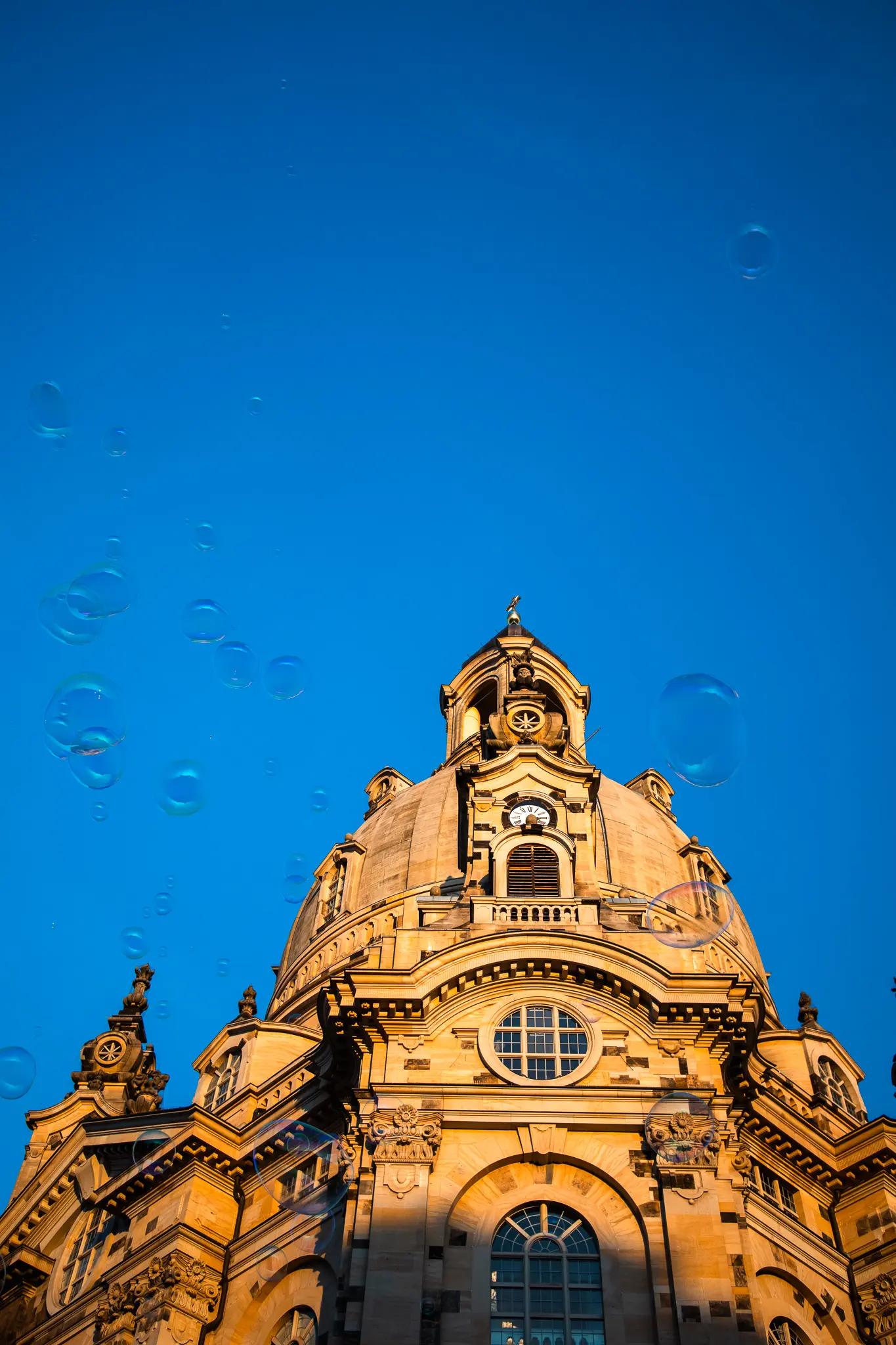
Across several upward-looking frames, soap bubbles drift past domes, clock faces, and elaborate stonework. They are a small detail, but they do a lot of work. Dresden can carry a certain weight in the imagination: court culture, bombing, reconstruction, canonical architecture, serious music, serious art, serious memory. Bubbles cut through that with a temporary, almost throwaway form of public life.
They also sharpen the photographic argument. Much of the set looks up rather than across, emphasizing height, ornament, and sky. Into that composed monumentality comes something totally unstable: iridescent circles that catch light for a second and disappear. If the trams are the system, the bubbles are the glitch. Both make the city feel lived in.
That may be the strongest takeaway from these images. Dresden’s center is not compelling because it presents a complete illusion of the past. It is compelling because ordinary movement keeps interrupting grandeur. The yellow trams do it structurally. The kiosks and hotel signs do it commercially. The bubbles do it playfully. Together they reveal a city where spectacle is still on duty, but so is the timetable.
Photography by Gil DeSaant. Explore more of his photography at gildesaant.com.