The Canon EOS M200 is still a pleasant travel camera in 2026 if you already own one, find a clean used example at a sensible price and mainly care about small size and still photos. After carrying mine in New York and Prague, I still like the files and the way the camera disappears into a small bag. I would not treat it as the obvious choice for someone starting a new system today: it is a 2019 body with an older lens mount, no viewfinder and a few video and handling compromises that newer cameras solve better.
| Best for | Main strengths | Main limitations |
|---|---|---|
| Travel stills, street details, food and casual portraits | Small body, 24.1 MP APS-C sensor, good color, flip-up touchscreen | No electronic viewfinder, limited physical controls |
| People who already own EF-M lenses | Light kit and familiar Canon menus | Older system with fewer future upgrade paths |
| Careful used buyers | Capable image quality in a genuinely compact package | Battery condition and lens choice matter |
| Occasional clips and simple travel video | Full HD is easy to use; screen flips forward | 4K and audio options are less flexible than current creator cameras |
Canon M200 review: the short verdict
The M200 works best as a small stills camera that can come along when a larger body would stay in the hotel. Its 24.1-megapixel APS-C sensor gives more room to edit than a phone, the touchscreen is approachable and the body weighs about 299 grams with a battery and memory card. Those numbers come from Canon’s current EOS M200 product specifications.
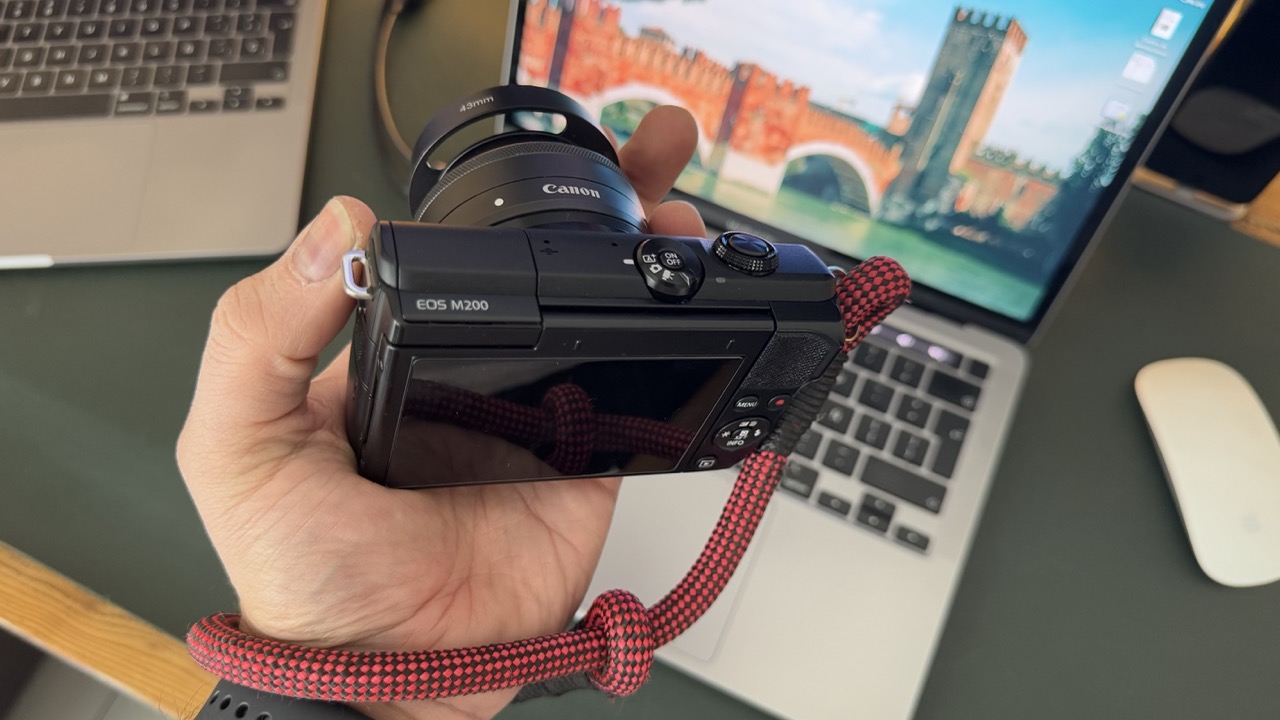
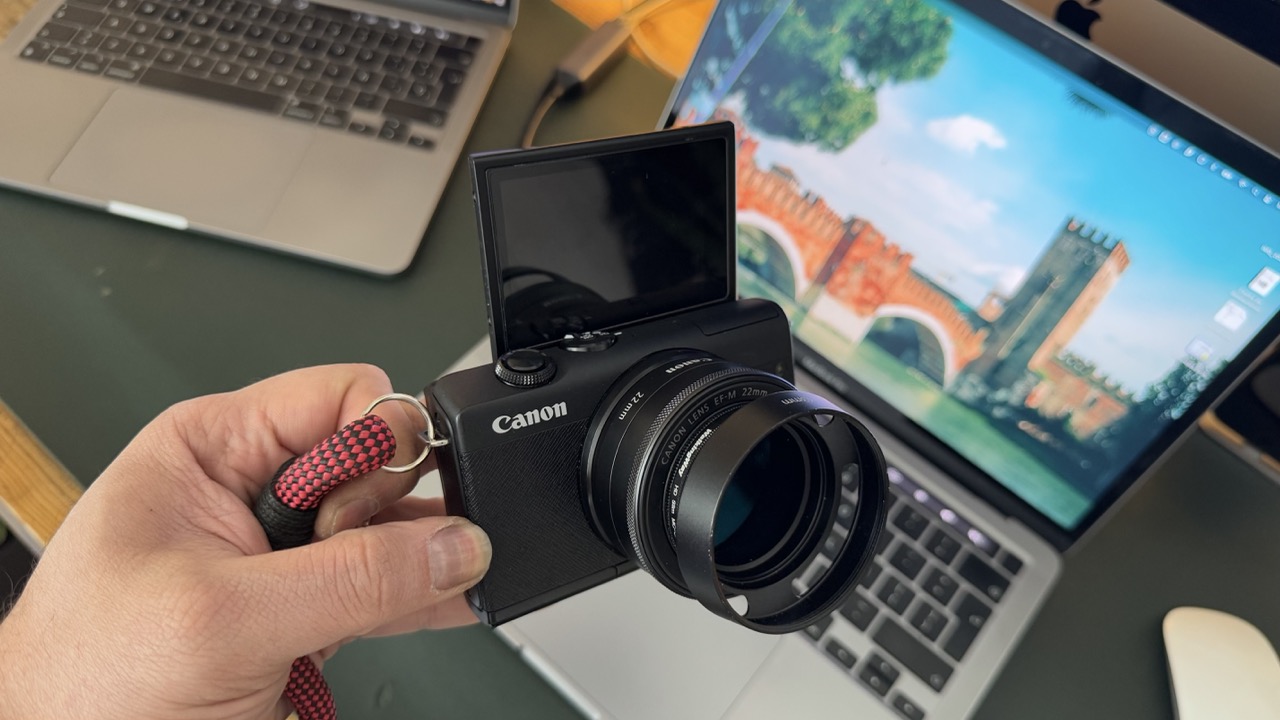
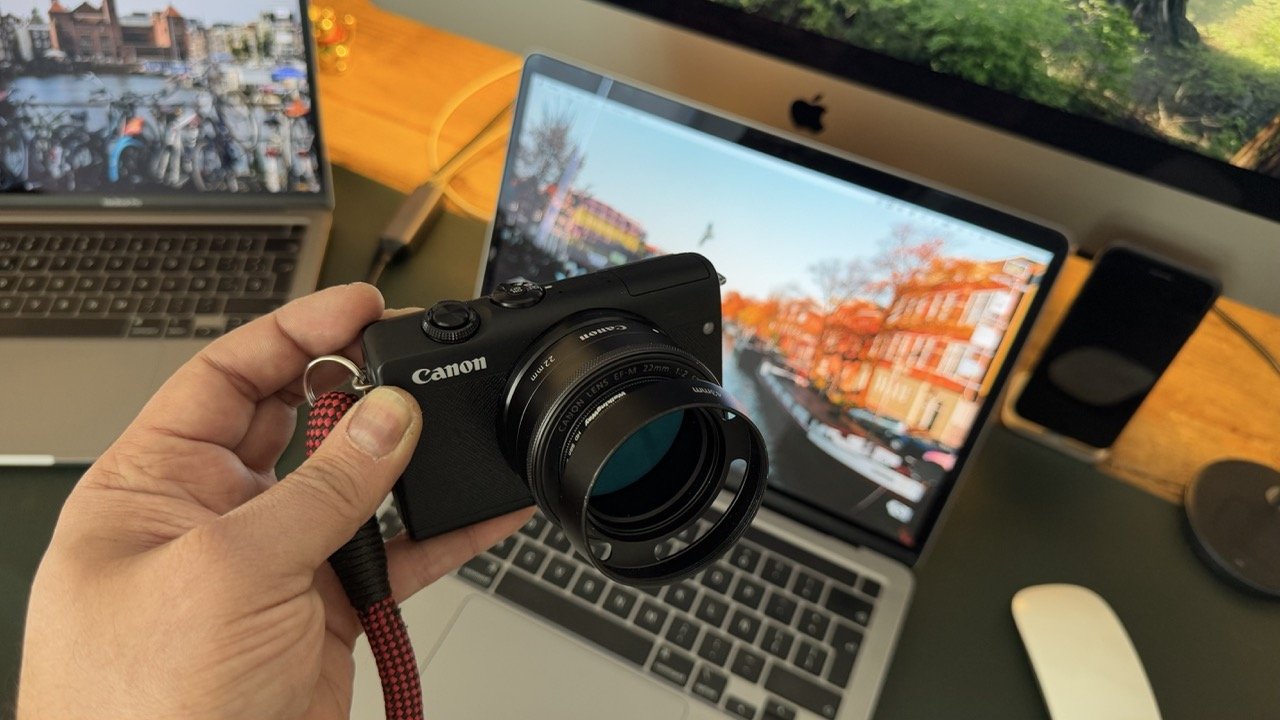
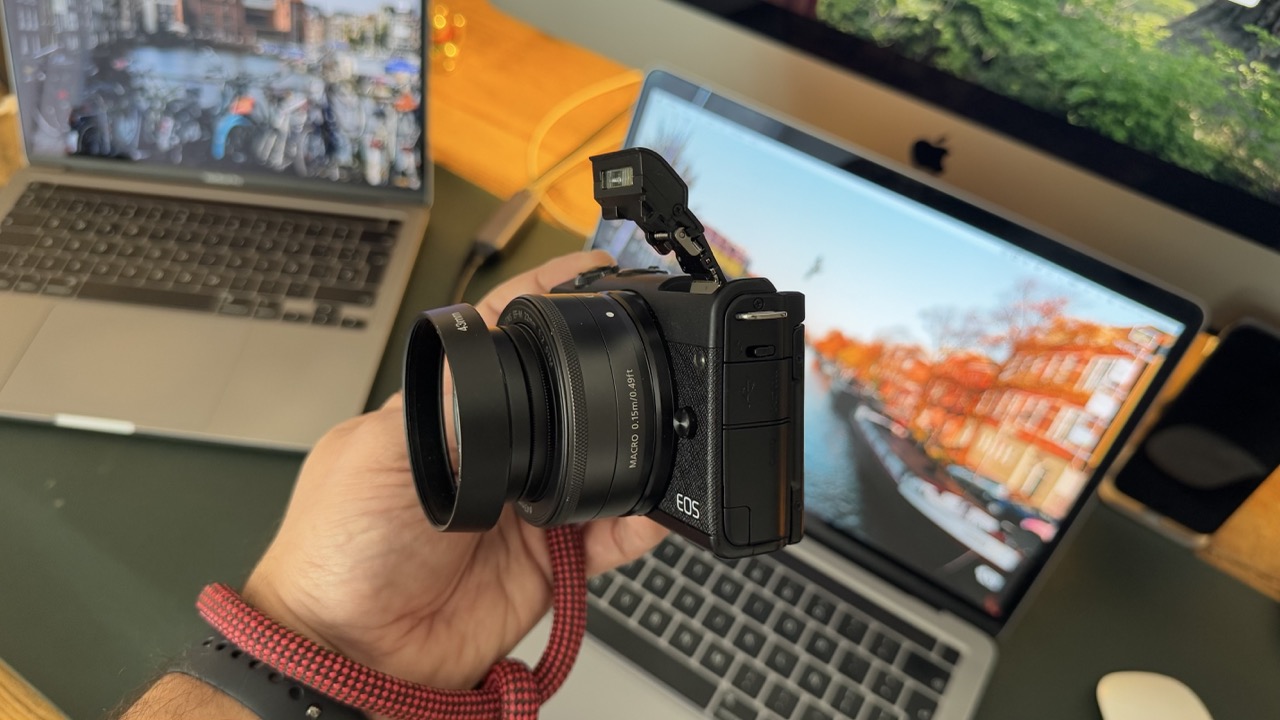
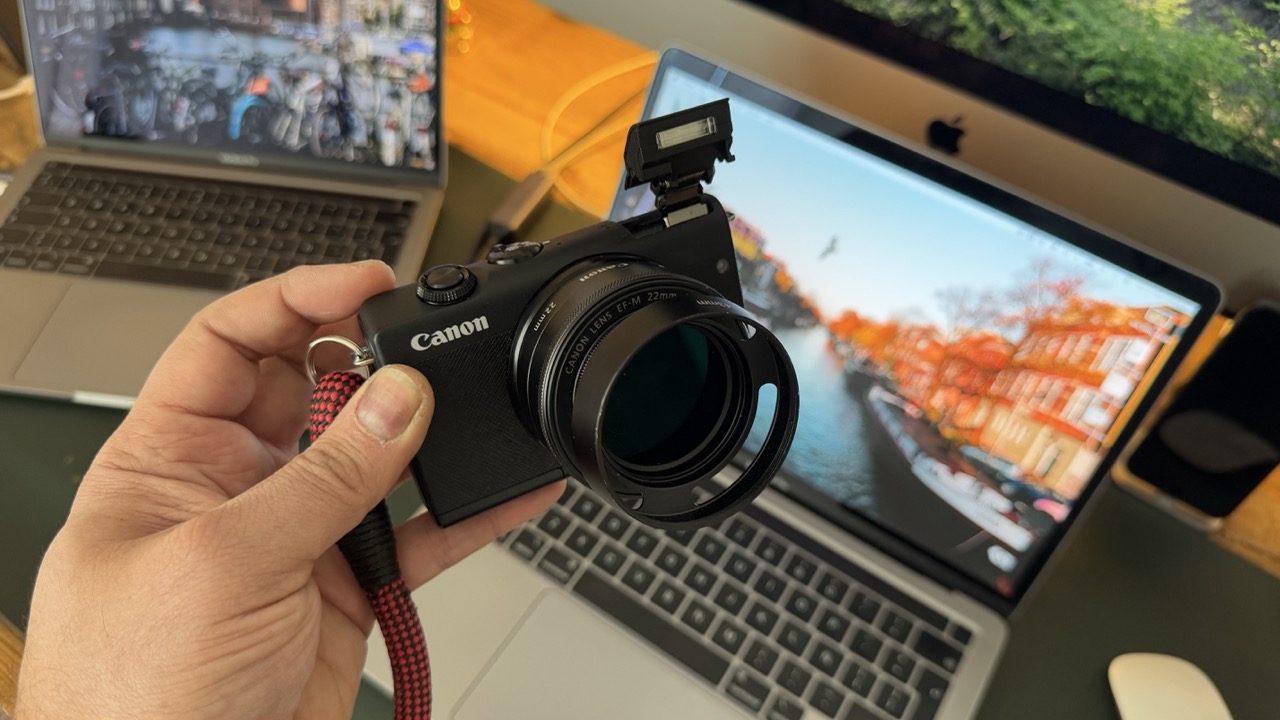
The important qualifier is that portability depends on the lens. A small prime or the collapsible EF-M 15–45mm kit zoom keeps the package compact. A large adapted EF or EF-S lens removes much of the reason to choose this body. My preferred setup uses the compact 27mm prime shown in these photographs. On Canon’s 1.6× APS-C format, its angle of view is similar to roughly 43mm on full frame: natural for street scenes, food, details and environmental portraits, but not wide enough for every interior or dramatic landscape.
What the Canon M200 still does well for travel
It is small enough to carry without planning around it
The best travel-camera feature is availability. The M200 body is approximately 108 × 67 × 35 mm, so a small-lens kit fits in places where a full-size camera and zoom would become a separate piece of luggage. In New York, I initially struggled with the unfamiliar controls after using Sony and Fujifilm bodies. In Prague, the size made more sense: I could carry it all day, pull it out quickly and put it away without reorganizing my bag.
That low-friction experience matters for the type of street observation behind photo essays such as Prague as a City of Layered Facades. A technically superior camera is not useful if its weight persuades you to leave it behind.
The sensor remains capable
The 24.1 MP APS-C sensor records 6000 × 4000-pixel files and supports Canon CR3 RAW and C-RAW formats. That is enough resolution for generous web crops, prints and ordinary travel editing. Canon’s official M200 specification sheet documents the sensor, file formats and compatible lenses.
Image quality is strongest when the exposure is close in camera and the lens is working in a comfortable range. The body does not make difficult light disappear. A fast compact prime helps indoors and near sunset, while the kit zoom adds flexibility in daylight. I like the color and detail I get from the M200, but I still watch shutter speed carefully because neither the body nor every EF-M lens provides stabilization.
The touchscreen lowers the learning curve
The 3-inch screen tilts upward approximately 180 degrees. Touch focus, menu navigation and image review are straightforward, and the forward-facing position helps with solo travel photographs and simple pieces to camera. Canon’s guided interface also makes the body approachable for someone moving beyond a phone for the first time.
Where the M200 feels dated in 2026
There is no viewfinder
Everything is composed on the rear screen. That is fine indoors and in shade, but bright sun can make framing and exposure judgment harder. Travelers who prefer holding a camera to the eye, track moving subjects or shoot for long periods may be happier with a body that includes an electronic viewfinder.
The controls favor simplicity over speed
The compact body has limited direct controls. Changing several settings in quick succession takes more screen interaction than it would on a camera with extra dials and custom buttons. I adapted to it, but this is an important distinction: the M200 is easy to begin using, yet less efficient when you want to change exposure settings by feel.
Battery life rewards preparation
Canon rates the LP-E12 battery at approximately 315 still images under standard CIPA conditions, or about 485 in Eco Mode. Real use varies with screen brightness, wireless transfers, temperature, autofocus and image review. I carry a charged spare on long photo days. Used buyers should budget for the possibility that an older battery no longer performs like a new one.
Video is not the strongest reason to buy it
The camera records 4K and Full HD, but a specification on a list does not describe the whole experience. The M200 is better suited to occasional travel clips and simple talking shots than to a modern creator workflow that needs an external microphone, extensive stabilization options or fast access to video controls. For primarily photographic travel, that may not matter. For a video-first purchase, it should be a deciding limitation.
Autofocus and handling in real travel use
For people, food, architecture and ordinary street scenes, face and eye detection make the M200 simple to use. Touching the subject on screen is often the fastest way to communicate where you want focus. The camera can shoot up to about 6.1 frames per second with One-Shot AF, but it is not designed as a sports or wildlife specialist.
My early frustration came less from image quality than from muscle memory. I expected the physical controls of other systems. Once I stopped treating the M200 like a smaller version of a camera with more dials, the interface made more sense. That is why a short practice walk before a trip is valuable: set the file type, learn how to move the focus point, confirm Auto ISO behavior and decide which screen displays you actually need.
The 27mm prime changes the character of the camera
A compact 27mm prime produces a normal-angle view on the M200. It is less dramatic than an ultrawide lens and more inclusive than a short telephoto. I find it useful for storefronts, meals, public transport details and scenes where a person belongs within the environment. It also keeps the body balanced and discreet.
The tradeoff is obvious when a narrow street, building interior or broad landscape will not fit. The 15–45mm kit lens is more flexible and starts much wider, while the prime is smaller and brighter. Neither is universally better. Choose the lens around the photographs you make instead of buying a focal length because someone else calls it ideal for travel.
Who should consider a Canon M200 now?
- Current owners: keep using it if the camera is producing the photographs you want. Its age does not reduce the quality of files already within its capabilities.
- Travelers who prioritize size: it makes sense when a small APS-C stills kit is more important than a viewfinder, extensive controls or advanced video.
- People with EF-M lenses: the body remains a simple way to use an existing lightweight kit.
- Careful used buyers: it can be appealing if the condition, included lens and total price compensate for the older system.
I would look elsewhere if you want to build a system with a clear path to current bodies, depend on an electronic viewfinder, need strong video tools or routinely photograph fast action. The M200 should win because its specific compromises suit you, not because an old review calls it a universal game changer.
Used Canon M200 buying checklist
- Inspect the sensor and mount. Look for damage, heavy dust and bent contacts. Test the camera with the actual lens you plan to buy.
- Check the screen hinge and touch response. The screen is central to framing and control because there is no viewfinder.
- Test autofocus at several distances. Use a face, a close object and a distant subject in good light.
- Confirm the battery and charger. The camera uses the LP-E12. An aging battery may work but deliver a much shorter day.
- Record a clip and review the card slot. Confirm that video records, files save correctly and the card door closes securely.
- Test Wi-Fi and Bluetooth only if they matter to you. Canon still provides an EOS M200 support page with manuals and software information, but phone and operating-system compatibility can change.
- Price the whole kit. Include the lens, spare battery, memory card and any adapter. A cheap body attached to an expensive workaround may not be a good value.
My practical travel setup
I keep the setup uncomplicated: M200, one compact lens, spare LP-E12 battery, SD card, small cloth and a short wrist strap. Before leaving, I set the correct date, confirm RAW or C-RAW plus JPEG according to the trip, format the card after backing it up and take a few test photographs. The camera then stays accessible instead of buried under the rest of the bag.
The same redundancy principle applies to the rest of the trip. Our updated travel hacks checklist covers offline information, charging, document backups and other systems that keep a small problem from taking over the day.
Frequently asked questions
Is the Canon M200 still good in 2026?
Yes, for travel stills and everyday photography, especially if you already own it. Its APS-C sensor, small body and straightforward autofocus still produce useful results. Its age is more apparent in the lack of a viewfinder, limited controls, battery endurance and video workflow.
Is the Canon M200 good for beginners?
The touchscreen and guided interface are beginner-friendly. A beginner should still consider the long-term lens and body path before buying into an older mount. The simplest camera today is not always the simplest system to expand tomorrow.
Does the Canon M200 have a viewfinder?
No. Photographs and menus are viewed on the rear touchscreen. That keeps the body small but can be inconvenient in strong sunlight.
What lens is best for travel on the Canon M200?
The EF-M 15–45mm kit zoom is the flexible choice because it covers wide scenes through short-portrait framing. A compact prime around 22–27mm makes the kit smaller and can perform better in low light, but it gives up zoom and may feel too tight indoors.
Final verdict
The Canon M200 is no longer a camera I would recommend without qualifications. It is a compact, enjoyable stills body with good files, a useful touchscreen and enough autofocus for ordinary travel. It is also an older design with no viewfinder, a modest battery and a system that deserves careful thought before a new purchase.
For me, that balance is still worthwhile. The M200 earned its place by being present in New York and Prague when a larger kit would have been easier to leave behind. In 2026, its strongest argument is not novelty. It is the simple fact that a small camera you understand and enjoy carrying can still make very good photographs.